Clear Sky Science · en
Synergic utilization of waste glass powder for fire-resilient and low alkali-activated concrete
Turning Trash Glass into Tougher Buildings
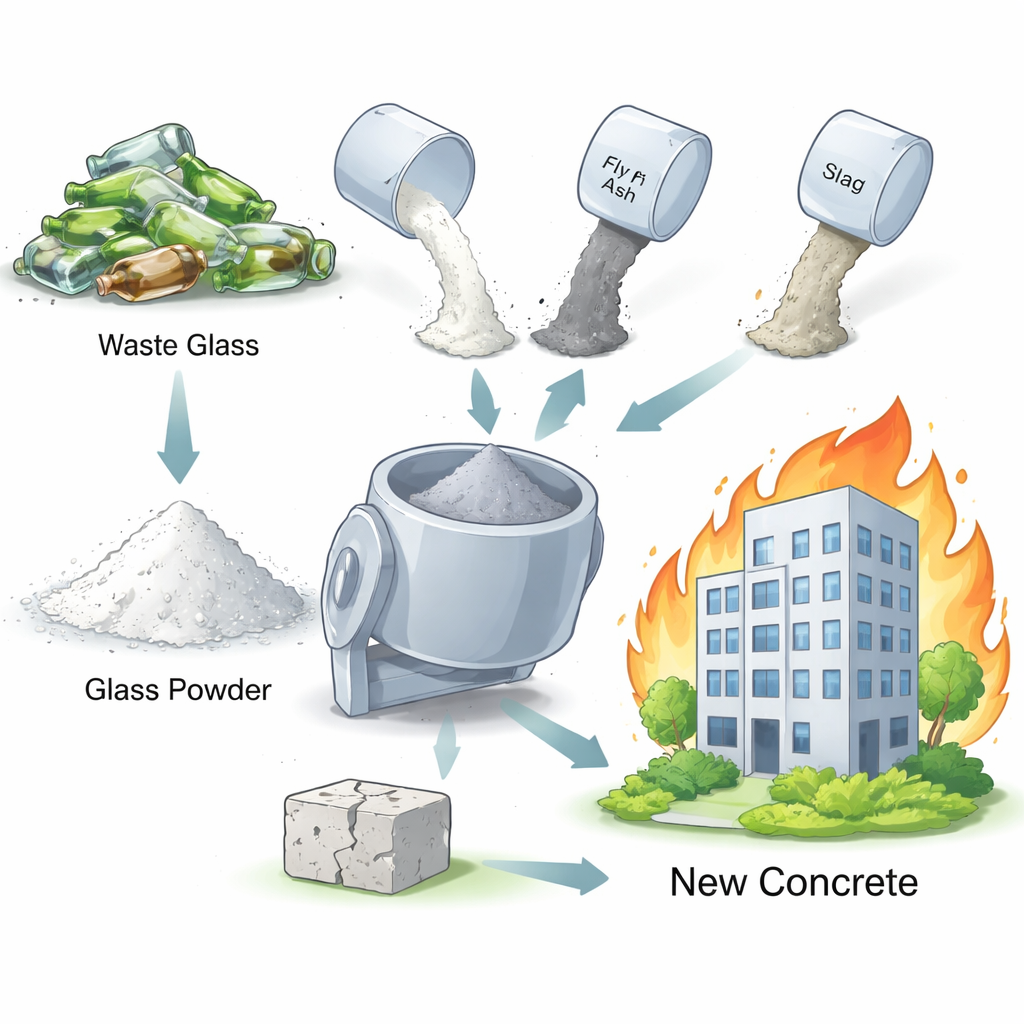
Every year, mountains of glass bottles and jars end up as waste, while many concrete buildings remain vulnerable to intense fires and carry a heavy carbon footprint. This research explores a way to tackle both problems at once: grinding waste glass into powder and using it to make a new kind of concrete that is not only stronger, but also better able to withstand extreme heat, all while cutting down on the chemicals and energy normally required.
Why Ordinary Concrete Struggles in a Fire
The concrete used in most buildings is based on Ordinary Portland Cement, a material whose manufacture releases large amounts of carbon dioxide. Under fire conditions, this conventional concrete can crack, lose strength, and even fail, threatening the safety of structures and people. Engineers have been developing alternative binders that replace cement with industrial by-products such as fly ash from coal plants and slag from steelmaking. When these powders are “activated” with alkaline solutions, they form alkali-activated concrete, which has already shown better performance at high temperatures than traditional concrete, but still has limitations and can require high doses of caustic chemicals.
How Waste Glass Joins the Mix
The study focuses on finely ground waste glass powder as a third ingredient in this alternative concrete. Glass is rich in a form of silica that reacts readily in the alkaline environment, helping to knit the other particles together into a tighter internal network. The authors systematically adjusted how much glass powder replaced either fly ash or slag, and how much sodium hydroxide (a common alkali) was needed. They then cast concrete cubes and exposed them to temperatures from room level up to a blistering 1000 °C, measuring how much strength the samples retained and how they deformed under load.
Finding the Sweet Spot for Strength and Heat
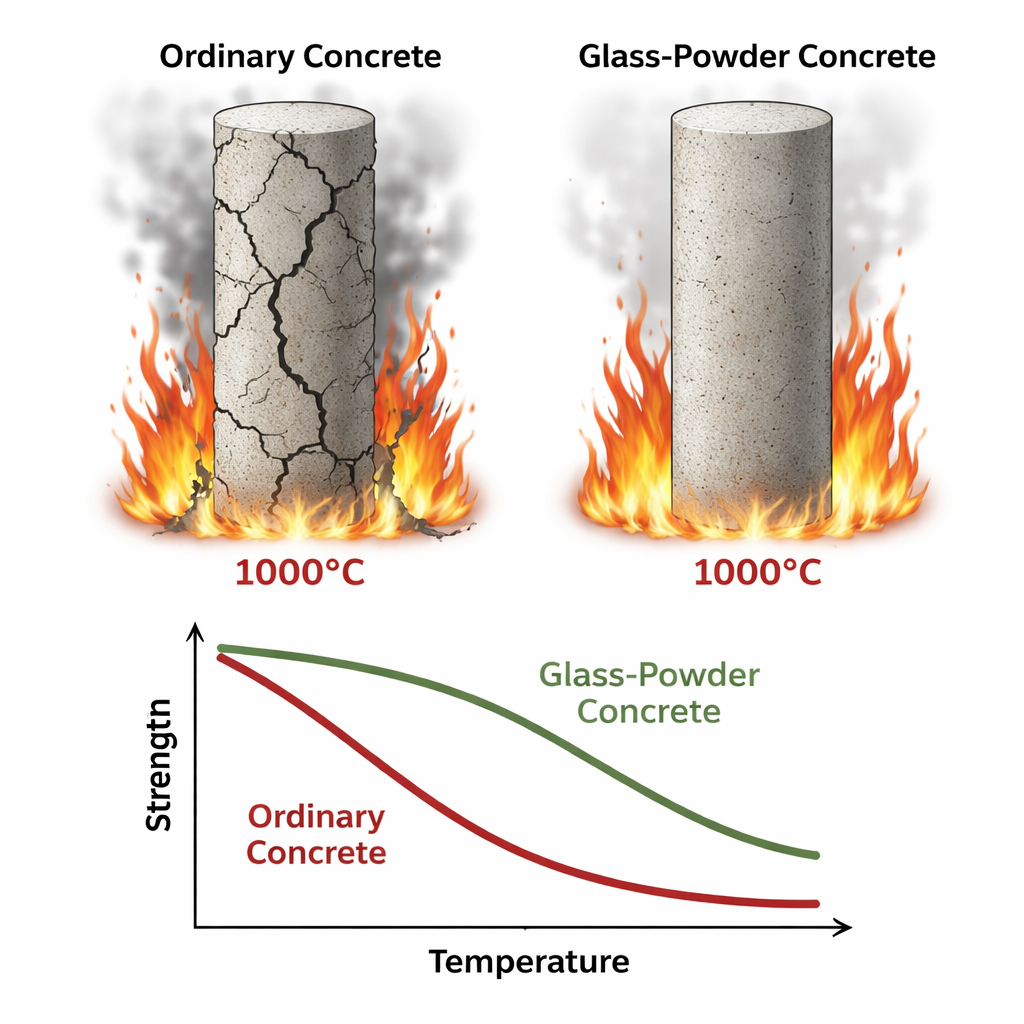
Among five key mixtures, one stood out: a blend where 25% of the fly ash was replaced with waste glass powder while keeping slag content unchanged. This mix, called M3C5 in the study, reached an impressive compressive strength of about 69 megapascals at normal temperature—significantly higher than the best cement-free control mix that used no glass. Crucially, the glass-based mix achieved this performance with only 8% sodium hydroxide, whereas the control needed 10% to come close. When heated to 1000 °C, the glass-enhanced concrete kept just over 40% of its original strength, outperforming the control mix, and it showed better ability to deform without suddenly breaking, a valuable trait in fire scenarios where structures are pushed to their limits.
Looking Inside the New Concrete
To understand why the glass-filled concrete behaved so well, the researchers zoomed in on its internal structure using microscopes and X-ray techniques. In the control mix, they found patches of unreacted fly ash and a more uneven, porous gel binding the grains together. In contrast, the mix with glass powder showed a denser, more uniform matrix, with fewer voids and better contact between particles. The high-silica glass promoted the formation of strong, intertwined gels that resisted cracking and limited how much water and material were burned off during heating. As a result, samples with glass lost less weight and developed fewer surface cracks as temperatures climbed.
What This Means for Future Buildings
For non-experts, the bottom line is straightforward: finely ground waste glass can help create a new type of concrete that is stronger, stays more reliable in extreme heat, and uses less harsh chemical activator. By turning discarded bottles into part of the structure of fire-resilient buildings, this approach supports a circular economy, reduces the environmental burden of both cement production and glass disposal, and points toward safer, more sustainable cities.
Citation: Deepti, Y., Kumar, S., Bandyopadhyay, A. et al. Synergic utilization of waste glass powder for fire-resilient and low alkali-activated concrete. Sci Rep 16, 4989 (2026). https://doi.org/10.1038/s41598-026-35338-3
Keywords: waste glass concrete, fire resistant materials, low carbon construction, alkali activated concrete, circular economy