Clear Sky Science · en
Unveiling the fundamentals of two-phase axial-flow-induced vibrations of cantilever rods
Why Shaking Fuel Rods Matter
Nuclear power plants quietly deliver a large share of the world’s low‑carbon electricity. Inside their cores, hundreds of slender metal tubes, called fuel rods, contain the uranium that powers the reaction. These rods sit in a tight bundle while water rushes past at high speed to carry heat away. That flow, however, can make the rods vibrate. Over time, repeated rubbing where rods touch their supports can wear through the metal, forcing costly shutdowns. This study tackles a particularly tricky case: when the coolant is a mixture of water and gas bubbles, and the rods vibrate along the direction of the flow. The authors also unveil a new way to “listen” to these motions without disturbing them.
A Simple Model of a Complex Reactor
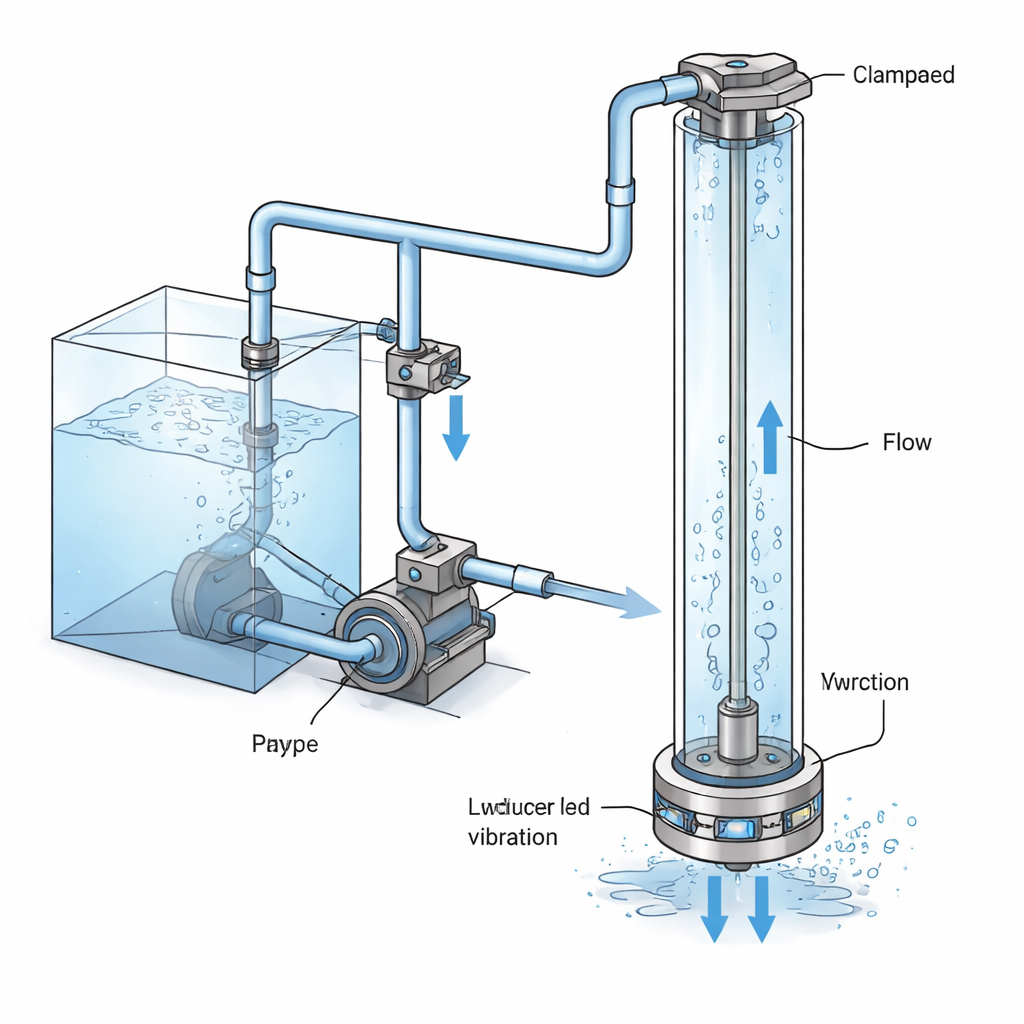
Real reactor cores are mechanically and geometrically complex, making them hard to study in detail. To get at the underlying physics, the researchers built a simplified but carefully scaled model: a single vertical metal rod, clamped at one end and free at the other, inside a slightly larger tube so that water (or water mixed with air) can flow along it. By changing the tip shape of the rod and reversing the flow direction, they recreated conditions similar to those in modern water‑cooled reactors. This pared‑down setup keeps the essential ingredients—strong flow, tight confinement, and realistic rod mass—while allowing precise control of flow speed and gas content.
Listening with Magnetism Instead of Light
Measuring tiny vibrations in a cloudy, two‑phase flow is not straightforward. Traditional optical tracking fails because bubbles block the view, and attaching conventional sensors directly to the rod could change its behavior. The team sidestepped both problems using the Hall effect, which links magnetic fields to electric signals. They mounted small permanent magnets on the free end of the rod and placed four magnetic field sensors just outside the transparent test section. As the rod moved, the magnetic field at each sensor changed, producing a voltage signal that could be converted into precise tip displacement. Calibration tests showed that the system could resolve motions smaller than 40 micrometers, and comparisons with high‑speed imaging in clear water confirmed that the new method accurately captured both vibration amplitude and frequency.
How Bubbles Reshape the Flow
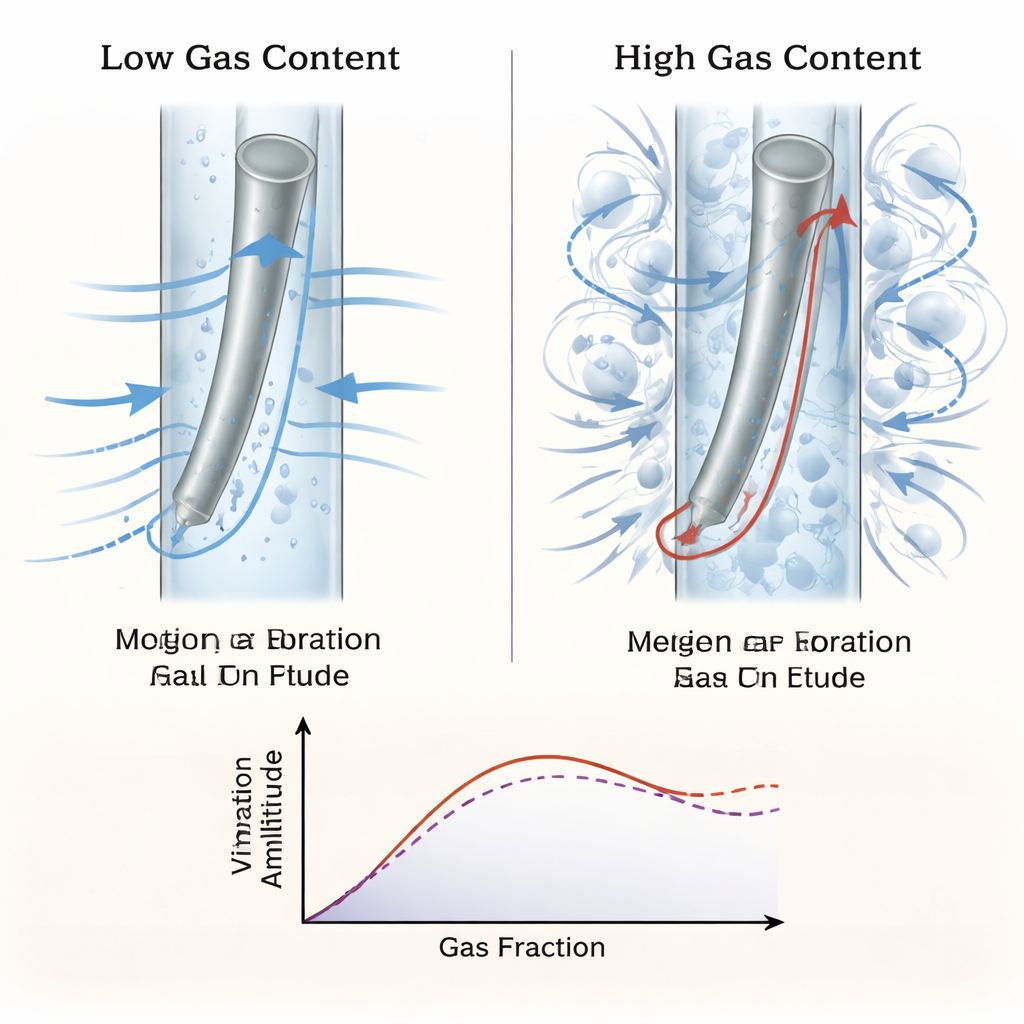
With this tool in hand, the researchers explored how adding air bubbles alters both the flow and the rod’s response. At low gas content, small bubbles are scattered through the water and only gently disturb the overall flow. The pressure and shear forces along the rod are similar to those in pure water, with some added randomness from occasional bubble impacts. As the gas fraction rises, bubbles collide and merge into elongated pockets and “cavity channels” that can span much of the gap between rod and tube. At low flow speeds, these cavities remain largely intact; at higher speeds, turbulence tears them into smaller structures. Using laser‑based flow visualization, the team showed that higher gas content both increases the average flow speed (because the mixture is lighter) and strongly amplifies fluctuations in vorticity and velocity. In other words, the flow becomes more chaotic and more effective at randomly jostling the rod.
The Battle Between Orderly and Random Shaking
The key insight of the study is that the rod’s vibrations arise from a competition between two kinds of fluid forces. On one side are movement‑induced, almost periodic forces: if the rod bends, the flowing water can push it further in a rhythmic way, leading to large, flutter‑like oscillations. On the other side are stochastic forces: irregular pushes from turbulent eddies and impacts from bubbles or gas cavities. In single‑phase water at high speed, the periodic forces can dominate, driving strong, regular vibrations that depend sensitively on rod tip shape and flow direction. As more gas is added, however, the growing disorder in the flow disrupts this rhythm. The periodic forcing weakens, while the random kicks grow stronger, especially when the gas forms large, unsteady structures around the tip.
A Threshold Where Randomness Takes Over
By systematically varying flow speed and gas fraction, the authors mapped how vibration amplitude and frequency change. They found a striking pattern: when the gas fraction exceeds about 0.2, the vibration amplitudes for very different tip shapes and flow speeds begin to converge to similar values. Above this threshold, the behavior is controlled mainly by two‑phase randomness rather than by the details of geometry or flow rate. Frequencies remain close to the rod’s natural frequency, but the motion becomes more chaotic, as revealed by statistical measures of the displacement signals. For reactor designers, this has a clear message: strategies that work well in pure water, such as fine‑tuning the rod tip shape to suppress periodic instabilities, become much less effective once significant boiling or gas injection is present. Instead, design concepts that reduce turbulent fluctuations or break up large gas structures may be needed to keep wear‑inducing vibrations in check. The new magnetic sensing method offers a powerful, non‑intrusive way to test such ideas in realistic two‑phase conditions.
Citation: Li, H., Cioncolini, A., Iacovides, H. et al. Unveiling the fundamentals of two-phase axial-flow-induced vibrations of cantilever rods. Sci Rep 16, 5102 (2026). https://doi.org/10.1038/s41598-026-35337-4
Keywords: flow-induced vibration, two-phase flow, nuclear fuel rods, bubble dynamics, Hall-effect sensing