Clear Sky Science · en
Formulation of bacterial cellulose nanofibrils incorporated with xanthone as functional green ingredients for cosmeceutical products
Why a natural acne gel matters
Many people with acne are caught between two frustrations: breakouts that won’t quit, and treatments that dry, sting, or irritate their skin. This study explores a different path—a plant‑based acne gel built from edible‑grade materials. By combining an ultra‑fine cellulose network made by bacteria with a powerful natural compound from mangosteen fruit peel, the researchers set out to create a gentle gel that can calm inflammation, fight acne‑causing germs, and protect the skin, all while avoiding controversial synthetic ingredients.
A fruit peel with hidden power
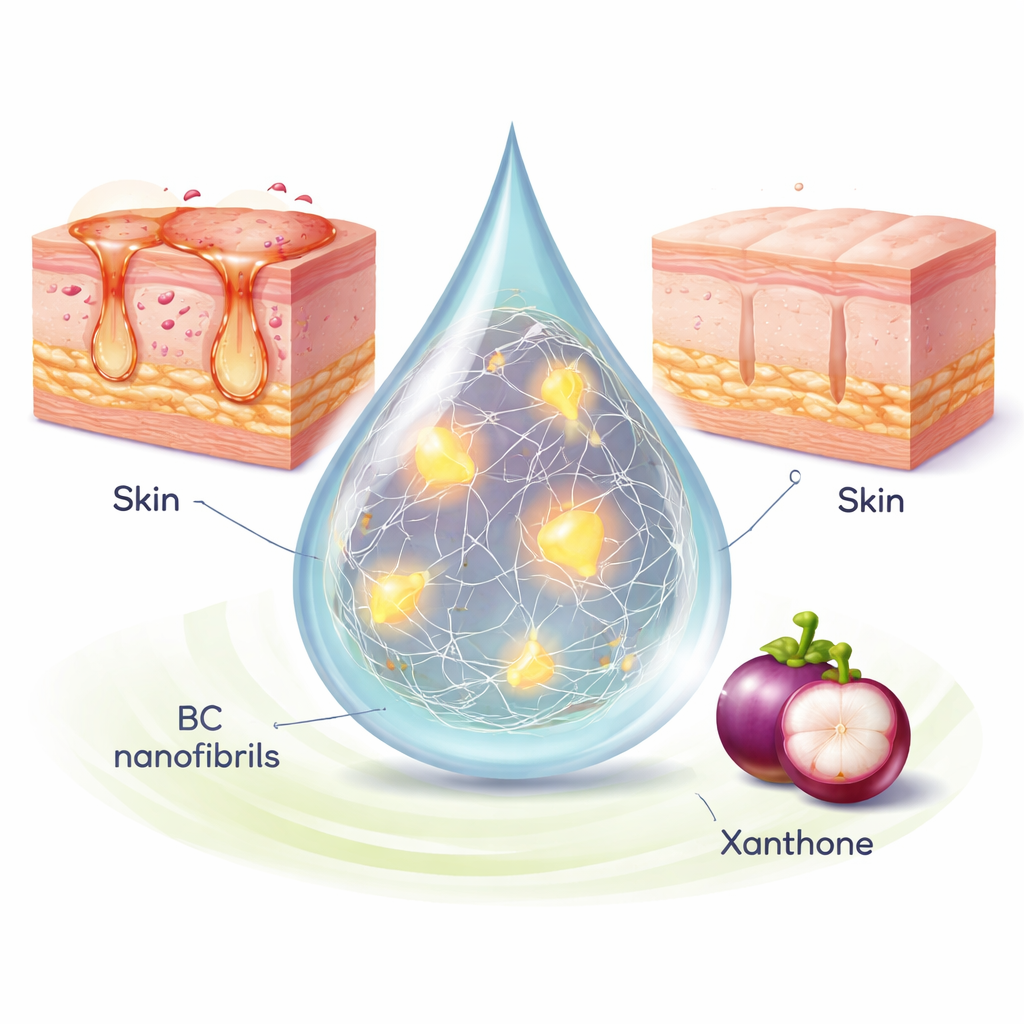
The star active ingredient here is xanthone, a group of natural molecules found in the deep purple peel of Garcinia mangostana, or mangosteen. Earlier work has shown that xanthones can kill bacteria, reduce inflammation, and neutralize harmful free radicals—features that make them attractive for acne care. But there’s a problem: xanthones do not mix well with water, can be unstable, and have difficulty passing through the outer layers of skin. In ordinary creams or gels, much of their potential is simply wasted. This study tackles that challenge by housing xanthone inside a new kind of natural scaffold: ultra‑thin fibers of bacterial cellulose, which act like a moist, flexible sponge for the active compound.
A tiny fiber network as a skin‑friendly carrier
Bacterial cellulose is a pure form of cellulose produced by certain microbes. When broken down into nanofibrils—extremely small, hair‑like strands—it forms a smooth, transparent network that holds large amounts of water. The researchers used only mechanical steps, such as high‑pressure homogenization, to turn bulk cellulose into nanofibrils about 30 nanometers wide, thousands of times thinner than a human hair. They then mixed these nanofibrils with xanthone dissolved in a cosmetic solvent. Chemical tests and X‑ray measurements confirmed that the cellulose structure remained intact while xanthone nestled into the network through hydrogen bonding, rather than forming a new chemical. This arrangement helps keep xanthone evenly distributed, protected from rapid breakdown, and ready for slow release onto the skin.
Putting the new gel to the test
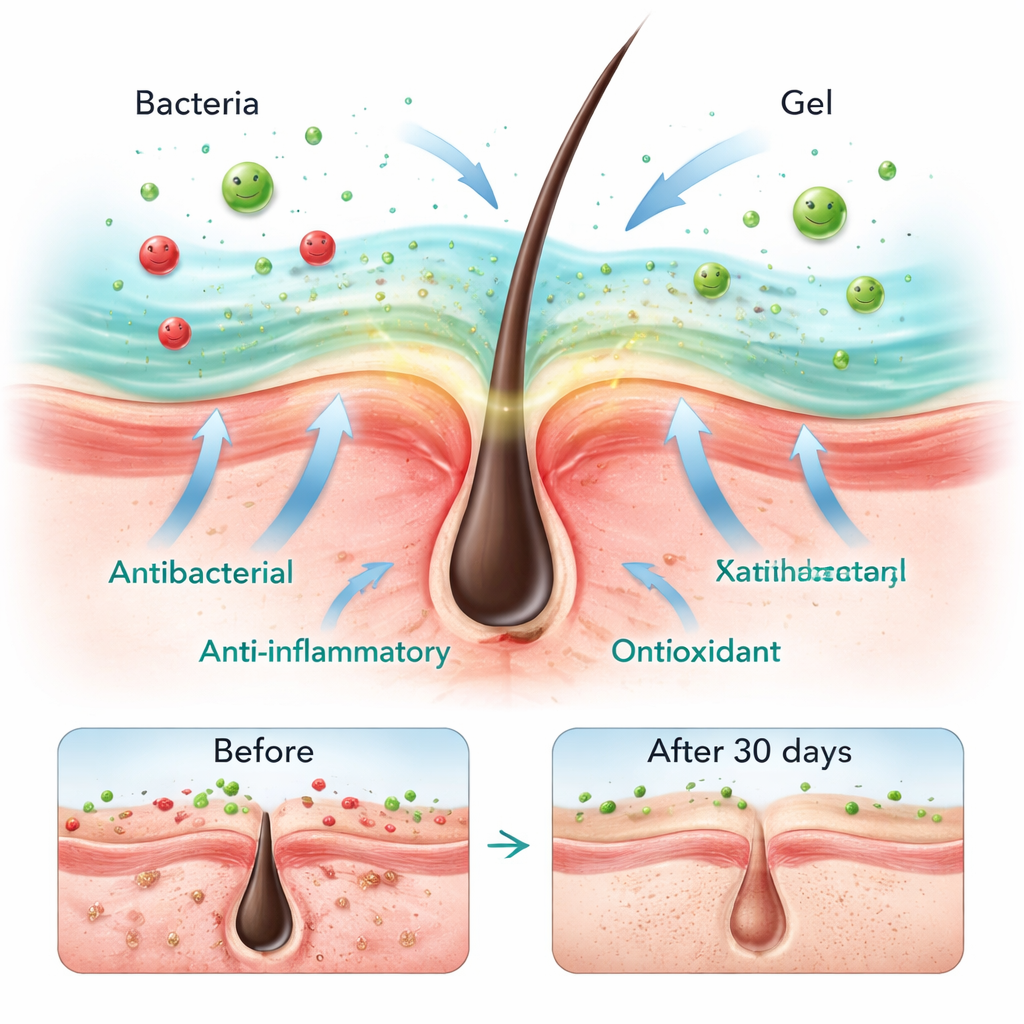
The team formulated several acne gels: a standard commercial‑style recipe with silicone oil and synthetic polymers, and three versions where these were gradually replaced by the bacterial cellulose–xanthone mixture. They then compared how each behaved in the lab. In inflammation tests, the composite reduced protein damage and dampened the production of nitric oxide—a chemical signal linked to redness and swelling—almost as effectively as a prescription‑strength steroid at certain doses. In antibacterial tests, the xanthone‑loaded nanofibrils stopped the growth of two key acne‑related microbes, Cutibacterium acnes and Staphylococcus aureus, at low concentrations, and were able to kill a large fraction of the bacterial population over time. Antioxidant measurements showed that the new gels not only scavenged free radicals but actually became more stable over 30 days, unlike a conventional gel whose activity faded.
Texture, feel, and long‑term stability
Beyond biological effects, the feel and performance of a gel on the skin are crucial for real‑world use. The cellulose‑based gels behaved as "shear‑thinning" materials: they were thick and stable in the jar, but became smoother and easier to spread when rubbed, a desirable trait for face products. The formulation that relied solely on the bacterial cellulose–xanthone system for structure and activity showed the highest viscosity without becoming sticky, and it maintained that structure well over a month. At the same time, its acidity (pH) stayed within the skin‑friendly range of about 4.5 to 6.5, which helps protect the natural skin barrier and its beneficial microbes.
What this could mean for people with acne
In simple terms, the study shows that it is possible to build an effective acne gel almost entirely from bio‑based ingredients. The tiny cellulose fibers act like a natural, water‑loving mesh that holds and slowly releases xanthone, allowing it to calm inflammation, kill acne‑related bacteria, and neutralize irritants without relying on harsh synthetic agents. The best version of the gel matched or surpassed a conventional formula in stability and performance, while avoiding silicone oils and extra polymers. Although clinical trials on real patients are still needed, this work points toward future "green" acne treatments that are kinder to both skin and the environment, without sacrificing effectiveness.
Citation: Kongtaveesombat, S., Torgbo, S., Kamonsutthipaijit, N. et al. Formulation of bacterial cellulose nanofibrils incorporated with xanthone as functional green ingredients for cosmeceutical products. Sci Rep 16, 5530 (2026). https://doi.org/10.1038/s41598-026-35333-8
Keywords: natural acne treatment, bacterial cellulose, mangosteen xanthone, cosmeceutical gel, anti-inflammatory skincare