Clear Sky Science · en
Multifactorial formulation for stable encapsulated plant growth promoting microorganisms
Why tiny farm helpers need smart packaging
Farmers increasingly rely on helpful microbes—good bacteria and fungi—to boost crop growth, cut chemical fertilizer use, and help plants cope with drought and disease. But there is a catch: once these living helpers are bottled or bagged, many of them slowly die before they ever reach the field. This study asks a practical question with big implications for sustainable agriculture: how can we "package" these microbes so they stay alive and effective for months on the shelf?
Friends in the root zone
Plants do not grow alone. Their roots are surrounded by bustling communities of microbes that help them find nutrients, fight off disease, and better tolerate harsh conditions. The paper focuses on three such allies: a fungus called Trichoderma harzianum and two bacteria, Pseudomonas fluorescens and Bacillus subtilis. These organisms can act like natural fertilizers and bodyguards for crops. However, to be used by farmers at scale, they need to be turned into reliable products that survive manufacturing, storage, transport, and finally application to the soil.
Turning microbes into tiny beads
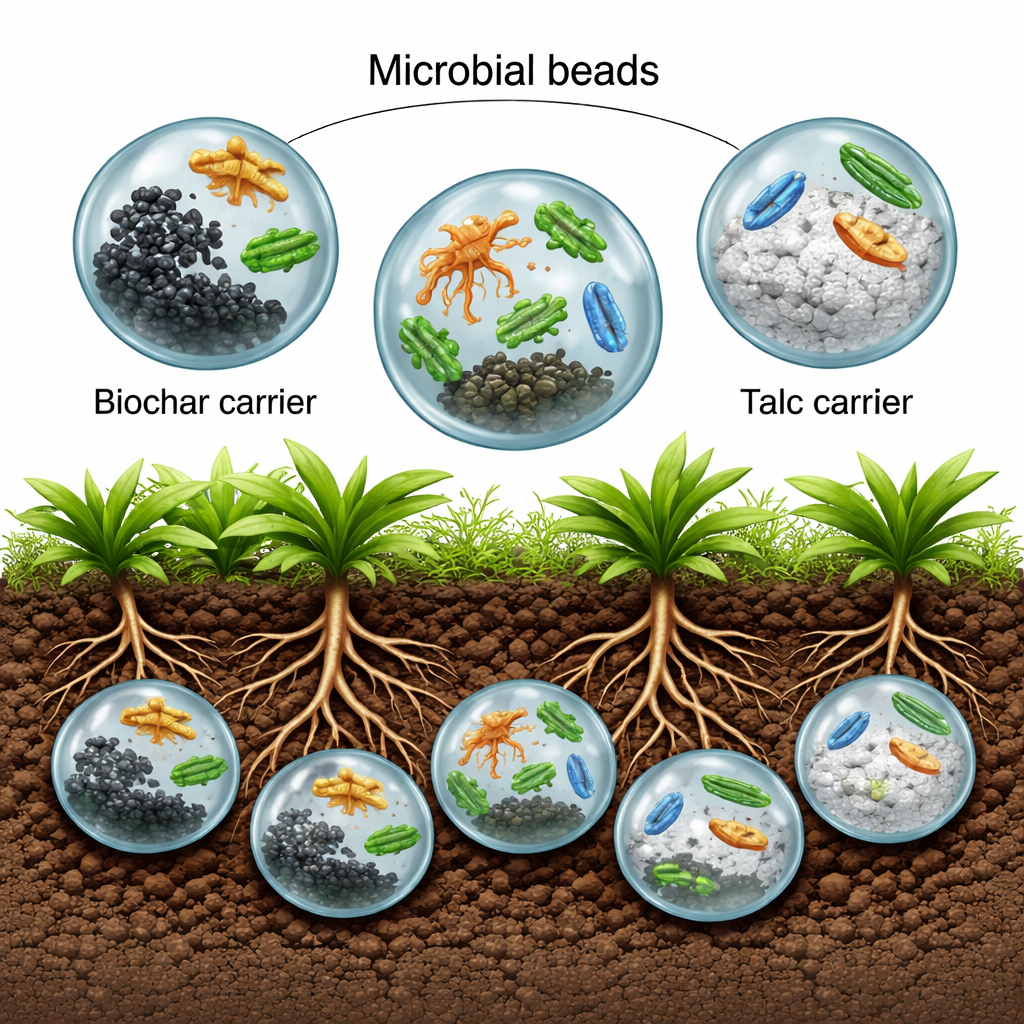
To protect the microbes, the researcher used a technique called encapsulation: the cells are trapped inside tiny gel beads made from a natural substance similar to seaweed jelly (sodium alginate). These beads act like miniature shelters that cushion the microbes from drying out, temperature swings, and other stresses. The study tested eight different bead recipes, all based on the same gel but mixed with different combinations of two solid carriers—soft mineral talc or porous plant-based charcoal known as biochar—and two protective additives, glycerol and trehalose, which help cells survive drying and storage. The beads were then stored either at room temperature or in a cold room for six months, and the number of living microbes was measured over time.
Mixing and matching ingredients
The eight formulations combined gel, talc or biochar, and sometimes glycerol and/or trehalose. Biochar, which looks like black, sponge-like charcoal, can hold water and nutrients in its pores, potentially giving microbes more comfortable hiding places. Glycerol acts like an antifreeze, especially helpful in the cold, while trehalose is a sugar that stabilizes cell structures during drying and storage at normal temperatures. By systematically varying these ingredients, the study could see which combinations gave the best survival for each microbe under different storage conditions. A detailed statistical analysis showed that survival was not driven by any single factor alone, but by how the formulation, temperature, and time interacted.
Who survives best, and in what shelter?
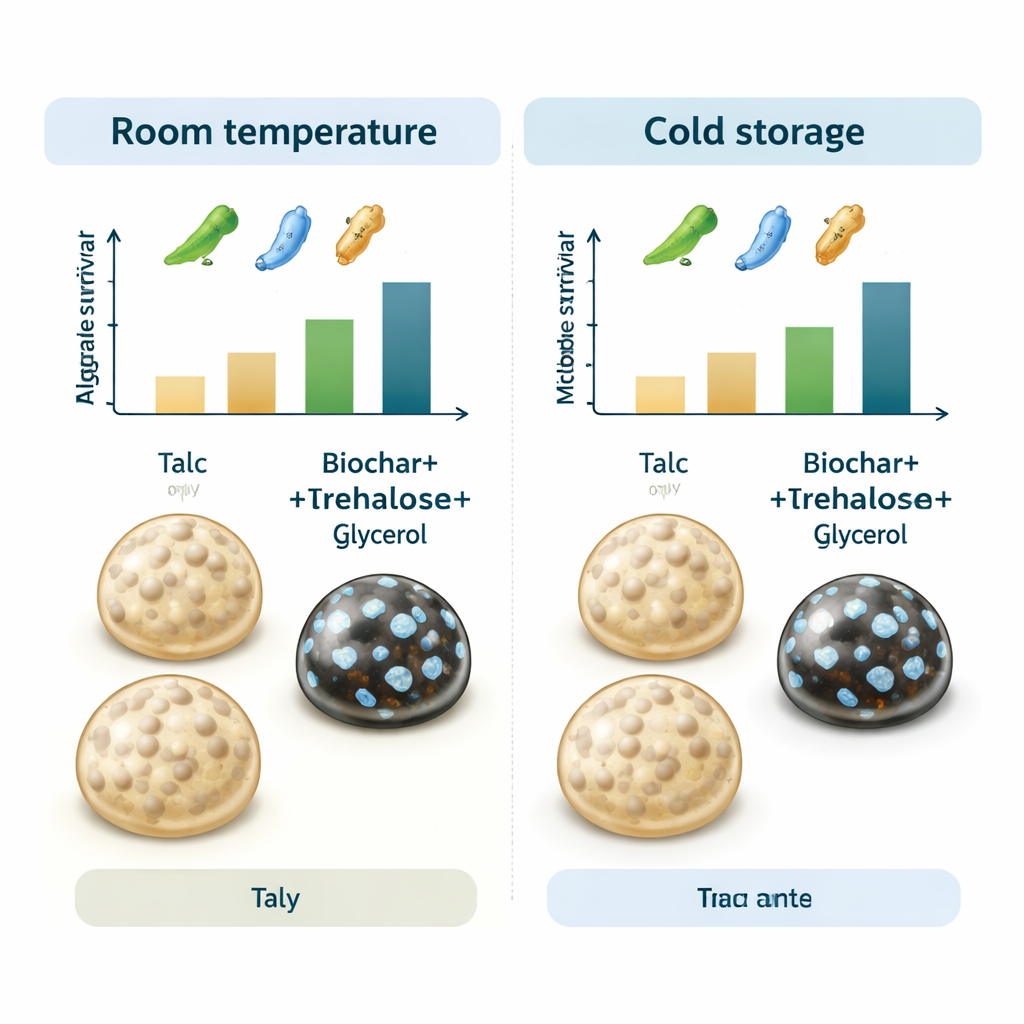
Across the board, one recipe stood out: beads containing biochar, trehalose, and glycerol preserved the highest numbers of all three microbes after six months at room temperature. This same formula also gave the best stability for Trichoderma and Pseudomonas in cold storage. For Bacillus, a closely related recipe using talc instead of biochar performed slightly better in the cold, but differences between talc and biochar were generally small there. Glycerol clearly helped all three microbes in cold storage, while trehalose was especially useful for keeping Trichoderma and Pseudomonas alive at room temperature. Among the microbes, Bacillus subtilis proved most robust overall, likely because it can form hardy spores, whereas Pseudomonas was the most fragile and benefited most from careful formulation.
What this means for greener farming
For non-specialists, the main message is straightforward: helpful farm microbes need the right “sleeping bag” if they are to survive long enough to help crops. Using gel beads loaded with biochar plus two protective ingredients, trehalose and glycerol, greatly extends the shelf life of key beneficial microbes under both room and cold storage. This makes microbial fertilizers more reliable and easier to store and transport, reducing waste and improving their practical value for farmers. In turn, better microbe products can help reduce reliance on synthetic fertilizers and pesticides, moving agriculture a step closer to being both productive and environmentally friendly.
Citation: Dolatabad, H.K. Multifactorial formulation for stable encapsulated plant growth promoting microorganisms. Sci Rep 16, 4797 (2026). https://doi.org/10.1038/s41598-026-35331-w
Keywords: biofertilizer, plant growth-promoting microorganisms, microbial encapsulation, biochar carrier, sustainable agriculture