Smarter trade-offs for complex engineering decisions
Everyday technologies—from power grids to gearboxes—must juggle conflicting goals: keeping costs low, cutting pollution, and staying safe and reliable. This paper introduces a new algorithm, inspired by the humble starfish, that helps engineers navigate these trade-offs more efficiently. By mimicking how starfish explore their surroundings, hunt, and regenerate lost limbs, the method finds many high-quality compromise solutions at once, giving decision-makers a richer menu of options instead of a single “best” answer.
Why balancing many goals is so hard
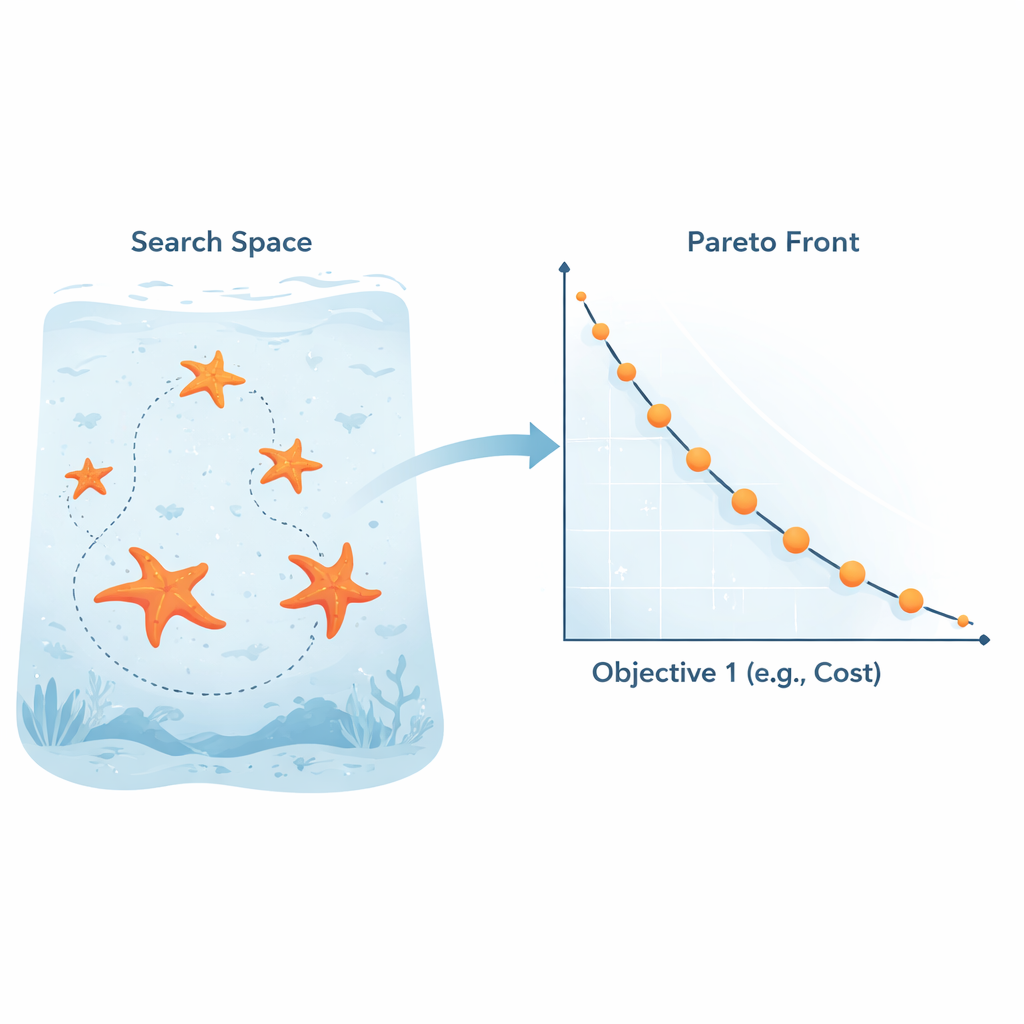
Real engineering problems rarely have a single objective. For example, operating an electrical power system involves minimizing fuel costs, while also reducing emissions, losses in transmission lines, and voltage instability. Improving one target often worsens another. Instead of one optimum, there is usually a curved frontier of equally reasonable choices, known as the Pareto front, where moving closer to one goal means stepping away from another. Finding a set of solutions that lies close to this front and spreads evenly along it is computationally demanding, especially as systems become larger and more complex.
From starfish behavior to search strategy Figure 1.
The authors build on a previous single-goal method called the Starfish Optimization Algorithm, which models three natural behaviors: exploration as the animal scans its surroundings with multiple arms, predation as it homes in on food, and regeneration when an arm is lost and slowly regrows. In the algorithmic version, each “starfish” represents a candidate design or operating point. During exploration, only a few coordinates of each starfish move at a time, which helps scan large spaces efficiently. During exploitation, starfish move in two directions around the current best solutions, sharpening promising designs. A regeneration step occasionally shrinks a solution back and nudges it in a new direction, restoring diversity and helping escape local dead ends.
Turning a single aim into many objectives
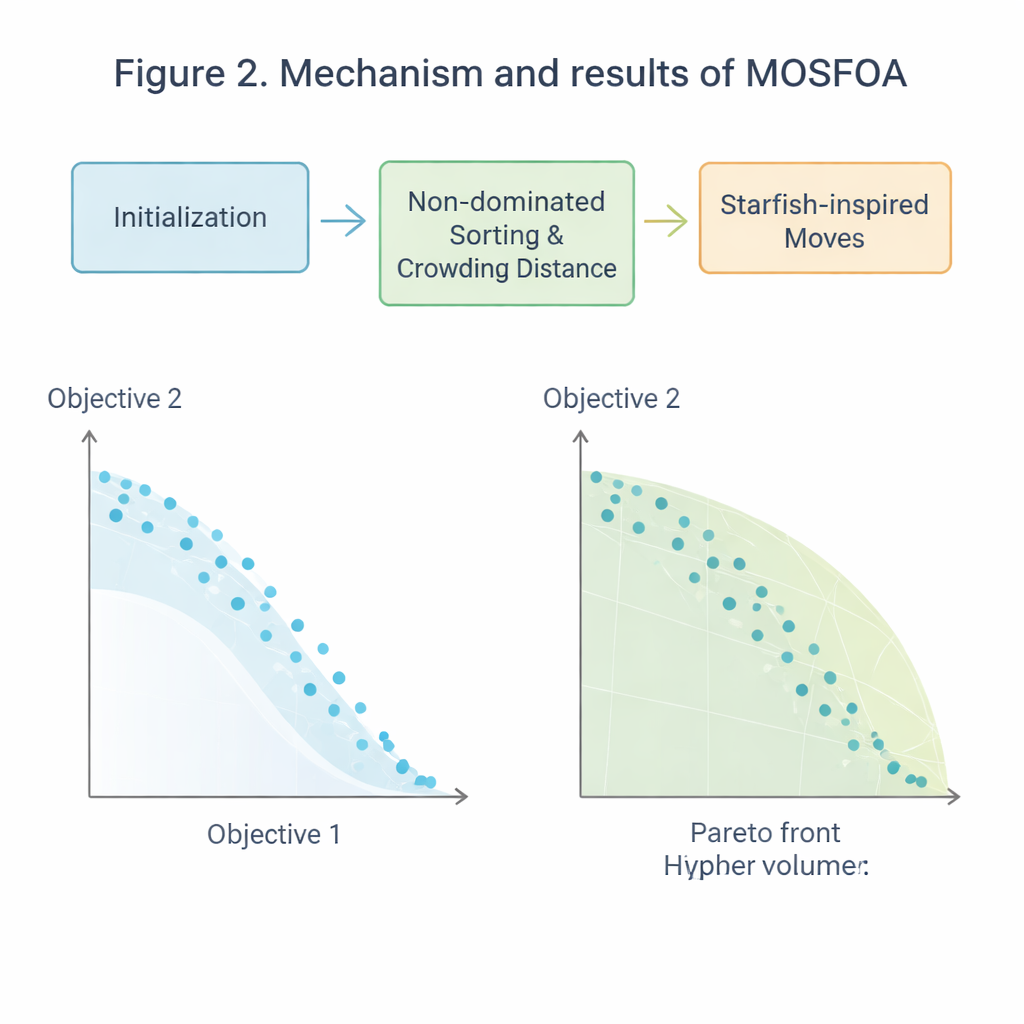
To upgrade this idea for multi-goal problems, the authors propose the Multiobjective Starfish Optimization Algorithm (MOSFOA). MOSFOA wraps the starfish movements inside a ranking and selection layer borrowed from leading evolutionary methods. At each generation, all candidate solutions are sorted into “fronts” according to whether any one solution clearly outperforms another across all objectives. The best front contains those that are not beaten on every goal simultaneously. Within each front, a crowding-distance measure favors points that are well separated from their neighbors, preventing the algorithm from clustering in only one region of the trade-off curve. Together, these mechanisms ensure that the starfish moves push the population both toward the Pareto front and along it, preserving a broad spread of options.
Putting the method to the test Figure 2.
MOSFOA is tested on a wide suite of standard mathematical benchmarks that are designed to stress different aspects of multi-objective search, including fronts that are convex, concave, broken into pieces, or riddled with local traps. The authors compare their algorithm with ten well-known competitors and evaluate performance using accepted indicators that capture how close solutions lie to the true Pareto front and how widely they cover it. On most tests, MOSFOA achieves smaller distances to the ideal trade-off curve and larger covered volume in objective space, signaling both better accuracy and richer diversity. A mathematical measure based on classical optimality conditions further confirms that its solutions sit very near theoretically best compromises.
Real-world impact: power grids and mechanical design
Beyond test functions, the algorithm is applied to demanding engineering tasks. One set of trials involves a standard 30-bus electrical power network, where MOSFOA helps operators jointly minimize fuel costs, emissions, power losses, and voltage deviations under realistic constraints on generators, transformers, and network security. Another application tackles a speed reducer—a gearbox component—where the algorithm searches for designs that minimize both material volume and mechanical stresses. In both settings, MOSFOA consistently finds high-quality trade-offs that respect all safety limits, and it does so more reliably across repeated runs than competing techniques.
What this means for non-specialists
In practical terms, this work offers engineers and planners a more dependable way to see the full landscape of “good compromises” rather than a single recommended point. By combining a simple biological metaphor with careful mathematical ranking and diversity controls, MOSFOA produces solution sets that are both near-optimal and well spread out, making it easier to choose according to local priorities—whether that is cheaper electricity, cleaner air, or longer-lived machinery. The study’s results, including in real power systems and industrial design problems, suggest that this starfish-inspired approach is a promising addition to the toolbox for complex decision-making.
Citation: Jameel, M., Merah, H., El-latif, A.M.A. et al. Multiobjective starfish optimization algorithm for engineering design and optimal power flow problems.
Sci Rep16, 3302 (2026). https://doi.org/10.1038/s41598-026-35329-4
Keywords: multi-objective optimization, metaheuristics, power system planning, engineering design, Pareto front