Clear Sky Science · en
Complementary metal-oxide-semiconductor (CMOS) time of evaporation measurement system for binary chemical monitoring
Why timing tiny droplets matters
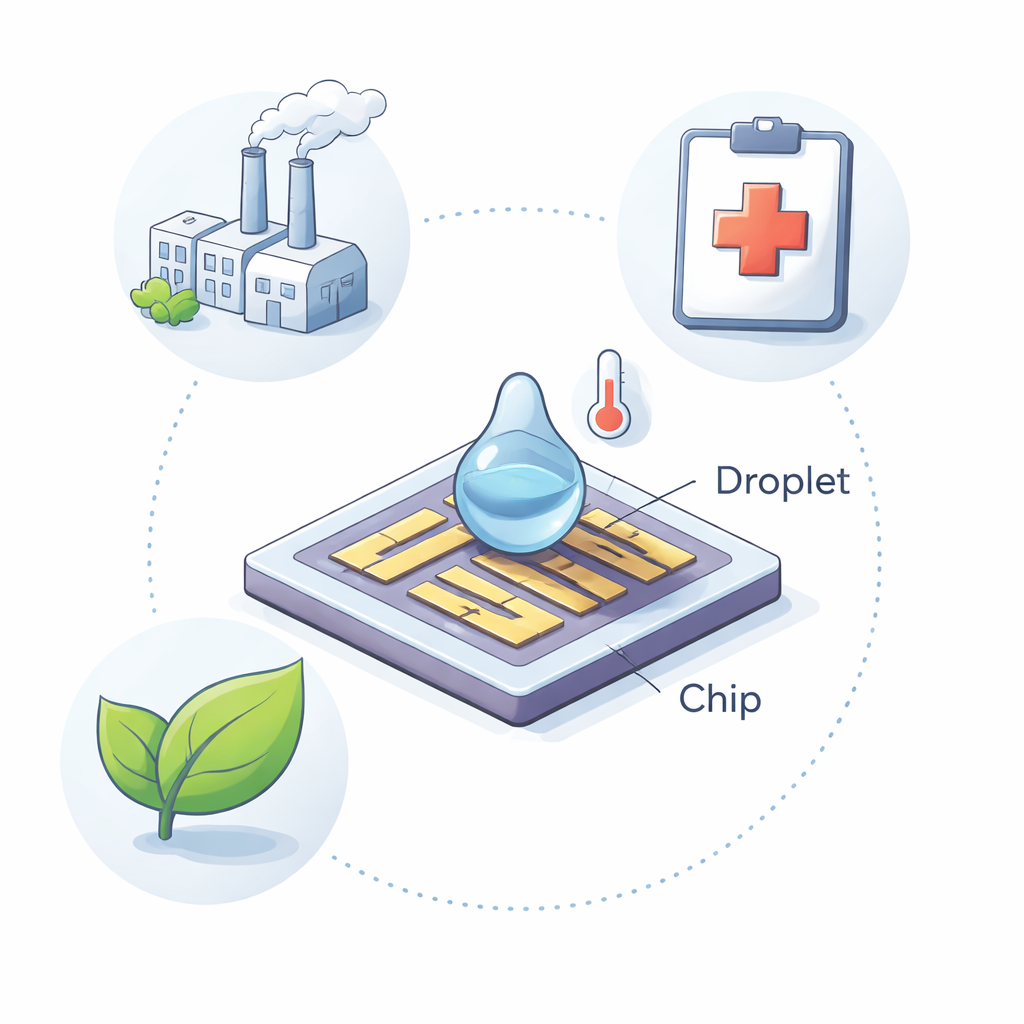
From testing the alcohol content of drinks to checking fuel quality or monitoring pollutants, many industries need to know exactly what is dissolved in tiny liquid samples. Today’s gold-standard laboratory methods are powerful but often slow, bulky, and expensive. This paper introduces a new chip-based tool that reads the “evaporation fingerprint” of microscopic droplets to reveal what they are made of. It aims to shrink part of the chemistry lab onto a low-cost electronic chip, opening the door to fast, portable chemical checks in factories, clinics, and even wearable devices.
Old and new ways to read a liquid
There are many ways to measure alcohol and other chemicals in liquids. Classic techniques like distillation and high-end instruments such as gas chromatographs or spectrometers can be extremely accurate, but they require skilled operators, large samples, and stationary equipment. Simpler tools like hydrometers are cheaper and easier to use, yet suffer from errors due to temperature changes or impurities. The authors compare this landscape and highlight a gap: there is still no very small, low-cost method that can quickly measure composition from less than a microliter of sample, with little preparation, and operate outside of a full laboratory. This is where their CMOS-based approach fits in, leveraging the same technology used to make computer chips.
A chip that listens to a droplet vanish
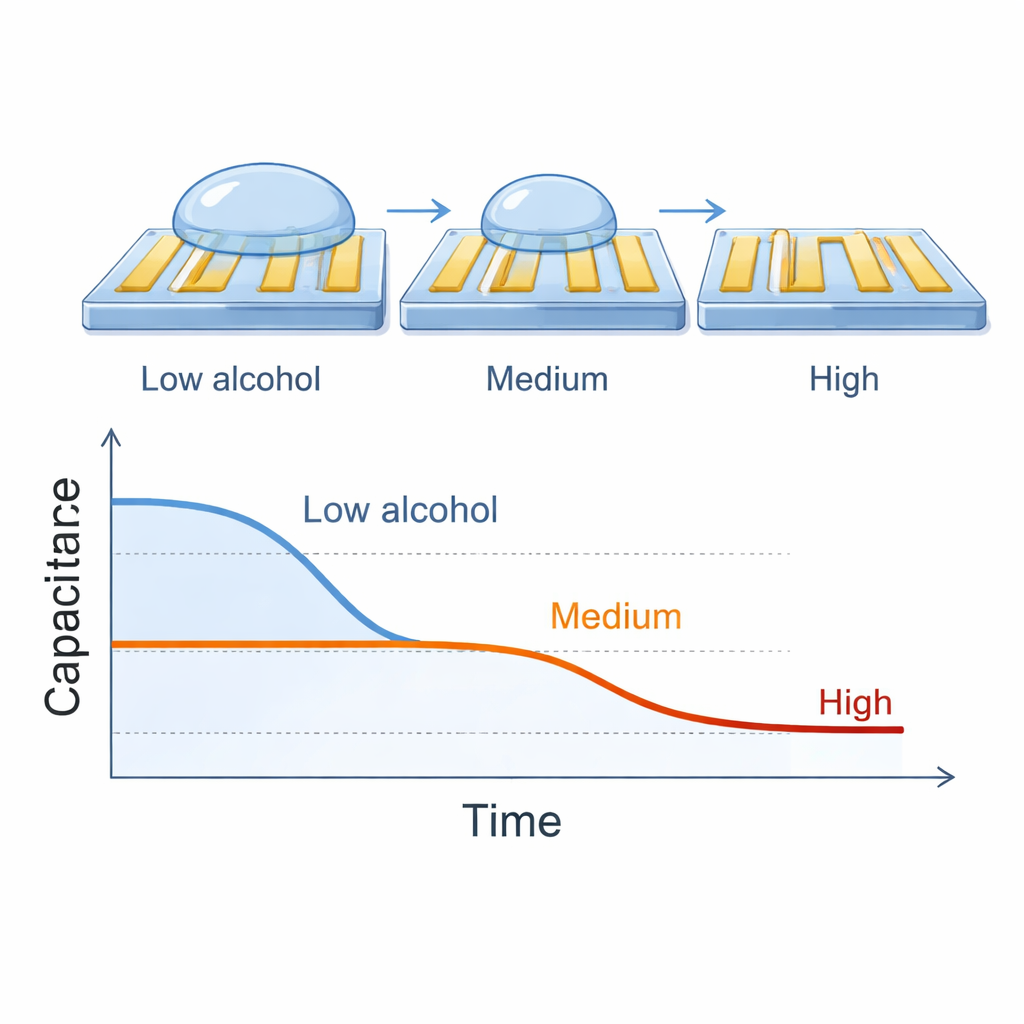
The core of the new system, called ITEMS (Integrated Time-of-Evaporation Measurement System), is a set of comb-like metal electrodes built on a standard CMOS chip. When a tiny droplet of a water–alcohol mixture is placed on these electrodes, it changes the chip’s electrical capacitance, a measure of how well the droplet stores electric charge. As the droplet evaporates, this capacitance rises, stays roughly flat, and then falls again. The researchers track three time periods in this signal and the total time until the droplet disappears. Because alcohols such as ethanol and methanol evaporate faster than water, mixtures with more alcohol produce shorter plateau and total evaporation times, giving each composition a distinctive timing pattern.
From raw signals to meaningful patterns
To turn these subtle changes into reliable measurements, the chip includes an on-board circuit that converts the tiny capacitance shifts into a digital signal a microcontroller can read. The team tested mixtures of ethanol–water, methanol–water, and ethanol–methanol across a full range of concentrations, and at temperatures from room temperature up to 60 °C. They found that evaporation time and capacitance change do not vary in a simple straight-line fashion with concentration, especially at higher temperatures where evaporation speeds up. To capture these curved trends, they compared basic straight-line fitting with a more flexible method known as LOESS, which smoothly follows the data without assuming a simple formula. LOESS consistently matched the experimental curves better, confirming that the sensor’s response is rich but predictably non-linear.
Tuning temperature and reading complex mixtures
By scanning many combinations of temperature and mixture type, the researchers mapped how each key parameter behaves. For water–ethanol droplets, changes in capacitance and evaporation time were especially strong, making it easier to distinguish nearby concentrations. Water–methanol droplets showed similar but slightly milder effects, while mixtures of ethanol and methanol without water behaved more gently. Raising the temperature amplified the differences and shortened the total evaporation time, which is useful for faster readings but also demands careful modeling. The study shows that by choosing suitable temperatures and using non-linear analysis, the same small sensor can cover a wide range of mixtures and provide repeatable, high-sensitivity readings from droplets smaller than a pinhead.
From lab bench to field and bedside
In simple terms, the work demonstrates that you can “listen” to how a droplet disappears to figure out what is inside it. By integrating sensing electrodes, timing electronics, and a digital interface on one CMOS chip, ITEMS offers a compact, low-power platform for chemical monitoring. With only about one microliter of sample required and no labels or added chemicals, it could be adapted for environmental checks, industrial quality control, or even monitoring tiny amounts of bodily fluids like sweat or saliva for health diagnostics. The authors argue that with further refinement and smart software, this evaporation-based fingerprinting could evolve into practical handheld or wearable tools that bring sophisticated liquid analysis out of the central lab and closer to where decisions are made.
Citation: Ghafar-Zadeh, E., Forouhi, S., Osouli Tabrizi, H. et al. Complementary metal-oxide-semiconductor (CMOS) time of evaporation measurement system for binary chemical monitoring. Sci Rep 16, 5542 (2026). https://doi.org/10.1038/s41598-026-35322-x
Keywords: evaporation sensing, CMOS biosensor, binary liquid mixtures, alcohol concentration, capacitive sensor