Clear Sky Science · en
A novel prognostic nomogram for elderly renal cell carcinoma patients with lung metastases
Why this matters for older cancer patients
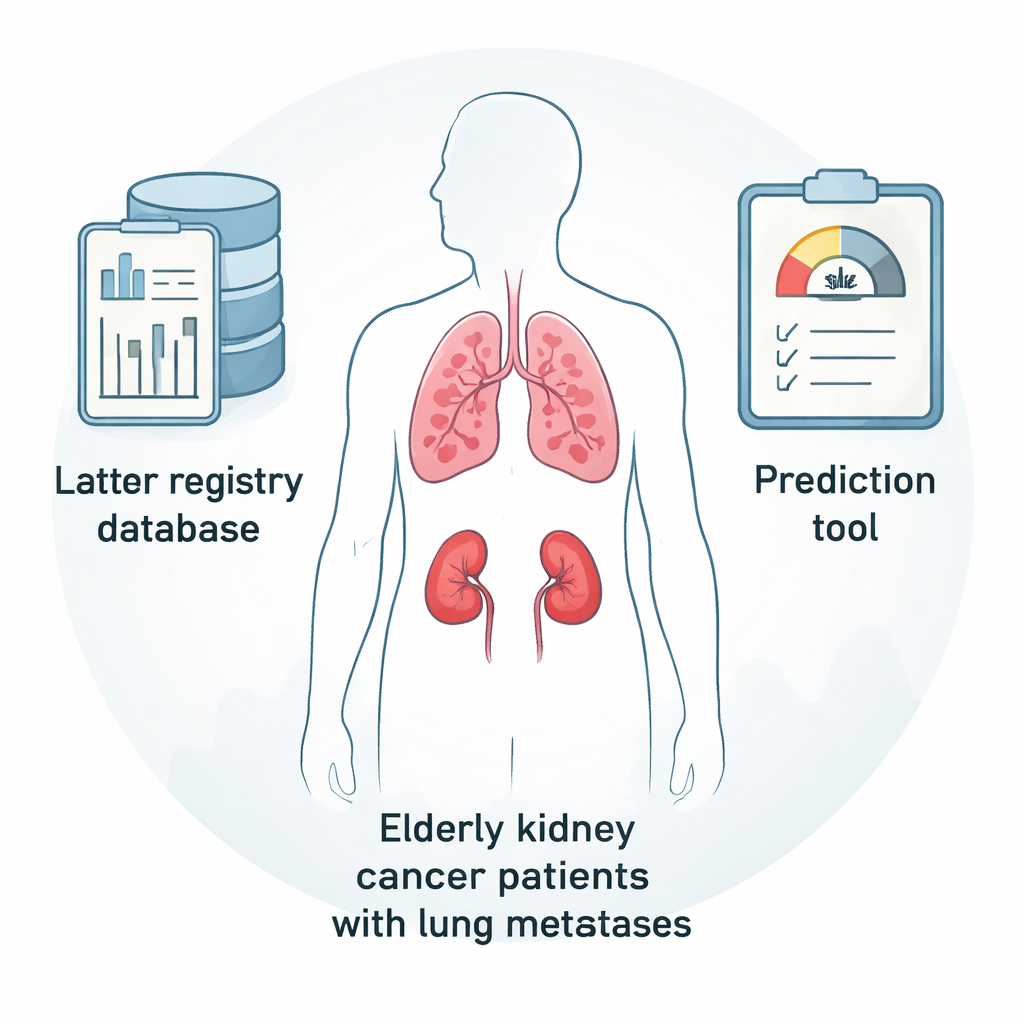
Kidney cancer is being diagnosed more often, and many patients are older adults. When this cancer spreads to the lungs, doctors and families face hard choices about surgery and other treatments, especially in people over 65 who may be frail or have other illnesses. This study uses a very large U.S. cancer registry to build a practical prediction tool that helps estimate how long such patients might live and asks a crucial question: does operating on the kidney still make sense when the cancer has already reached the lungs?
Who was studied and what the researchers built
The authors drew on the U.S. National Cancer Institute’s SEER database, which tracks cancer diagnoses and outcomes across the country. They focused on 2,383 people aged 65 and older who had kidney cancer that had already spread to the lungs at the time of diagnosis, between 2010 and 2019. Most were in their late 60s or 70s, and about two thirds were men. The team randomly split patients diagnosed from 2010 to 2017 into a training group and an internal test group, and used patients from 2018 to 2019 as an external test group. Using these data, they developed a "nomogram"—a visual scoring chart that combines several everyday clinical features into a single prediction of overall survival at 6 months, 1 year, 2 years, and 3 years.
The key ingredients of the prediction tool
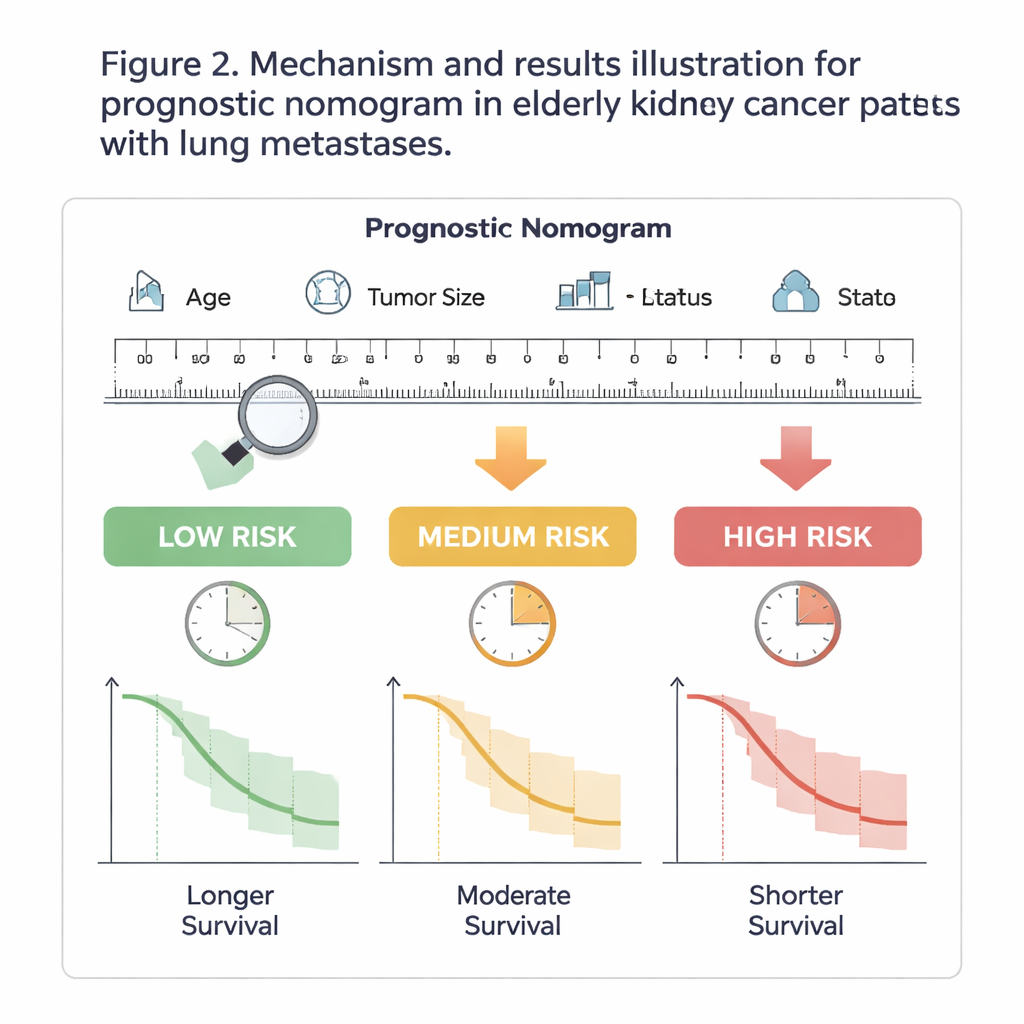
The final nomogram brought together 11 factors that any oncologist can quickly obtain: age, marital status, the microscopic type of kidney cancer, tumor grade (how abnormal the cells look), main tumor size and spread within the kidney (T stage), spread to nearby lymph nodes (N stage), whether the patient had kidney surgery, whether they received chemotherapy, and whether the cancer had also reached the bones, brain, or liver. Each factor adds or subtracts points on the chart, and the total score converts to a predicted chance of being alive at different time points. In tests, the tool separated patients with better and worse survival quite well: its accuracy measures (C-index and AUC values) were all above commonly accepted benchmarks, and the predicted survival closely matched what actually happened in all three patient groups.
What drove survival the most
To look beyond standard statistics, the researchers also used a modern machine learning method called XGBoost to rank which features mattered most for survival. Across nearly all time points and datasets, having kidney surgery stood out as the single strongest factor linked to living longer, often outranking tumor stage and drug treatment. Chemotherapy and how far the main tumor had grown in and around the kidney were also important. Patients whose cancer had spread beyond the lungs to the bone, brain, or liver tended to do worse. Being married, having the more common clear cell subtype, and having better-differentiated tumors were all tied to longer survival, likely reflecting both biological differences and the value of social support.
Does surgery still help when the cancer has spread?
Because people who are offered surgery are often healthier to begin with, the authors used a matching technique to pair surgical patients with non-surgical patients who had similar ages, tumor stages, and other characteristics. After this balancing step, those who underwent removal of the kidney tumor had about half the risk of death compared with similar patients who did not have surgery, and this benefit appeared in both major subtypes of kidney cancer. These findings echo several other studies suggesting that, for carefully selected patients with spread to the lungs or other organs, removing the primary kidney tumor can still be worthwhile when combined with modern drug treatments.
What this means for patients and clinicians
For older adults with kidney cancer that has already reached the lungs, decisions about aggressive treatment are often clouded by age, frailty, and uncertainty about benefit. This work offers a user-friendly chart that can translate a handful of routine clinical details into concrete survival estimates over the next several years. Just as important, it suggests that, even in this high-risk group, surgery on the kidney may meaningfully prolong life for many patients, provided they are chosen carefully. While the study is retrospective and lacks some treatment details, it gives doctors and families a more evidence-based way to weigh the risks and rewards of major surgery and to tailor care to each older patient’s situation and goals.
Citation: Li, Z., Liu, M., Wang, X. et al. A novel prognostic nomogram for elderly renal cell carcinoma patients with lung metastases. Sci Rep 16, 4955 (2026). https://doi.org/10.1038/s41598-026-35320-z
Keywords: kidney cancer, lung metastases, elderly patients, cancer surgery, survival prediction