Clear Sky Science · en
Disaster causing mechanism and monitoring of dynamic and static load coupling of deep multi layer hard roof
Hidden Earthquakes Under Our Feet
Deep underground, far below towns and farmland, coal mines can suddenly jolt like a small earthquake. These violent releases of energy, known as rock bursts, can crush equipment and threaten miners’ lives in an instant. This study looks inside one such mine in China to understand how layers of strong rock high above a coal seam can quietly store energy and then unleash it, and how that danger can be detected and managed before disaster strikes. 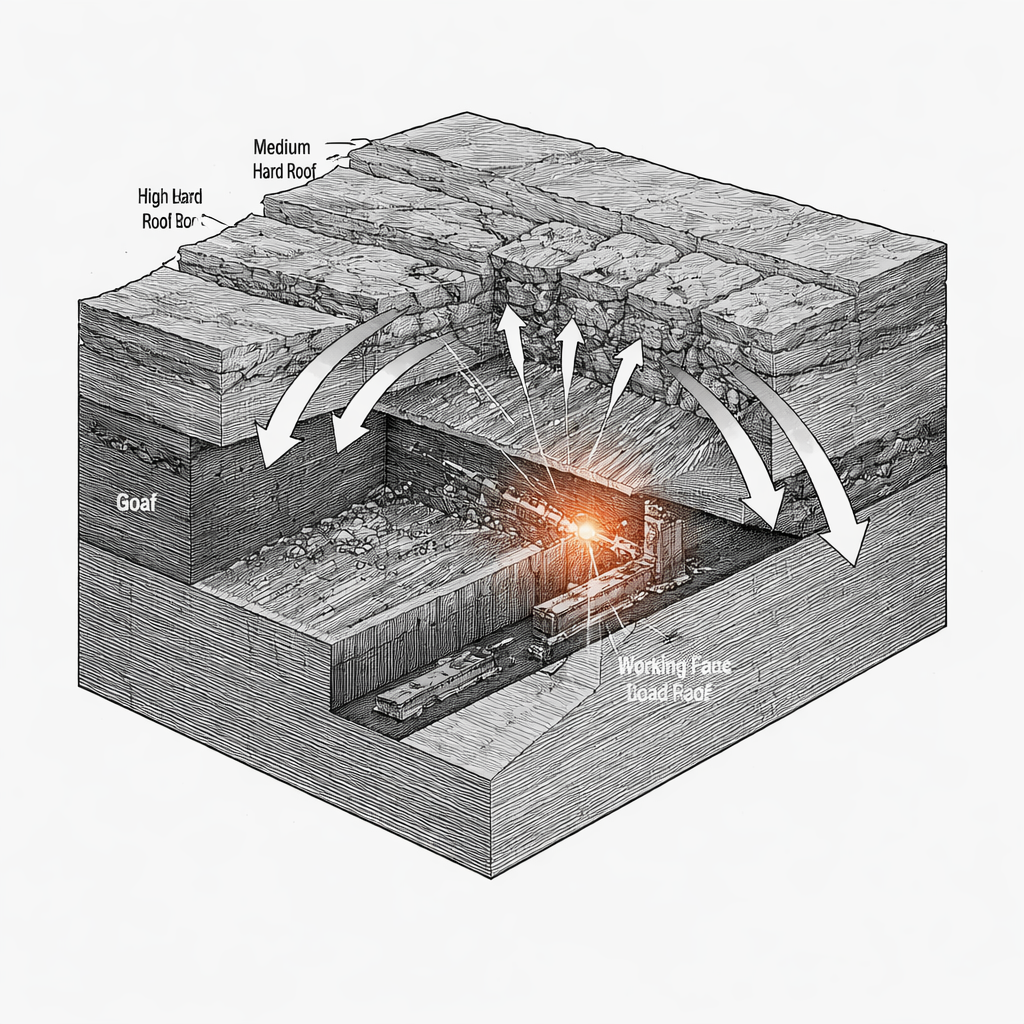
Why Deep Coal Mines Become More Dangerous
As China’s shallower coal seams are exhausted, mining has moved deeper underground, where the rock is heavier and the geology more complex. In the Gengcun Coal Mine, the coal seam lies more than half a kilometer below the surface, beneath several thick, strong rock layers called a “hard roof.” These layers act like stiff beams spanning the empty space left behind the advancing mining area, or working face. Instead of collapsing gently, they can hang in the air over large distances. That hanging roof squeezes the coal ahead of the working face, building up stress and energy. When the load becomes too great, the stiff rock can snap and shift suddenly, sending a shock into the surrounding rock and coal.
How Static Weight and Sudden Shocks Add Up
The authors focus on how two kinds of loading — slow, steady weight (static load) and sudden movement (dynamic load) — combine to trigger rock bursts. Using an engineering model of the rock layers over the 12,240 working face in Gengcun Mine, they calculate how the weight of the overlying rocks arches onto the coal just in front of the mining machines. On its own, this static loading raises stress and energy in the coal but does not reach the level needed to cause a burst. The dangerous situation arises when the hard roof above becomes unstable and breaks. That break releases bending energy from several rock layers at once, sending a vibration pulse downward. When the pulse arrives in the already stressed coal, the total energy can cross the critical threshold for a rock burst. In this mine, calculations show that when the low hard rock layer and two higher hard layers fracture together, they can deliver about 1.22×10⁴ joules to the working face — more than the mine’s known bursting threshold.
Listening to Tiny Quakes and Watching the Roof Move
To test this picture, the team combined two kinds of measurements. First, they examined microseismic records — tiny underground “quakes” that occur as rock cracks and shifts. Most of these events clustered in the zone between the lower and middle hard rock layers, and many appeared near the place where a major rock burst later occurred. Second, they installed special steel anchor cables into the low hard rock layer from a roadway below and continuously measured the tension in these cables as mining advanced. Rising cable tension signaled that the lower hard roof was bending and taking on more stress. One cable in particular showed a sharp jump in stress over a short distance, followed by a sudden drop — behavior that lined up closely in space with the calculated high-energy roof break and with the actual rock burst location. 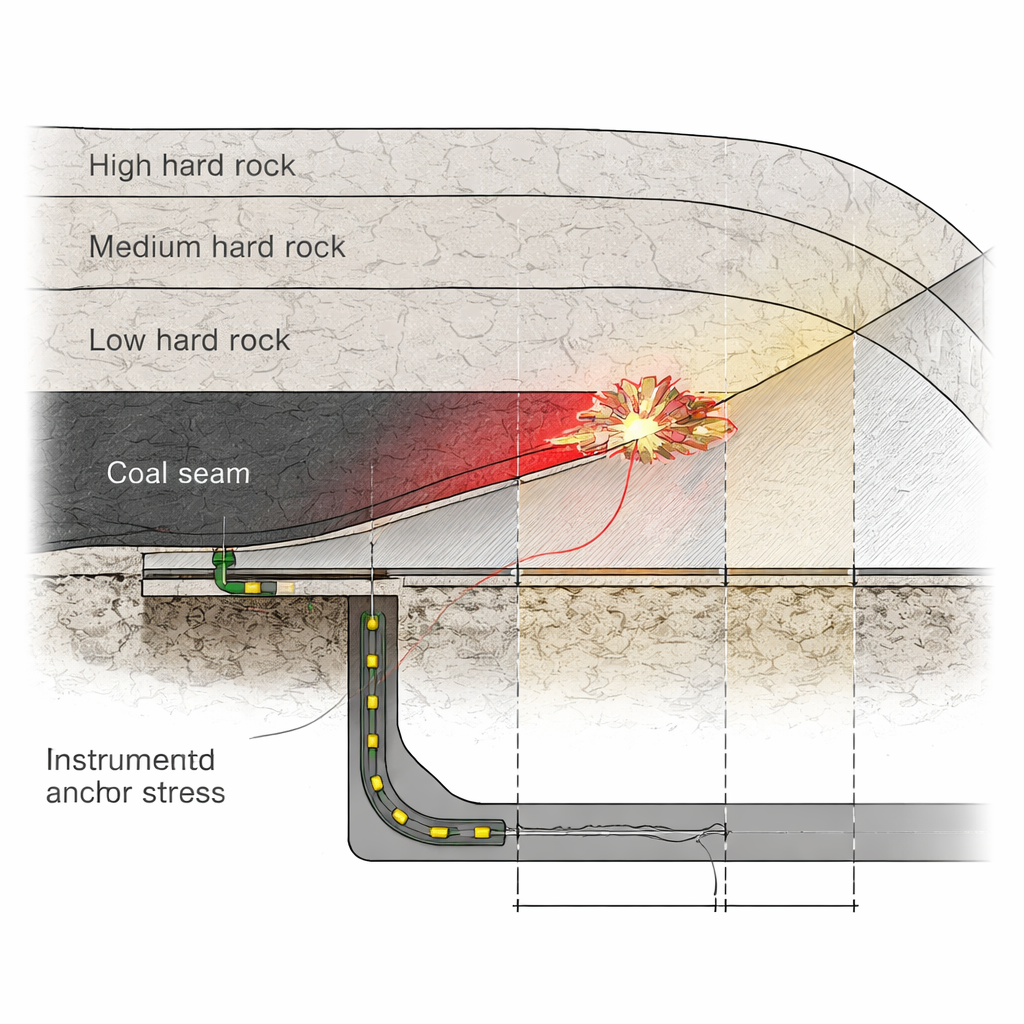
Three Zones of Growing and Fading Danger
By tracking how the anchor cable forces changed as the working face moved, the researchers identified three practical zones of risk in front of the mining area. Far ahead, from about 120 to 20 meters, the rock feels only a slow, modest rise in stress. Closer in, from 20 to about 2.5 meters, the stress in the low hard roof grows much faster, marking a zone of strong influence where the danger of a burst is greatest. In the last few meters right in front of the face, the stress drops quickly as the coal is cut away and the roof begins to cave. This three-stage pattern matches modern Chinese safety rules that demand heavy support and close monitoring over roughly the same distances in high-risk faces.
Turning Dangerous Roofs into Manageable Risks
For non-specialists, the key message is that rock bursts are not random underground explosions. They result from a build-up of stored energy in stiff rock layers above the coal and from the way that slow squeezing and sudden snapping of those layers add together. By combining physics-based calculations, microseismic “listening,” and direct stress measurements in a carefully chosen target layer, mine operators can estimate when the roof is approaching a dangerous state and act early — by adjusting support, changing mining speed, or using controlled weakening techniques — to keep miners safer while still accessing deep coal resources.
Citation: Fu, X., Zeng, L., Rong, H. et al. Disaster causing mechanism and monitoring of dynamic and static load coupling of deep multi layer hard roof. Sci Rep 16, 5081 (2026). https://doi.org/10.1038/s41598-026-35315-w
Keywords: rock burst, deep coal mining, hard roof, mine safety, microseismic monitoring