Clear Sky Science · en
Deep residual network enhanced with multilevel residual-of-residual for automatic classification of radio signals for 5G and beyond systems
Smarter Radios for a Crowded Airwaves Future
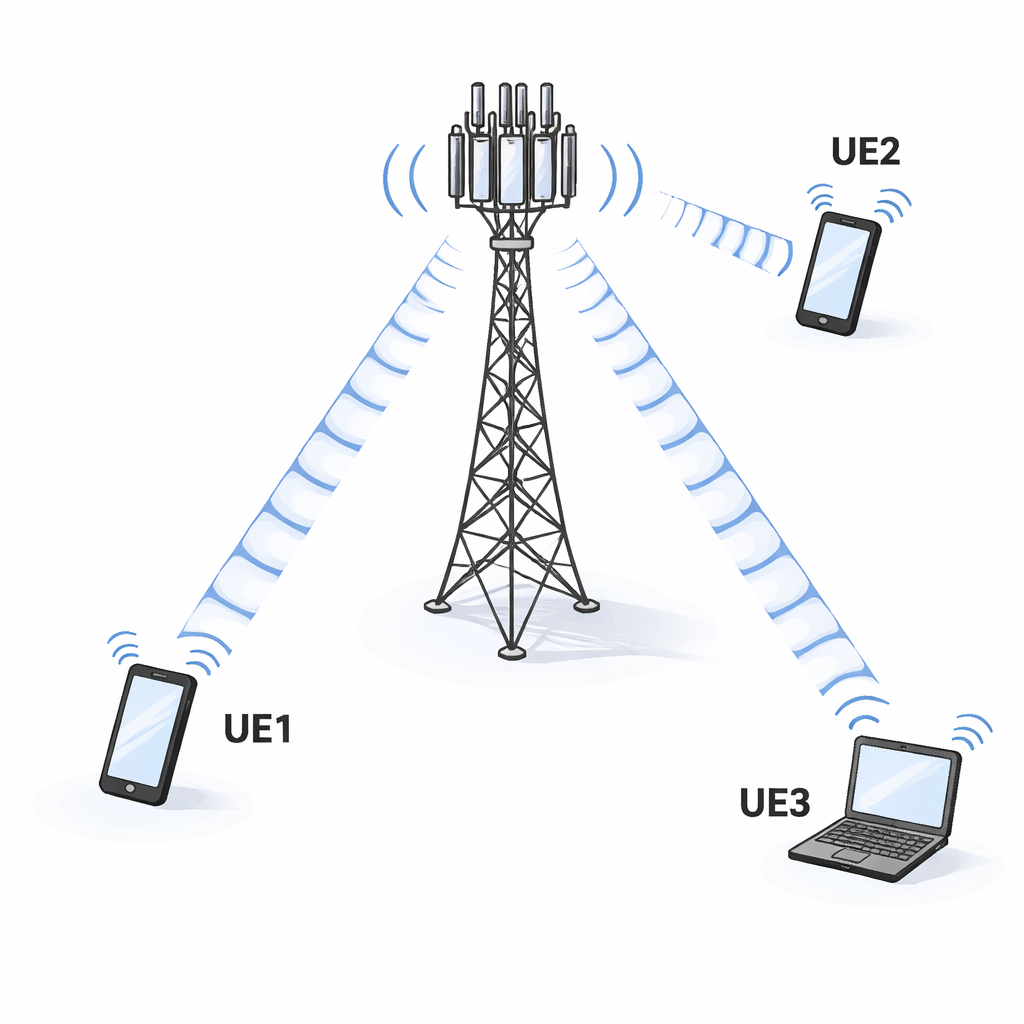
As our phones, cars, and even power grids all compete for wireless connectivity, the airwaves are becoming increasingly crowded and complex. To keep these networks running smoothly, receivers must quickly recognize what kind of signal they are hearing so they can decode it correctly and avoid interference. This paper presents a new artificial intelligence method that helps 5G—and future—radio systems automatically identify signal types more accurately, even in noisy, real‑world conditions.
Why Recognizing Signal Types Matters
Every wireless transmission, from a phone call to a sensor reading, is packaged using a particular “modulation” format—essentially a way of shaping radio waves to carry bits. Modern 5G systems support a mix of advanced waveforms such as OFDM, FBMC, UFMC, FOFDM, and WOLA, each optimized for different needs like high speed, low interference, or better use of spectrum. On top of that, they use different symbol alphabets, such as 16‑QAM and 64‑QAM, to squeeze more data into the same bandwidth. Automatically figuring out which combination is being used—known as Automatic Modulation Classification (AMC)—is crucial for smart receivers in applications ranging from everyday mobile broadband to defense and renewable‑energy control networks. Mistakes at this stage can ripple through the entire communication chain, causing dropped links, slower data, or poor coordination among devices.
Teaching a Neural Network to Listen
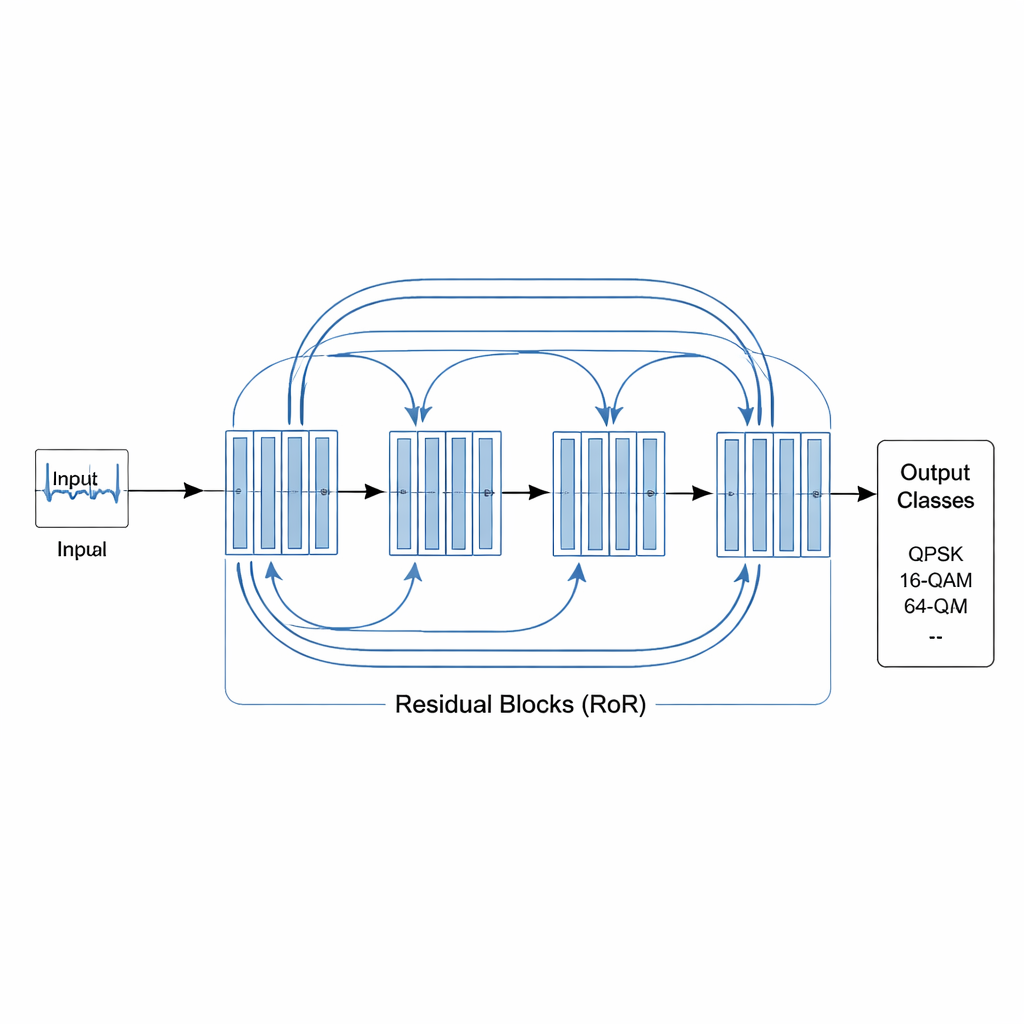
The authors design a new AMC framework built around a powerful type of deep learning model called a Deep Residual Network (DRN). Traditional neural networks can struggle to train when they become very deep, because information and gradients fade as they move through many layers. Residual networks address this by adding shortcut paths that let signals bypass layers, making learning more stable. This work goes a step further by using a “residual‑of‑residual” design, where multiple shortcut levels are stacked: within each block, across groups of blocks, and from input to output. This multilevel structure helps the network reuse and refine features at different depths, making it better at spotting subtle patterns in noisy radio signals that distinguish one modulation and waveform from another.
Picking Out the Most Telling Signal Clues
Rather than feeding raw samples alone into the network, the system first extracts a rich set of numerical descriptors from each received signal. These include statistics related to how the signal’s amplitude fluctuates, how its energy is distributed across frequencies, and higher‑order measures that capture more intricate shapes and phase behaviors. From an initial pool of thirty‑three such features, the authors apply a search strategy called Sequential Floating Forward Selection to find a smaller subset that still carries most of the discriminating power. This process trims the feature set down to just fourteen, cutting computational cost while retaining the most informative “fingerprints” of each modulation and waveform type.
Putting the Model to the Test
To evaluate their approach, the researchers generate a large simulated dataset of 5G‑style signals using a specialized link‑level simulator. The dataset spans ten different waveform–modulation pairs, two modulation depths (16‑QAM and 64‑QAM), and a wide range of signal‑to‑noise ratios from very poor to excellent reception conditions. They also model realistic wireless channels, including standard tapped‑delay line profiles and a challenging Vehicular‑A scenario that mimics fast‑moving users with strong multipath reflections. The proposed DRN with multilevel residual‑of‑residual connections is compared against a simpler DRN and an earlier convolutional neural network. Across metrics such as precision, recall, F1‑score, and overall accuracy, the new method consistently comes out on top, especially when signals are weak or the channel is strongly distorted.
Robust Performance in Realistic 5G Environments
Performance curves show that the new classifier reaches very high accuracy—around 95% correct decisions—at significantly lower signal quality than the baseline methods, needing more than 3 dB less signal strength than the standard DRN and over 7 dB less than the CNN. It also maintains strong results across different 5G channel models (TDL‑A, TDL‑B, TDL‑C) and in fast‑changing vehicular conditions, where many systems struggle. This combination of accuracy and resilience suggests the method can generalize well to diverse deployment scenarios, from dense indoor cells to large outdoor networks.
What This Means for Everyday Wireless Users
In practical terms, the study shows that carefully designed deep learning models can make future radios much better at understanding the signals they receive. A receiver equipped with this kind of classifier can more reliably identify complex 5G waveforms and modulation schemes on the fly, even amid noise, interference, and movement. That translates into more stable connections, higher data rates, and more efficient spectrum use for applications like smartphones, industrial automation, and smart energy grids. While the current results are based on simulations, the authors plan to validate their approach with real radio measurements and to explore even more advanced neural architectures, moving closer to intelligent receivers that can adapt seamlessly to whatever the airwaves throw at them.
Citation: Jabeur, R., Alaerjan, A. & Chikha, H.B. Deep residual network enhanced with multilevel residual-of-residual for automatic classification of radio signals for 5G and beyond systems. Sci Rep 16, 7003 (2026). https://doi.org/10.1038/s41598-026-35306-x
Keywords: 5G modulation, wireless signal classification, deep residual networks, radio waveforms, intelligent receivers