Clear Sky Science · en
Analysis and optimization of the J–T valve control logic for offshore oil and gas field low-temperature separators based on K-Spice
Keeping the Gas Flowing at Sea
Offshore gas platforms feed power plants and cities with a steady stream of natural gas. But that flow can be fragile: a single piece of faulty equipment may force operators to shut everything down, wasting fuel and money. This study looks at how a smarter way of opening and closing one key valve can keep gas production running safely, protect equipment, and still deliver gas that meets strict quality rules.
Why One Valve Matters So Much
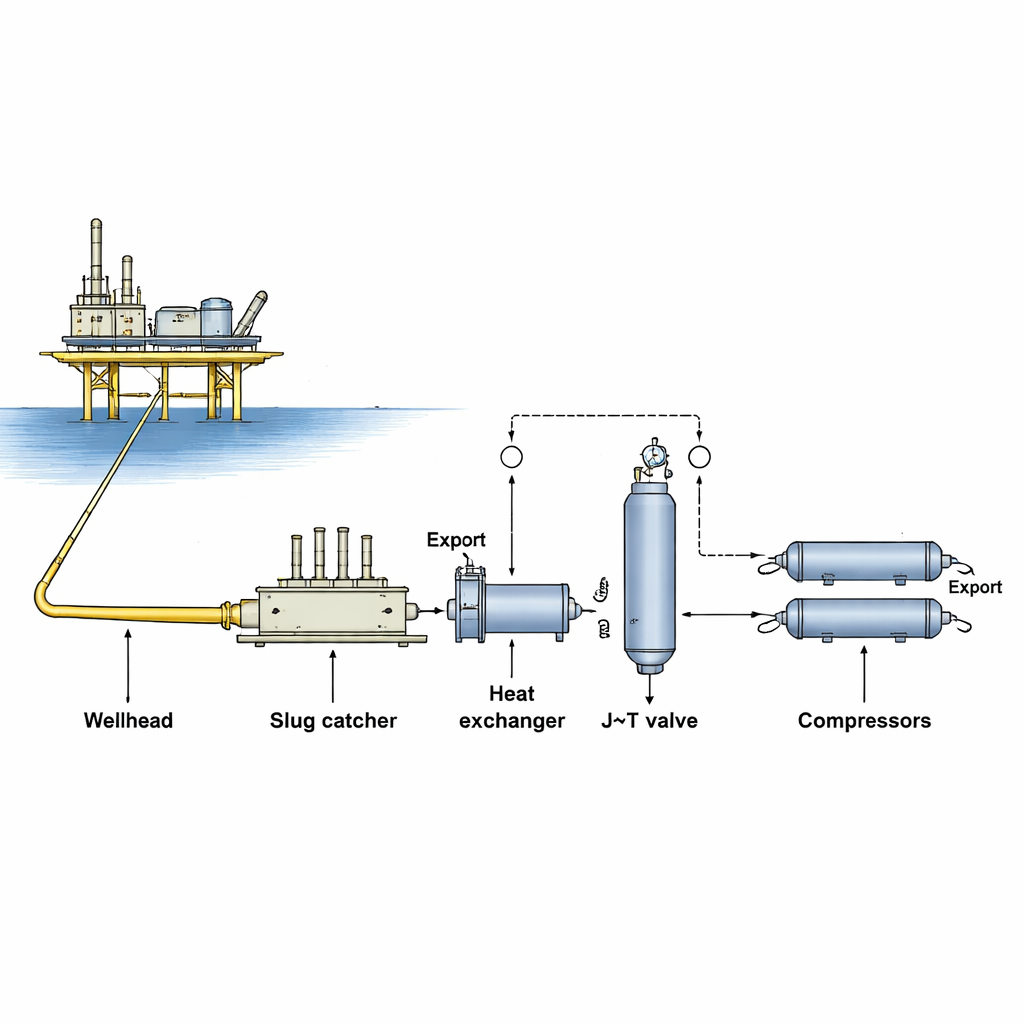
On the studied offshore platform, raw gas from a deepwater reservoir first travels through a long subsea pipeline to a device called a slug catcher, which separates gas from liquids. The gas is then cooled, pushed through a special throttling valve known as a Joule–Thomson (J–T) valve, and sent into a low-temperature separator where heavier hydrocarbons condense and drop out. Finally, dry gas compressors boost the pressure so the cleaned gas can be sent ashore. Under normal conditions, two compressors work in parallel, and the J–T valve opening is controlled only by the pressure upstream of the valve, not by what is happening in the separator or compressors downstream.
What Goes Wrong During a Compressor Failure
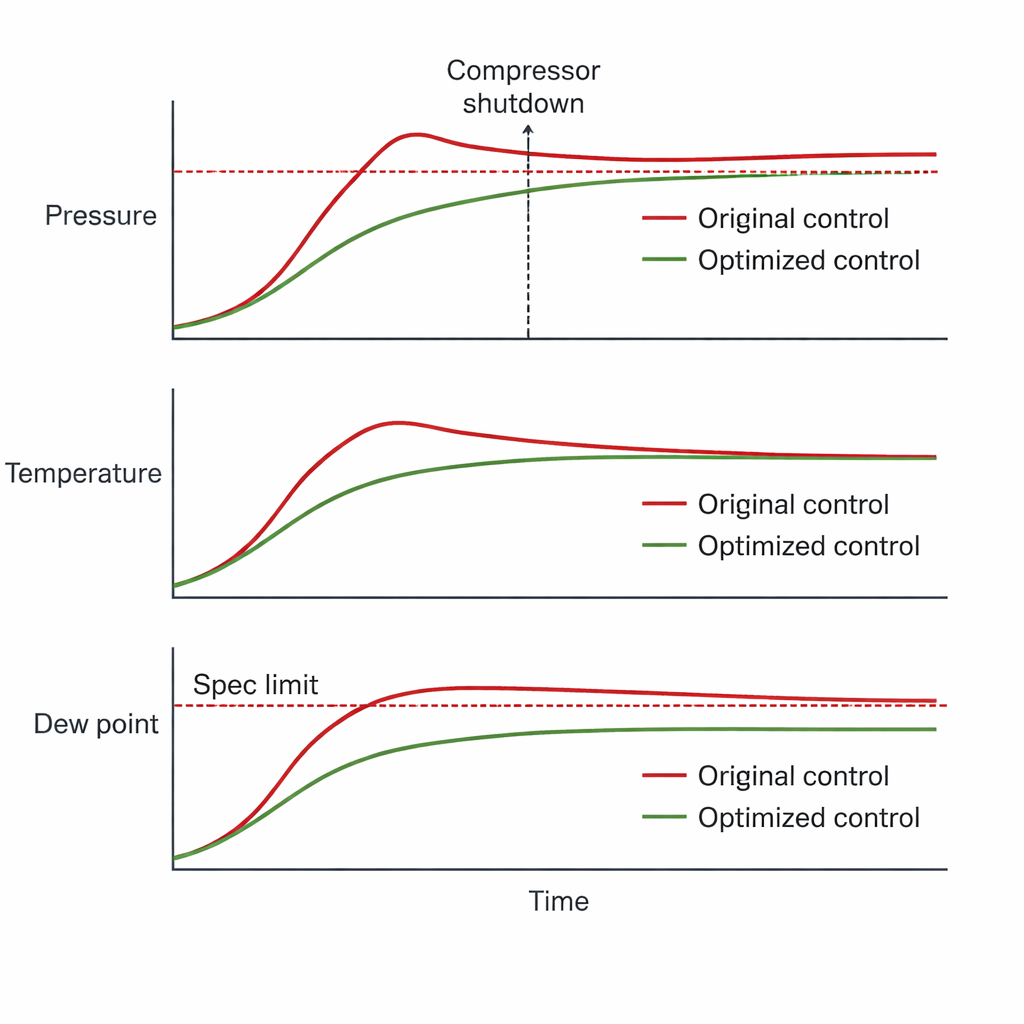
Problems arise when one of the compressors suddenly trips. With the original control logic, the J–T valve does not “know” about this event and keeps the same opening. As a result, nearly the same amount of gas continues to rush into the low-temperature separator, while only one compressor is left to handle it. Simulations using K-Spice, a detailed dynamic modeling tool, show that in this situation the separator pressure can jump to the plant’s high–high alarm limit of 82 barg in as little as 6–10 seconds. Crossing this limit forces an automatic production shutdown. At the same time, the separator temperature rises because the throttling-and-cooling effect of the J–T valve is weakened at higher pressure, which pushes the hydrocarbon dew point of the export gas above its specification. In other words, the platform risks both a shutdown and off-spec gas.
Designing and Testing a Smarter Control Strategy
The researchers built a high-fidelity K-Spice model of the subsea pipeline, slug catcher, heat exchanger, J–T valve, low-temperature separator and compressors, using real plant dimensions, flow rates and gas composition. They then compared four operating cases at two export flow rates (about 8.0 and 8.5 million standard cubic meters per day). In the original strategy, the J–T valve opening stayed fixed and was controlled only by upstream pressure. In the improved strategy, as soon as a single-compressor shutdown was detected, the J–T valve was forced to close quickly from its normal opening down to 20% within three seconds, temporarily limiting how much gas could enter the separator.
How Fast Valve Action Protects Safety and Gas Quality
The simulations showed that rapid partial closure of the J–T valve sharply limited the pressure surge in the separator. With the new logic, separator pressure peaked below the 82 barg alarm limit and then fell back towards its normal setpoint, so the remaining compressor could keep running and a full-field shutdown was avoided. At the lower export rate, gas quality stayed within the required hydrocarbon dew point limit of 5 °C. At the higher export rate, there was only a brief few-second period of slightly off-spec gas, which the authors suggest can be removed operationally. The trade-off is that throttling the J–T valve raises pressure in the upstream slug catcher faster, which can eventually trigger controlled venting if operators do not reduce well flow in time. The study quantifies these response times, showing that operators have on the order of a minute or more, depending on flow rate, to cut back production and avoid flaring losses.
From Computer Model to Real-World Gains
Based on the simulation results, the team also recommended lowering the separator temperature setpoint to about −22 °C at higher flow rates, which helps keep the export gas dew point comfortably within limits even during upsets. In 2024, the optimized control logic was installed on a deepwater gas field in the South China Sea. During two real compressor trips, the J–T valve automatically closed to 20% within three seconds, the second compressor kept running, no full-platform shutdown occurred, and gas quality stayed on target. The operator reported saving roughly 400,000 cubic meters of natural gas and 40 cubic meters of condensate, corresponding to over one million yuan in economic benefit.
What This Means for Offshore Energy
For non-specialists, the message is straightforward: by teaching a single valve to react more intelligently and more quickly to trouble, operators can avoid costly shutdowns, reduce wasteful flaring, and still deliver clean-burning gas that meets strict standards. The study shows that detailed digital models of offshore process systems can reveal how pressures, temperatures and valve positions interact in the first few critical seconds after a failure. With that insight, control logic can be redesigned to keep offshore gas fields running more safely, reliably and efficiently.
Citation: Liu, Y., Lin, F., Zhu, G. et al. Analysis and optimization of the J–T valve control logic for offshore oil and gas field low-temperature separators based on K-Spice. Sci Rep 16, 4973 (2026). https://doi.org/10.1038/s41598-026-35304-z
Keywords: offshore natural gas, process control, Joule–Thomson valve, dynamic simulation, compressor trip