Clear Sky Science · en
A case study discovering lock-in effects of culinary culture and behaviours on cooking energy use in Chinese homes
Why the kitchen matters for climate change
When people think about saving energy at home, they usually picture better insulation, efficient lights, or turning down the heat. This research shows that another, easily overlooked place—the kitchen—can quietly use a surprisingly large share of a household’s energy. By following how real Chinese families cook over many months, the study reveals how deeply rooted food traditions and family routines can "lock" homes into certain levels of cooking energy use and climate-warming emissions.
Cooking at home as a major energy user
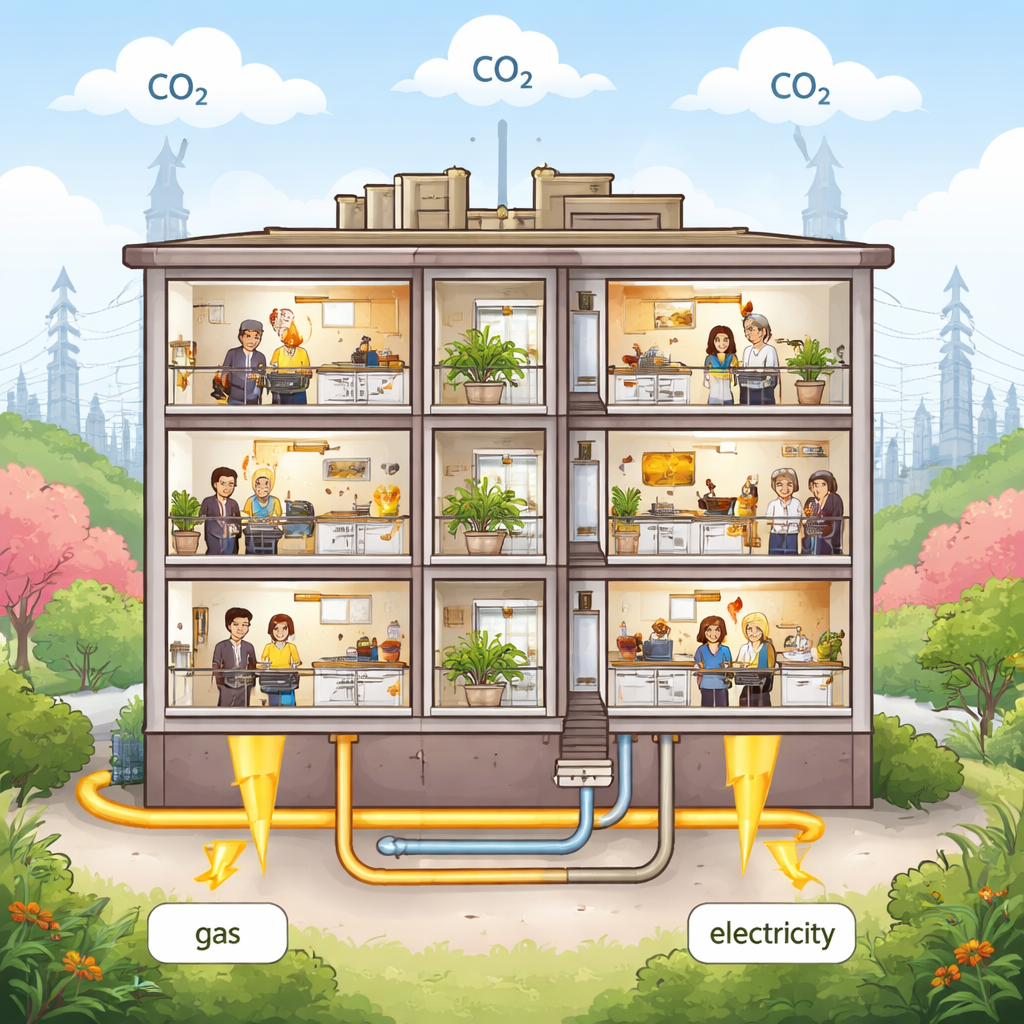
China’s rapid urban growth has made homes a major source of national carbon emissions, and cooking now ranks among the biggest energy uses indoors. The authors focus on urban Chinese households, where cooking often involves multiple hot dishes, long simmering, and generous use of boiling or steaming. Official energy statistics usually lump cooking together with "miscellaneous" uses, which hides its real scale. By separating it out and measuring it directly, the study finds that cooking can account for about one-quarter to nearly half of total household energy use—far more than many people expect from everyday meals.
Following real families through their daily meals
To uncover what drives this energy use, the researchers closely monitored two typical Beijing households. One was an elderly retired couple; the other was a three-generation family with a young child. Plug-in meters tracked electricity use of kitchen appliances, and gas meters recorded stovetop fuel. In the elderly couple’s home, cooking took about 23% of all energy used over a full year. In the three-generation home, across roughly three and a half months, cooking soared to 48% of total energy. When converted to a simple measure of average cooking energy per day, the elderly couple used around 6.4 kilowatt-hours, while the larger family used about 14.7—more than double.
A new way to measure everyday cooking energy
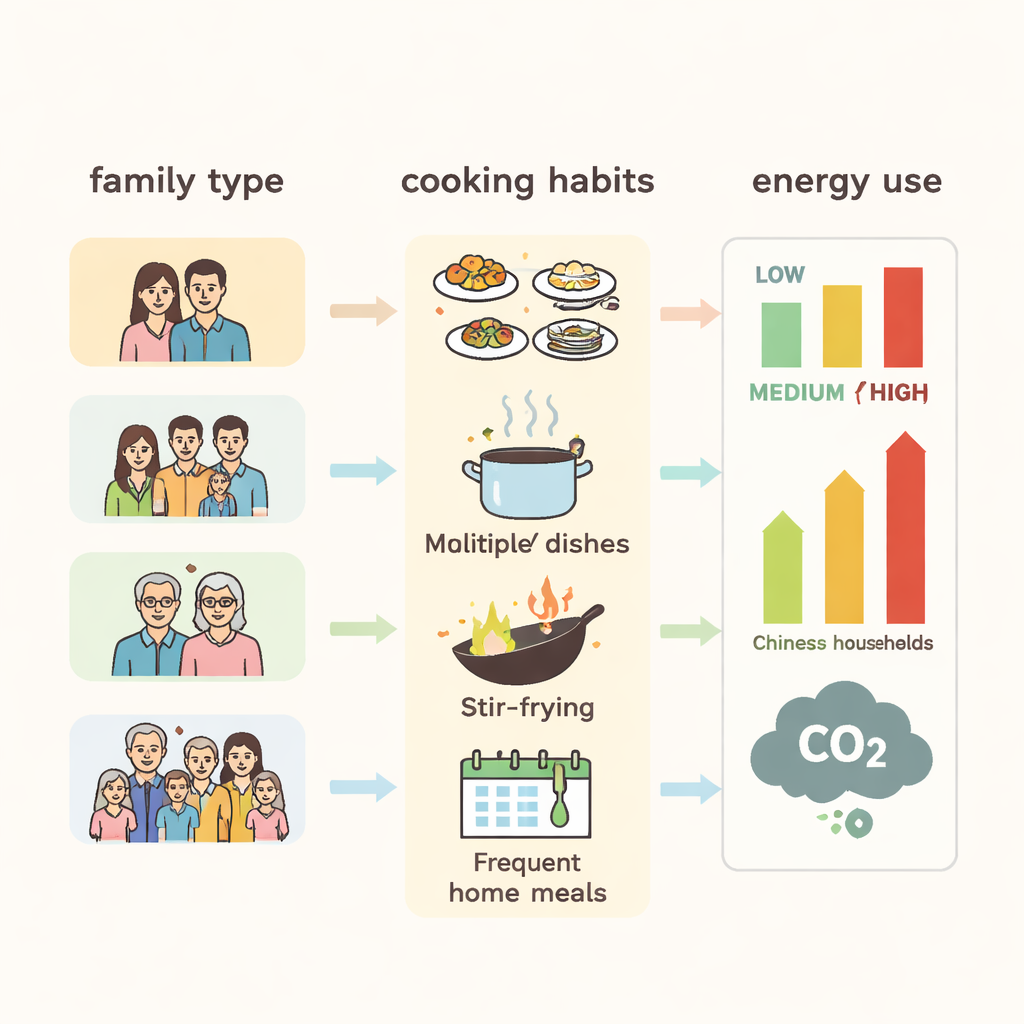
Because traditional building metrics focus on energy per square meter of floor area, they miss how strongly cooking depends on who lives in the home and how they cook. The study introduces a new indicator called "Cooking Energy Use Intensity" (CookEUI), defined as the average daily energy used for cooking. Using survey data from 202 households across China, the authors show clear bands of CookEUI linked to stages of family life. Elderly and middle-aged couples typically cluster around 4–5 kilowatt-hours per day, two-generation families around 6–7, and three-generation households with young children can reach 8–13. These bands do not simply scale with the number of people; instead, they mirror differences in routines and expectations about home-cooked meals.
How habits and food culture "lock in" energy use
The authors describe a "lock-in" effect, where the mix of family stage and culinary culture tends to stabilize cooking energy use at certain levels. Survey answers reveal that many Chinese families repeatedly cook the same set of dishes because they are quick to prepare, match long-standing taste preferences, or honour recipes passed down from older generations. About two-thirds of households have one fixed cook who follows these routines day after day. Popular techniques such as boiling and steaming, which heat large amounts of water, use more energy than methods like dry baking or grilling. Together, these habits make it difficult to cut cooking energy without challenging deep-seated ideas about what counts as proper, tasty, and healthy food.
What can realistically change in the kitchen
Recognizing that food traditions are hard to shift, the study explores options that keep beloved dishes while lowering energy use and emissions. More efficient tools—such as pressure cookers and microwave ovens—can shorten cooking times and reduce energy needs without changing recipes too much. Switching from gas stoves to electric or induction cooktops, especially when powered by cleaner electricity, can lower climate impacts, though many cooks still prefer the control and flavour they associate with open flames. Hybrid solutions, like dual-use stoves that pair a gas burner for quick stir-fries with an induction zone for simmering, may offer a practical compromise. The authors also suggest community dining halls that use large shared equipment for steaming and boiling, which can be more efficient than dozens of separate home kitchens.
What this means for households and planners
By showing that everyday cooking can be a major slice of home energy use—and that it is strongly shaped by family life stage and culture—this work argues that climate and energy planning should no longer treat the kitchen as an afterthought. The new CookEUI measure gives designers and policymakers a way to better estimate real-world cooking demand and to test how new appliances, fuels, or shared facilities might reduce emissions. For ordinary households, the message is not to abandon cherished dishes, but to consider smarter tools and cleaner energy sources that can keep the flavour of tradition while turning down its carbon footprint.
Citation: Wang, H., Lin, H., Riffat, S. et al. A case study discovering lock-in effects of culinary culture and behaviours on cooking energy use in Chinese homes. Sci Rep 16, 6565 (2026). https://doi.org/10.1038/s41598-026-35302-1
Keywords: cooking energy, Chinese households, family life cycle, culinary culture, household emissions