Clear Sky Science · en
Identifying and analysing the differences between flooding and waterlogging in urban areas
When City Streets Turn into Rivers
As extreme rainstorms strike growing cities more often, many people experience both rushing street torrents and deep, still pools of water—but we usually call all of it a “flood.” This study shows that treating these very different kinds of urban water as one problem can waste money, slow rescue efforts and even cost lives. By clearly separating fast, river-like flooding from slow-draining waterlogging, the authors argue, city planners and emergency teams can better protect residents in places like Zhengzhou, China, where deadly storms have already revealed the gaps in current defenses.
Two Kinds of Dangerous Water
In simple terms, the paper explains that cities face two main water threats during big storms. Flooding happens when water from outside—such as rivers, canals or reservoirs—rushes into the city, flowing quickly through streets, tunnels and subway lines. Waterlogging, by contrast, occurs when intense local rainfall overwhelms drains and pipes, leaving water to collect in low-lying areas like underpasses and flat residential districts. Both can drown cars, block escape routes and damage buildings, but they behave differently: floods move fast and hit hard, while waterlogging tends to spread slowly and linger.
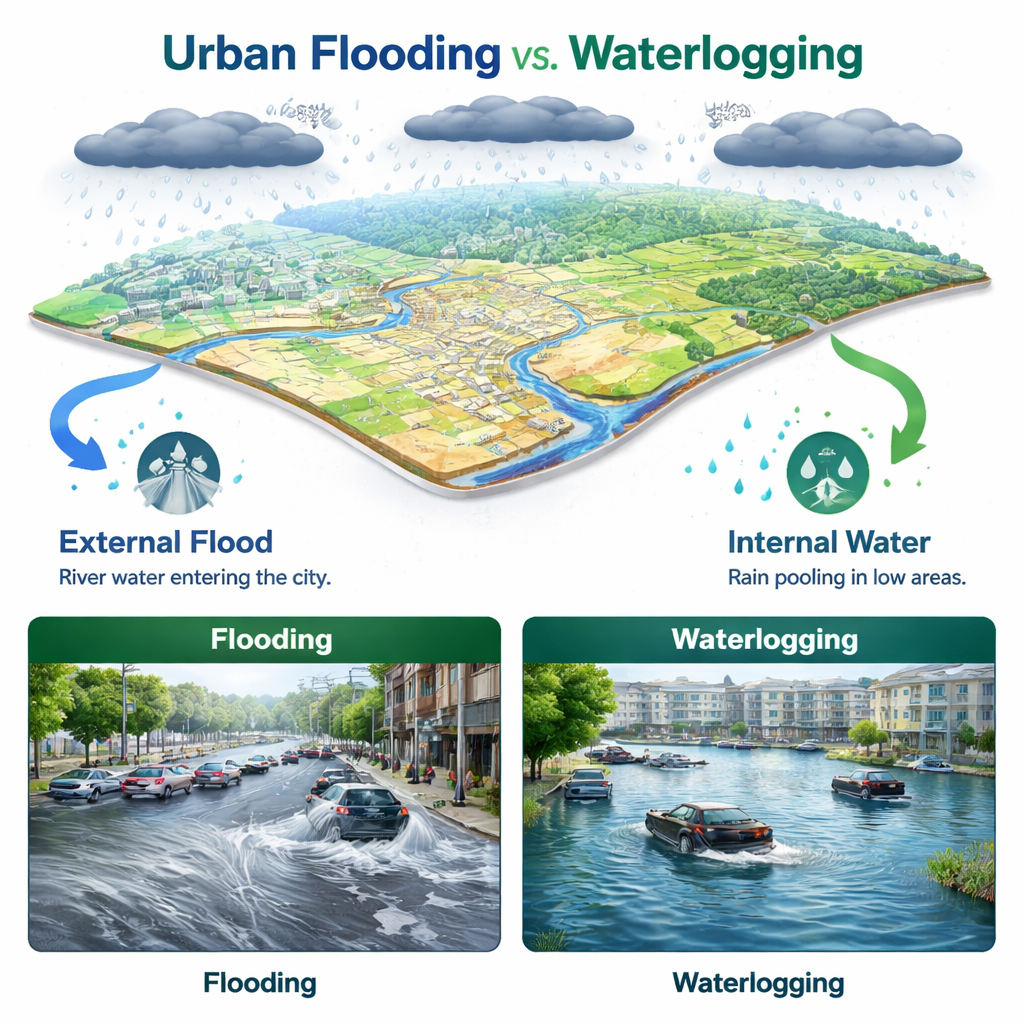
Lessons from a Deadly Storm
The authors focus on the 20 July 2021 rainstorm in Zhengzhou, where almost 700 millimeters of rain fell in 24 hours—more than three times the city’s design standard. Using a detailed computer model of two urban districts, they reconstructed how water moved across the landscape. The southwest sits higher, the northeast lower, creating natural paths for water to run and pool. Their simulations show how water from widespread rainfall and possible outside inflows combined to create fast, dangerous flows in some places and deep, stubborn ponds in others, especially in dense residential areas and around long road tunnels.
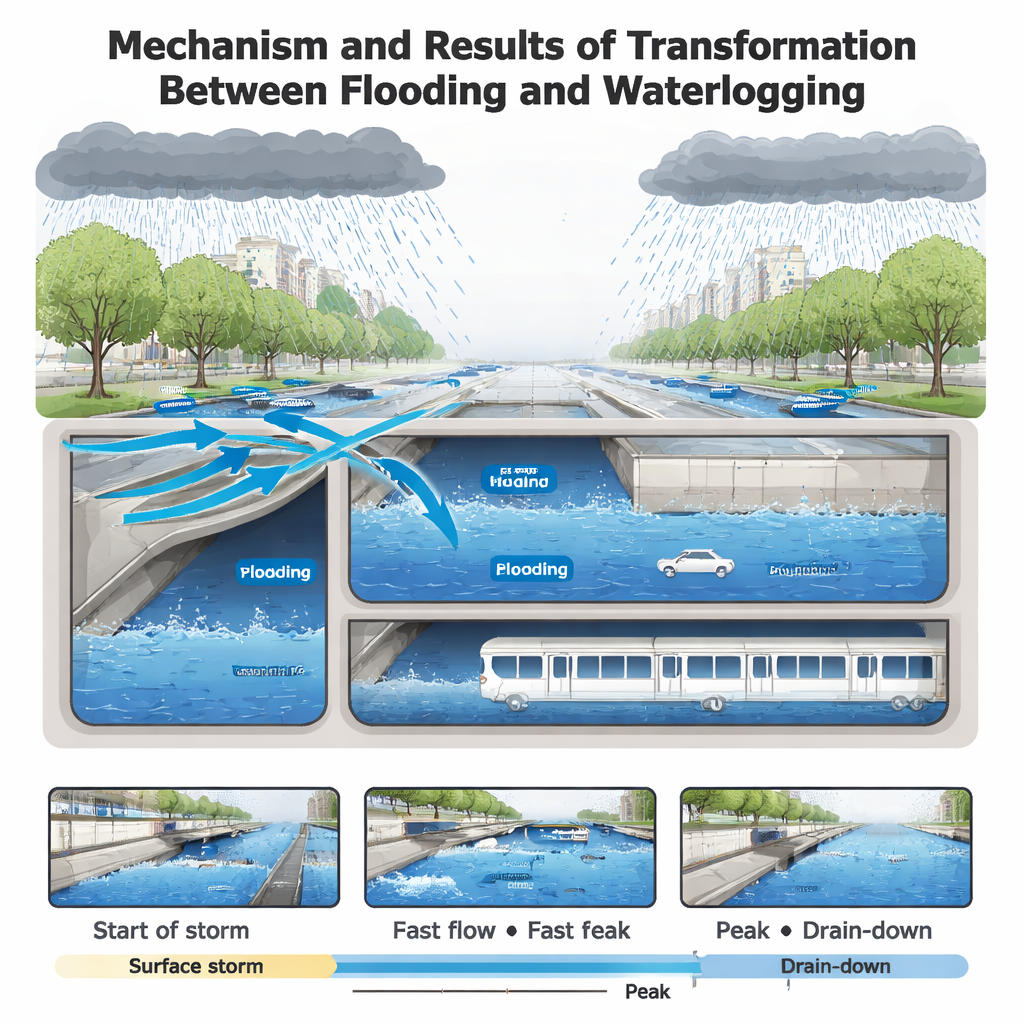
Turning Fuzzy Judgement into Numbers
City officials often rely on rough rules of thumb—such as how deep the water looks—to decide whether they are dealing with a flood or a waterlogging problem, and what response to send. The authors replace this experience-based judgement with a step-by-step scoring method drawn from a branch of mathematics called “fuzzy” evaluation, which is designed to handle vague and uncertain situations. For each patch of the city, they look at how fast water is moving, how much water is flowing through cross-sections, how deep it is, and how large an area is under water. Fast flow and strong currents point to flooding; great depth and wide coverage point to waterlogging. The method then assigns each area to one of several levels—from minor to very dangerous—and flags places where both types of hazard overlap.
Where Risks Pile Up
Applying this method to Zhengzhou, the researchers find that waterlogging is the dominant danger across most of the city: large, flat neighborhoods collect deep water that drains slowly, keeping roads and homes under threat long after peak rainfall. Yet in some zones—particularly in the east, with its tunnels and dense development—fast-moving floods and deep ponds occur together. In these overlapping areas, cars and subway stations face both strong currents and high water levels, making evacuation and rescue far more difficult. The study also shows that results differ depending on where people and buildings are concentrated, using maps of points of interest to highlight locations where the same amount of water poses greater risk because more assets and residents are exposed.
Guiding Smarter Protection for Cities
For non-specialists, the key message is that not all city “floods” are the same—and that recognizing the difference matters. Where waterlogging dominates, cities should focus on better drainage, storage ponds and raising vulnerable entrances to homes, shops and tunnels. Where true flooding dominates, stronger river defenses, barriers and flow-diverting works are more important. In places where fast flow and deep pooling combine, both sets of measures and more careful emergency planning are needed. By offering a practical way to label each neighborhood as mainly flooding, mainly waterlogging or a risky mix of both, this research provides a clearer blueprint for how cities worldwide can prepare for the next extreme storm.
Citation: Zhou, J., Du, W., Liu, J. et al. Identifying and analysing the differences between flooding and waterlogging in urban areas. Sci Rep 16, 5195 (2026). https://doi.org/10.1038/s41598-026-35296-w
Keywords: urban flooding, waterlogging, extreme rainfall, flood risk, Zhengzhou storm