Clear Sky Science · en
Genetic divergence and lower frequencies of insecticide resistance markers in the novel Anopheles gambiae Bissau molecular form in The Gambia
Why a new mosquito matters for malaria control
For many people, mosquito control means bed nets and indoor spraying. Yet the mosquitoes themselves are evolving in response to these weapons. This article explores a newly recognized kind of malaria-carrying mosquito in The Gambia, called the Bissau molecular form, and asks a simple but crucial question: is this hidden player changing how insecticides work and how we should fight malaria?
A hidden cousin in a familiar mosquito family
In sub-Saharan Africa, malaria is spread mainly by members of the Anopheles gambiae complex—a group of look‑alike “sibling” species that are genetically distinct. Four of them are major malaria vectors, including An. gambiae sensu stricto and An. coluzzii. Recent genomic work has revealed a new taxon within this complex in far‑west Africa, dubbed the Bissau molecular form. Unlike many other cryptic mosquitoes that prefer to bite and rest outdoors, Bissau seems to feed and rest indoors, exactly where bed nets and indoor spraying are targeted. This makes it particularly important for malaria control strategies.
Mapping where mosquitoes live and how they mix
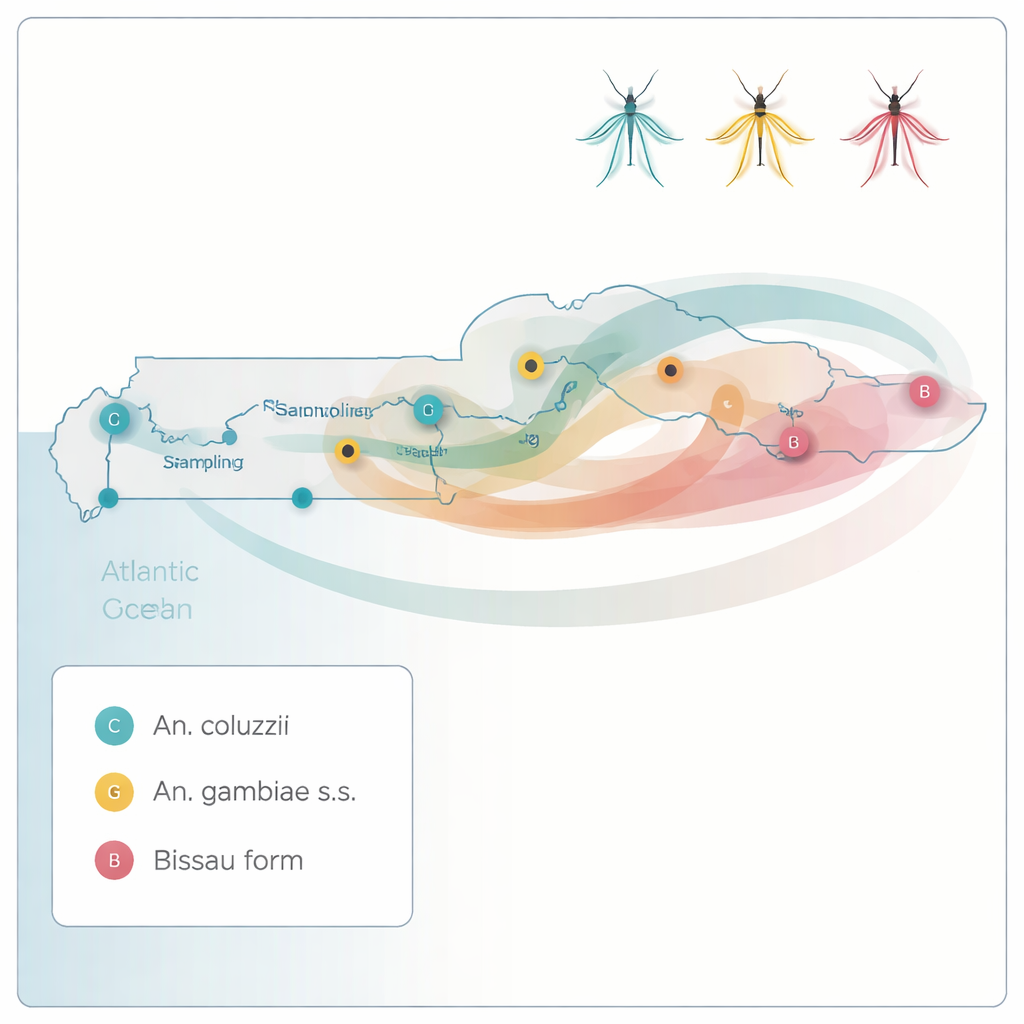
The researchers re‑analysed whole genome sequence data from over 1,100 mosquitoes collected across The Gambia between 2005 and 2021 as part of the Anopheles gambiae 1000 Genomes Project. Using thousands of genetic markers, they identified which specimens were An. coluzzii, An. gambiae s.s., or Bissau. An. coluzzii dominated most sites, but Bissau was common in the North Bank region and An. gambiae s.s. in some urban western areas. Statistical analyses of the genomes showed that the three taxa are only weakly differentiated, meaning they still share genes through interbreeding. However, Bissau mosquitoes formed two sub‑groups separated by the River Gambia, hinting that the river acts as a partial barrier and that local ecological conditions shape their evolution.
How mosquitoes dodge insecticides
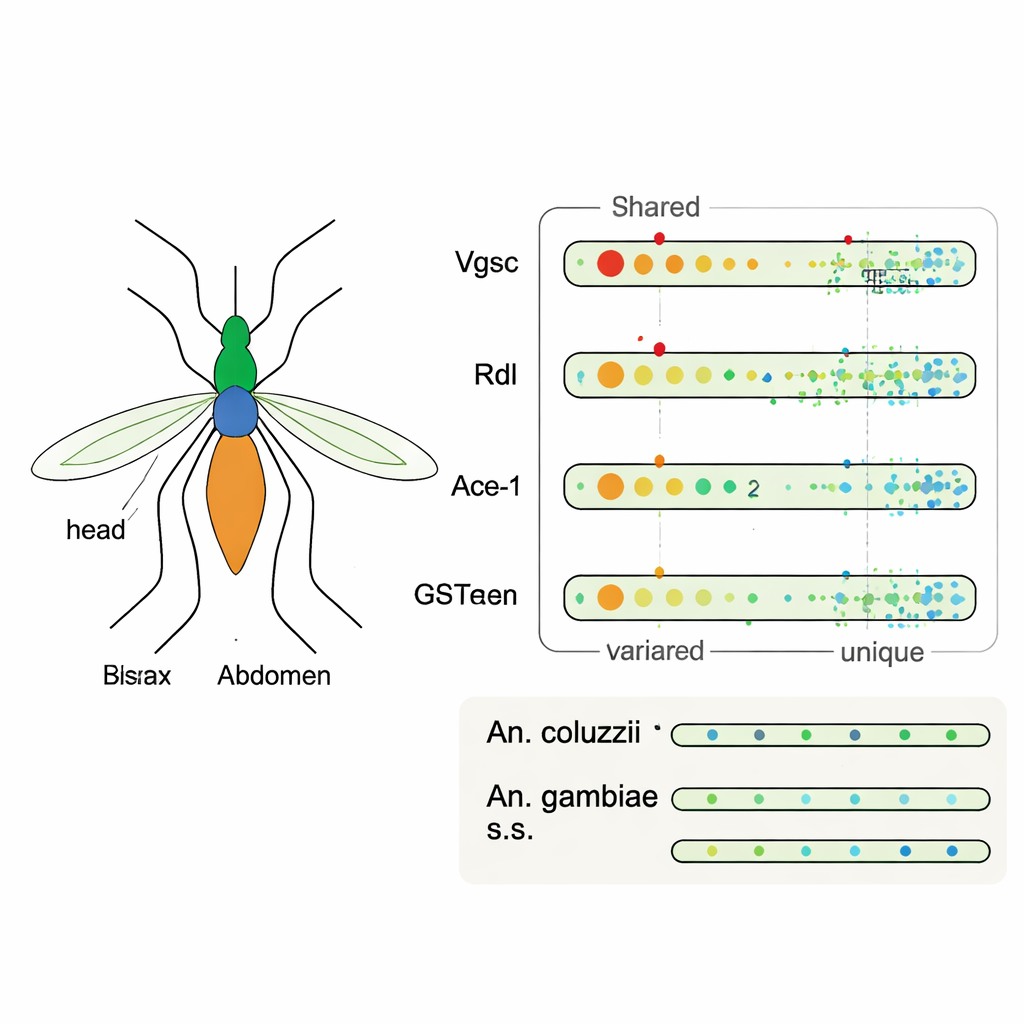
To understand insecticide resistance, the team focused on several well‑known genes. The voltage‑gated sodium channel gene (Vgsc) is a key target of pyrethroid insecticides and the old insecticide DDT. Across all taxa, a classic resistance mutation called L995F was very common, and in An. gambiae s.s. it was almost fixed, meaning nearly every mosquito carried it. Bissau mosquitoes also carried L995F together with other Vgsc changes, such as T791M and A1746S, that tended to occur together, suggesting they may be evolving as a linked resistance package. In other target genes—Ace‑1, which affects response to carbamates and organophosphates, and Rdl, linked to dieldrin‑like compounds—Bissau showed many additional rare variants, especially in more urban western areas, whereas An. coluzzii often lacked some of the key resistance combinations seen in the other two taxa.
A growing library of rare mutations
The scientists also examined GSTe‑2, a gene family involved in detoxifying insecticides inside the mosquito. Again, they found a patchwork of mutations across The Gambia, but Bissau stood out for having a broad array of low‑frequency variants. Some well‑studied changes associated with pyrethroid or DDT resistance were present, while others were missing or replaced by alternative versions, sometimes unique to a single taxon. In Bissau, the mix of rare variants was especially rich in western, more urban regions where household and agricultural insecticide use is likely to be intense and varied. This pattern suggests that Bissau may act as a genetic “reservoir,” holding many potential resistance mutations that could rise in frequency if selection pressures change.
What this means for malaria elimination
For a non‑specialist, the key message is that not all malaria mosquitoes are alike, even when they look the same. The Bissau molecular form is closely related to familiar vector species and lives indoors, but it has its own genetic structure and an unusual pattern of many low‑frequency resistance mutations. Because genes can flow between taxa, Bissau could help seed new forms of resistance into other mosquitoes, potentially undermining insecticide‑based control in The Gambia and neighbouring regions. The authors argue that ongoing genetic surveillance of all mosquito taxa, combined with studies of their behaviour and insecticide exposure, will be essential to design future tools—such as improved insecticides or gene drives—that remain effective as mosquitoes continue to evolve.
Citation: Abdoulaye, S., Milugo, T.K., Oriero, E. et al. Genetic divergence and lower frequencies of insecticide resistance markers in the novel Anopheles gambiae Bissau molecular form in The Gambia. Sci Rep 16, 5540 (2026). https://doi.org/10.1038/s41598-026-35295-x
Keywords: malaria mosquitoes, insecticide resistance, Anopheles gambiae, population genomics, The Gambia