Clear Sky Science · en
Evaluation of the coupled coordination of digital village, green agriculture and farmers’ well-being in China
Why Digital Countryside Matters
Across China, village life is changing fast. Smartphones, e‑commerce, and online services are reaching remote farms, while the country is also trying to grow food more cleanly and make life better for rural families. This study asks a simple but important question: when rural areas go digital, does it actually help both the environment and farmers’ day‑to‑day well‑being—and are these three goals moving forward together or pulling in different directions?
Three Pieces of One Rural Puzzle
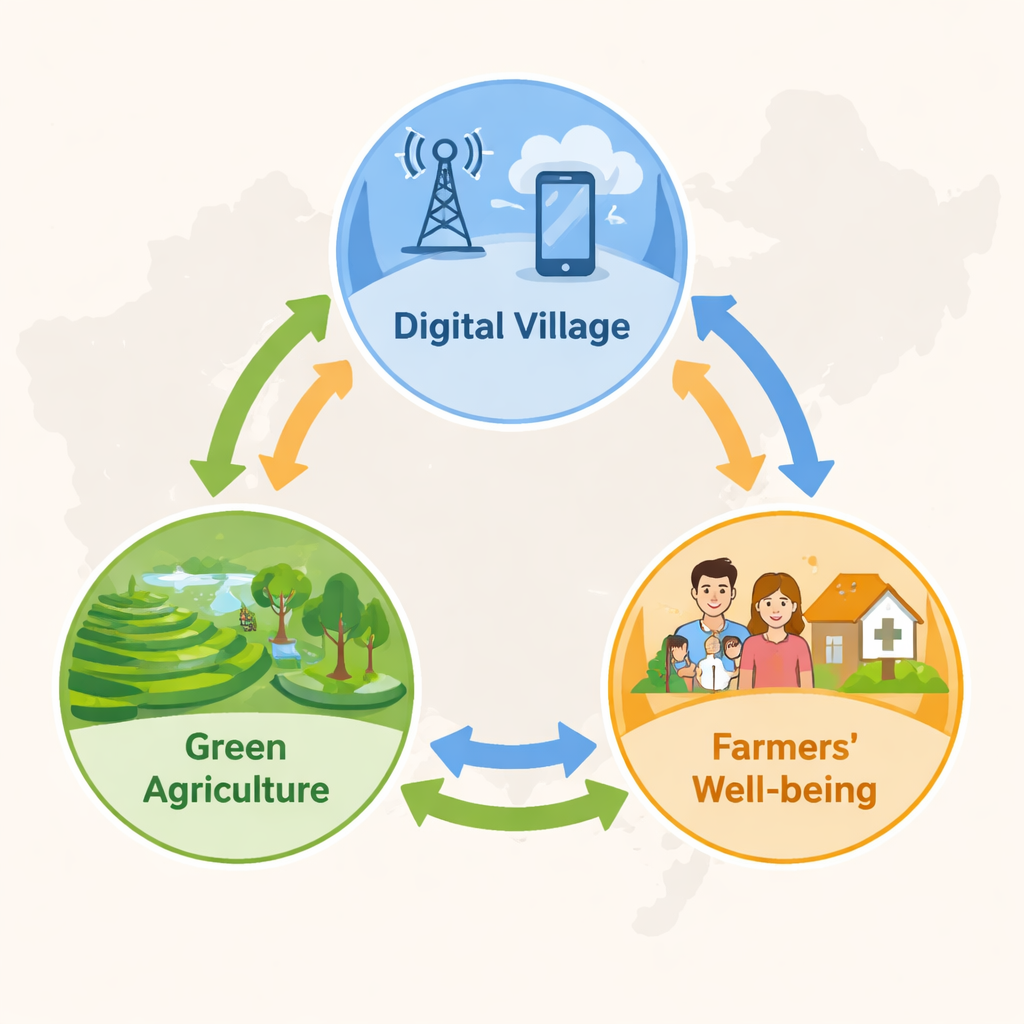
The researchers view rural China as a giant, interconnected system with three key pieces: the “digital village,” “green agriculture,” and “farmers’ well‑being.” The digital village covers things like broadband, mobile coverage, online shopping and finance, and digital public services. Green agriculture focuses on cutting back on pesticides, fertilizers, and water use while protecting forests and soil. Farmers’ well‑being includes income, education, public services, clean water, waste treatment, and health and cultural facilities. Rather than look at each piece alone, the team asks how strongly they are linked and whether they are rising together in a balanced way.
Turning Data into a Big Picture
To get answers, the authors collected data from 30 provinces between 2011 and 2021, drawing on national yearbooks and official statistics. They built an index system with dozens of concrete indicators—for example, kilometers of fiber‑optic cable, forest coverage, use of farm chemicals, rural household income, school years, and access to safe drinking water. Using a set of mathematical tools, they first calculated how advanced each province was on each of the three fronts. Then they measured how “coordinated” the three subsystems were—whether progress in one went hand in hand with progress in the others, or whether they lagged behind or clashed. Finally, they mapped how this coordination changed over time and across regions, and tested how much neighboring provinces tended to resemble one another.
Rural Progress, But Not Yet in Step
The results give a cautiously optimistic picture. On average, all three areas—digital services, green farming, and quality of life—improved clearly over the ten years. Villages gained better internet and power, farmers’ incomes and access to services rose, and environmental efforts strengthened, especially in water‑saving and forest protection. The links among the three systems also tightened: provinces moved from a state the authors call “moderate disruption” toward “intermediate synchronization,” meaning the three pillars increasingly support each other. Still, environmental progress tended to lag behind gains in digital access and living standards, and in many provinces the systems were strongly connected but not yet fully balanced.
Uneven Map of Winners and Stragglers
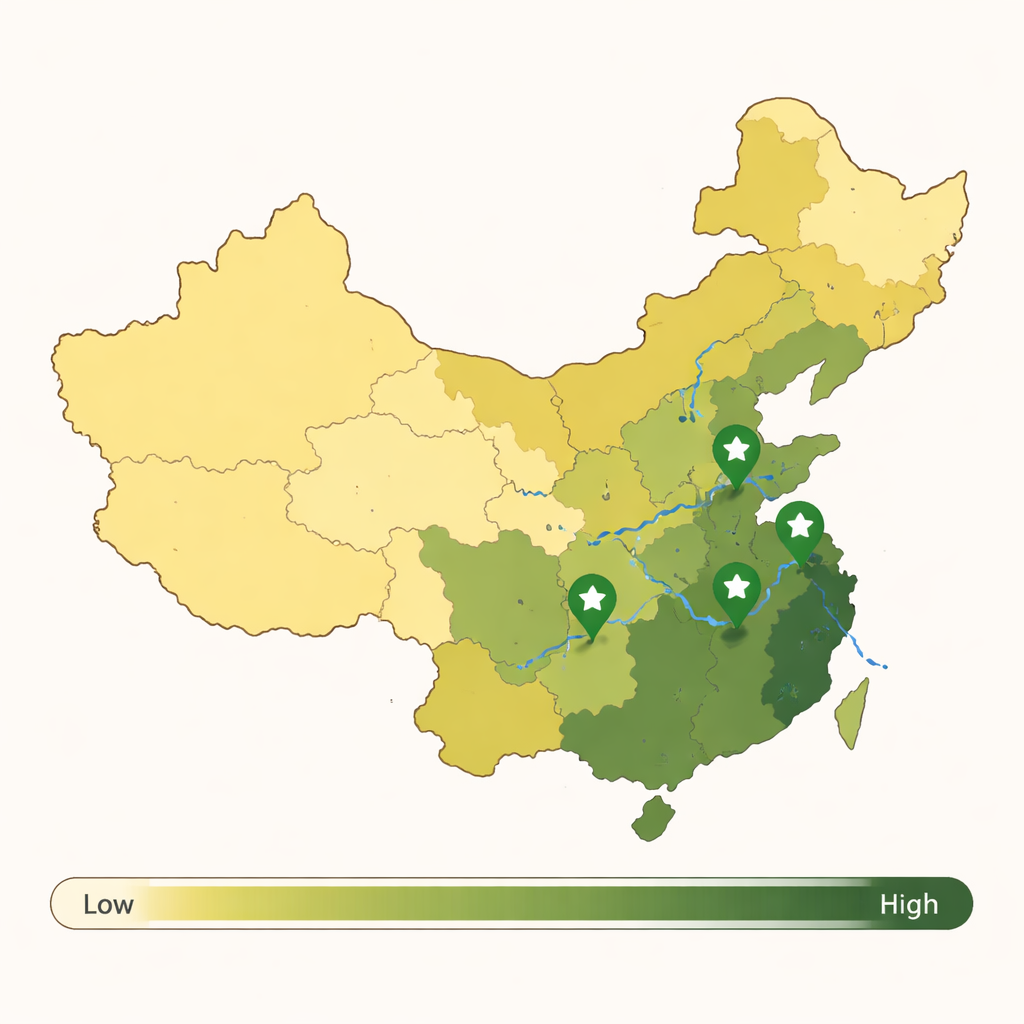
Looking across China’s map, the study finds big differences. Provinces in the middle and lower reaches of the Yangtze River and parts of the Yellow River Basin form “high‑high” clusters, where strong digital development, cleaner farming, and better rural living conditions reinforce one another and spill over to neighbors. Jiangsu, Shandong, and Sichuan stand out as leaders, having reached a mid‑level of coordination. In contrast, several northwestern and northeastern provinces remain in “low‑low” clusters, where all three areas trail and progress is slow. Overall gaps between regions are shrinking, but most of the remaining inequality comes from differences within major regions such as the Yangtze River Economic Belt rather than between broad regions.
What This Means for Farmers’ Lives
For ordinary villagers, the message is that digital tools, greener farming, and better living conditions are not separate agendas: they work best together. When governments invest in rural internet, e‑commerce, and smart farm equipment at the same time as cutting pollution and improving water, health, and education, farmers are more likely to earn higher incomes, live in cleaner surroundings, and feel more satisfied with life. The study concludes that China is moving in this direction, but that lagging provinces need extra support and smarter regional cooperation so that the benefits of a digital, green countryside are shared more evenly across the country.
Citation: Xiong, C., Zhou, X. & Liu, F. Evaluation of the coupled coordination of digital village, green agriculture and farmers’ well-being in China. Sci Rep 16, 5079 (2026). https://doi.org/10.1038/s41598-026-35293-z
Keywords: digital villages, green agriculture, rural well-being, China rural development, spatial disparities