Clear Sky Science · en
Secure, scalable, and interoperable healthcare data exchange using layer-2 ZK-rollups, smart contracts, and IPFS
Why your medical data needs a better highway
Every visit to a doctor, scan in a hospital, or claim to an insurer creates digital traces about your health. Today those records are scattered across many computer systems that often cannot talk to one another, and moving them safely can be slow, expensive, and insecure. This paper explores a new "data highway" for healthcare that borrows ideas from cryptocurrency blockchains to let hospitals, patients, and insurers share information quickly, cheaply, and with strong privacy protections.
From fragile files to tamper‑proof records
Traditional healthcare IT works a bit like a set of locked filing cabinets owned by different organizations. Each hospital or clinic maintains its own database, and exchanging records requires point‑to‑point connections or manual transfers. That makes it hard to see a full medical history, increases the risk of data leaks, and leaves patients with little control. Blockchains promise a shared, tamper‑proof log of actions: once information is written, it cannot be secretly altered. But the early, “Layer‑1” blockchains such as Bitcoin and basic versions of Ethereum are too slow and costly to handle the huge number of real‑time events that modern healthcare produces, from continuous monitoring devices to frequent insurance checks.
Stacking layers for speed and security
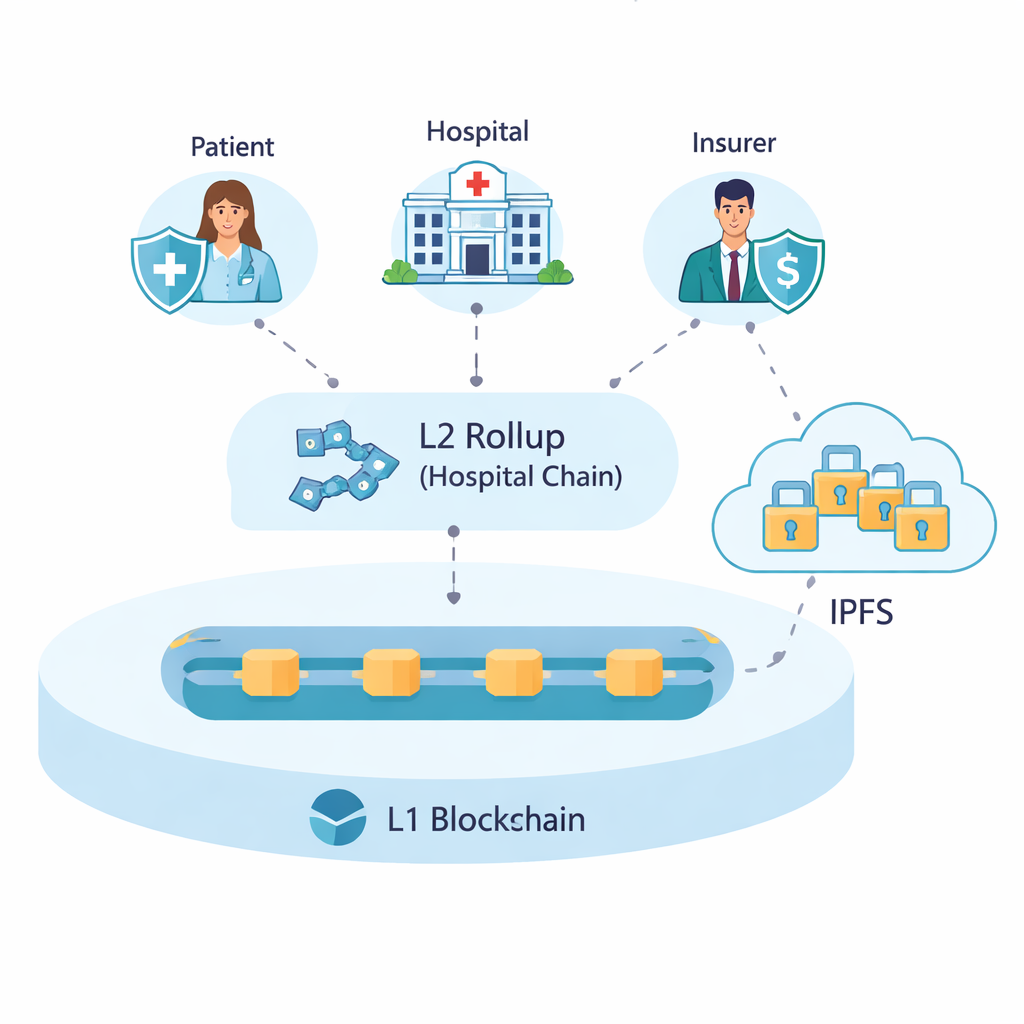
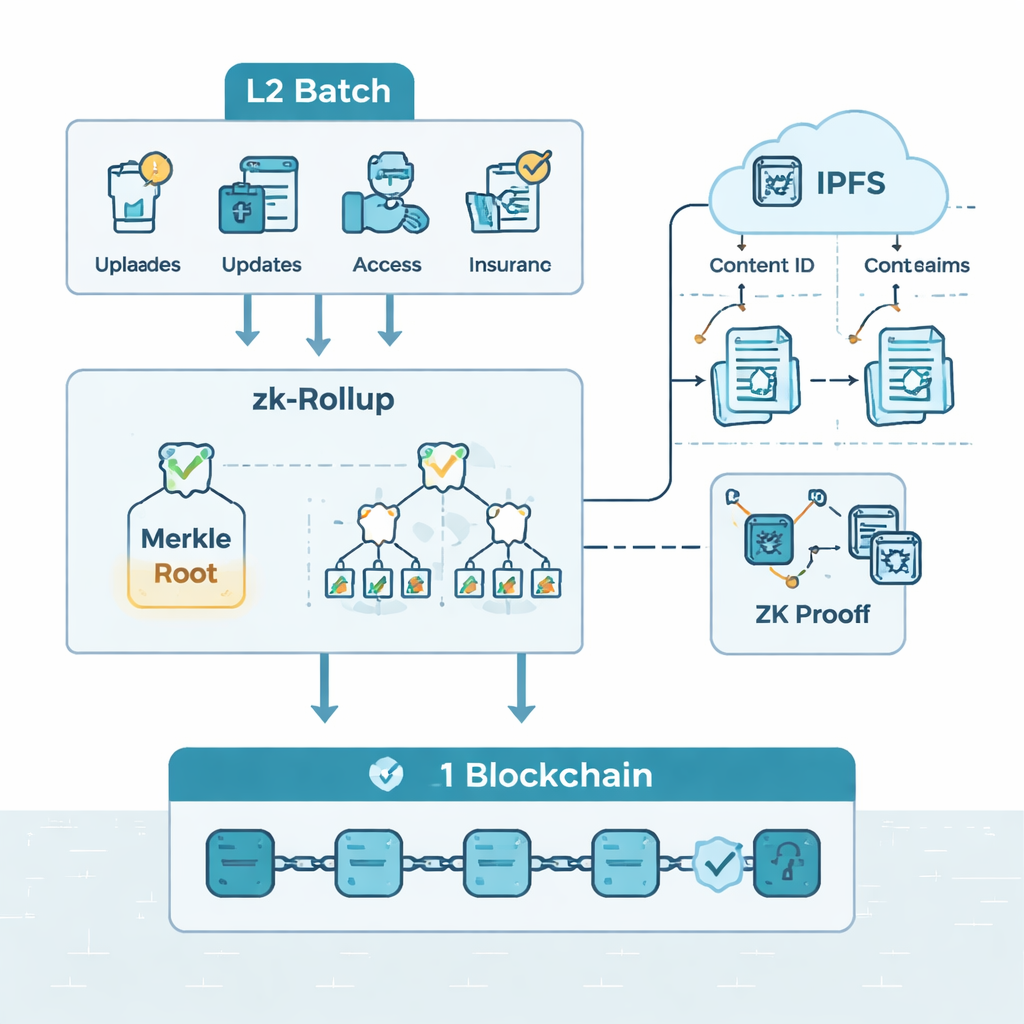
The authors propose a layered design that keeps the security of a base blockchain while moving most work to a faster upper layer. At the bottom sits a standard proof‑of‑stake blockchain (similar to Ethereum) that acts like a notary: it confirms the final outcome of batches of transactions and preserves them for the long term. Above it, a "Layer‑2" rollup network, run by trusted healthcare organizations, processes day‑to‑day activity: creating new records, updating them, granting access, and settling insurance‑related actions. Instead of sending each small step to the base chain, the rollup bundles thousands of operations together, computes a compact summary of how the shared state has changed, and submits only that summary for permanent recording.
Keeping data off-chain but still verifiable
A key challenge is that real medical files are large, sensitive, and sometimes must be corrected or deleted—things that do not fit well with the permanent nature of blockchains. To solve this, the system stores the actual health records in IPFS, a distributed file system that identifies files by cryptographic fingerprints rather than by location. Before leaving a patient’s device or a hospital system, each file is encrypted; only its fingerprint, plus information about who may access it, is referenced on the Layer‑2 network. An index file per patient tracks all versions of their records, and only the current index fingerprint is anchored on-chain. This design lets institutions confirm that they are all talking about the same data without ever exposing the content itself.
Mathematical checks instead of blind trust
To make sure no one can cheat when bundling transactions, the rollup uses zero‑knowledge proofs, a cryptographic technique that lets a computer prove it followed the rules without revealing the underlying data. Each batch of healthcare operations—such as record uploads, access requests, or claim submissions—is turned into a structured “state tree” summarizing all patient metadata and permissions. The system then produces a short mathematical proof that every signature, access decision, and state update in the batch was valid. The base blockchain verifies this proof before accepting the new state summary. If anything is wrong, the batch is rejected, so hospitals and insurers do not have to trust any single operator; they can trust the mathematics.
What the experiments show for real-world use
The researchers implemented a prototype and compared it with earlier blockchain‑based healthcare designs that either used only a base chain or simpler sidechains. In their tests, which simulated realistic mixes of patient record updates and insurance actions, the new system processed up to 10,000 transactions per second—far above the alternatives—while cutting the cost per thousand operations by around 96 percent. Latency, the time it takes for an action to be confirmed, dropped by more than half. At the same time, the architecture supports detailed audit trails, fine‑grained consent, and cross‑institution sharing without copying entire medical files.
What this could mean for patients and providers
In plain terms, the work points toward a future where your medical data can follow you securely wherever you go, without endless faxing, CD burning, or log‑in hassles. Doctors could pull up trustworthy, up‑to‑date histories in seconds; insurers could settle claims more quickly and transparently; and patients could see who accessed their data and revoke permissions when needed. While technical and regulatory hurdles remain—such as simplifying the complex cryptography and integrating with existing hospital systems—the study shows that combining layered blockchains, privacy‑preserving proofs, and off‑chain storage can make fast, low‑cost, and interoperable healthcare data exchange technically feasible.
Citation: Raghav, A., Tripathi, A.M., Wani, N.A. et al. Secure, scalable, and interoperable healthcare data exchange using layer-2 ZK-rollups, smart contracts, and IPFS. Sci Rep 16, 6132 (2026). https://doi.org/10.1038/s41598-026-35289-9
Keywords: healthcare data exchange, blockchain, zk-rollups, medical privacy, IPFS