Clear Sky Science · en
Spatial distribution characteristics and influencing factors of China’s important agricultural heritage systems
Why old farming ways still matter today
Across China, many traditional farming landscapes—rice terraces, orchards on hillsides, rice–fish paddies and more—have quietly supported local communities for centuries. This study looks at 188 of these places, officially called China’s Important Agricultural Heritage Systems (CIAHS). By mapping where they are and what shapes their survival, the authors show how climate, landforms, water, the economy, and people’s choices all work together. Their findings help explain why these living "heritage farms" are clustered in some regions, rare in others, and what is needed to protect them in an era of climate change and rapid modernization.
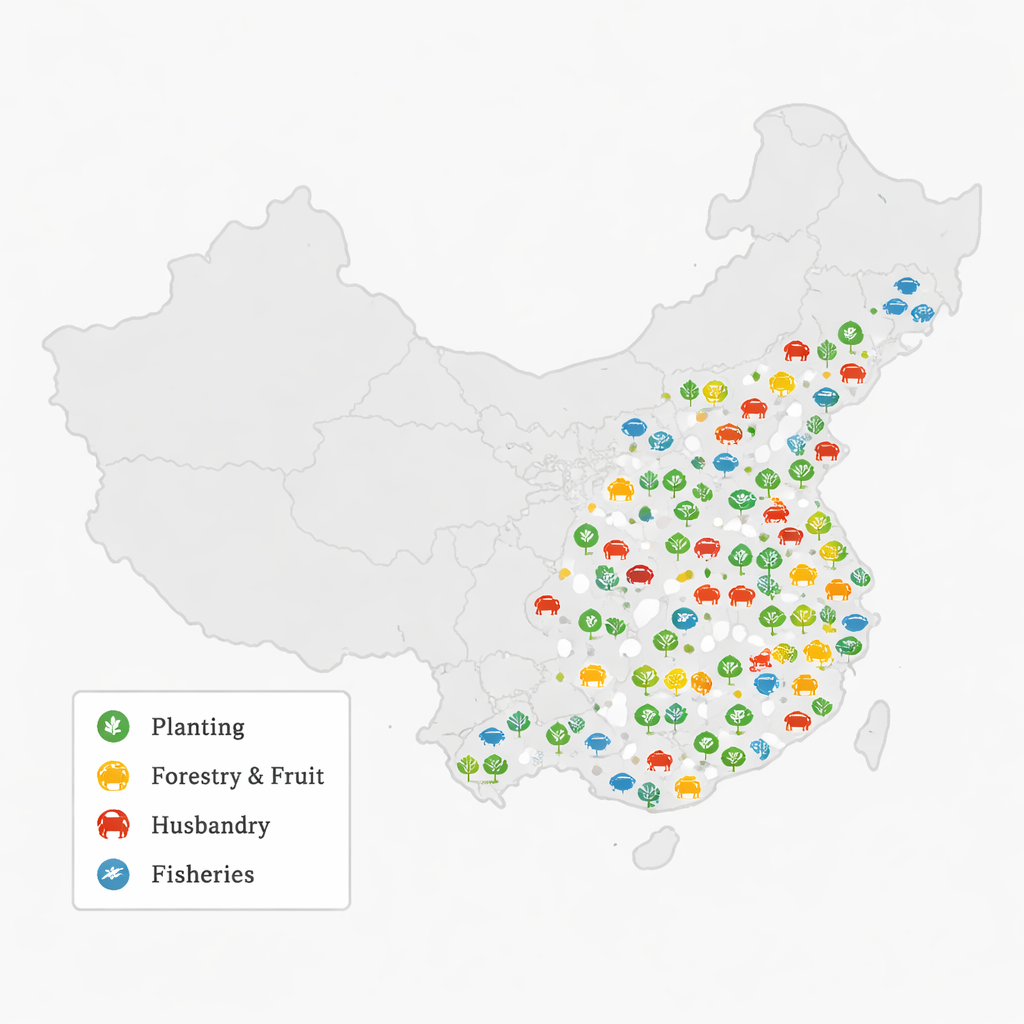
Where China’s heritage farms are found
The researchers first treated each heritage site as a point on the map and used several geographic tools to see whether they were scattered, random, or clustered. They found a clear pattern of clustering at the national scale: the sites are concentrated in eastern and southeastern China, especially along the Yangtze and Yellow River basins, and in provinces such as Zhejiang, Jiangsu, Sichuan, Hunan, Beijing and Tianjin. Within this broad pattern, different types of heritage systems—crop planting, forestry and fruit, animal husbandry, and fisheries—form slightly different clusters, but most share the same general belt running from the middle of China toward the coast.
The pull of climate, land and water
To understand why these clusters appear, the team compared each site’s surroundings with national maps of temperature, rainfall, elevation, slope and distance to rivers. Most heritage farms lie in regions with mild temperatures between about 10 and 25 degrees Celsius and moderate to high rainfall, mainly in the subtropical monsoon zone. They also tend to occupy low elevations below 1,000 meters and gentle slopes under 15 degrees, conditions that have historically favored dense settlement and stable farming. Water access proves especially critical: more than nine out of ten sites are within two kilometers of rivers or other surface water, confirming that reliable irrigation and domestic water supplies are a basic precondition for long-lasting farming cultures.
How people shape the pattern
Nature alone does not explain where heritage farms are recognized and maintained. The authors added information on economic output, population density, distance to major roads, how often local governments mention these systems in official documents, and how much attention they receive on social media and travel platforms. They found that most heritage sites lie in relatively prosperous, densely populated areas east of China’s famous Heihe–Tengchong dividing line. Crucially, government response emerged as the single strongest factor: places where provincial and local authorities actively talk about and plan for these systems are much more likely to gain official heritage status. Residents’ attention—measured through online discussions and tourism activity—also plays a powerful role, especially in coastal provinces with better connectivity and stronger heritage branding.
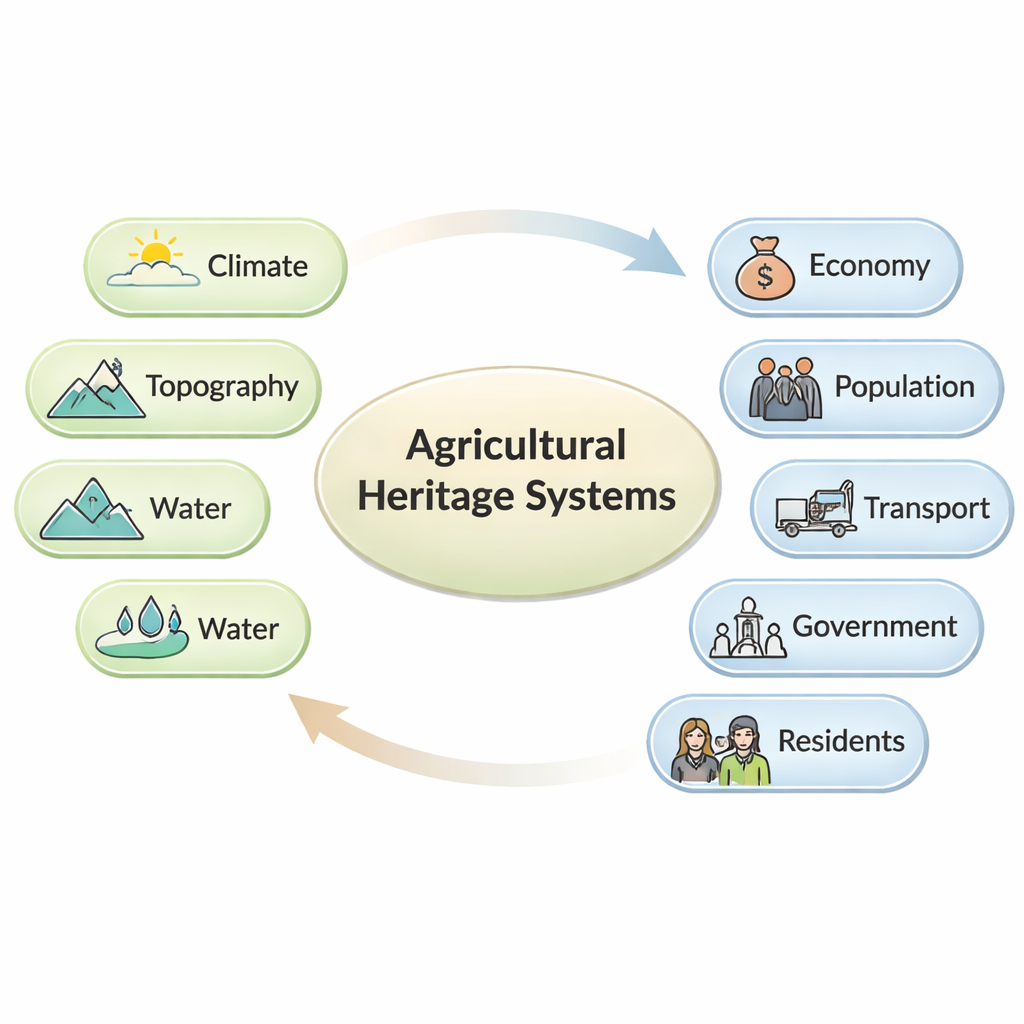
A web of forces working together
Using a method called Geodetector, the study tested how much each factor, alone and in combination, helps explain the overall pattern. Every factor examined—climate, landforms, water, economy, population, roads, government response and residents’ attention—had a statistically significant effect. Even more striking, whenever two factors were considered together, their combined influence was stronger than either on its own. For example, suitable temperatures working together with favorable elevations, or strong government support combined with high local interest, helped to explain the presence of heritage farms far better than any single driver. This suggests that these systems survive where good natural conditions and active human engagement reinforce each other.
What this means for the future of heritage farms
For non-specialists, the message is straightforward: China’s most treasured traditional farming landscapes are not randomly scattered relics, but products of a long-standing partnership between nature and society. Mild climates, gentle terrain and accessible water create the stage, while thriving local economies, roads, responsive governments and motivated residents keep the performance going. Because these sites help conserve biodiversity, sustain rural livelihoods and carry cultural memory, the authors argue that protecting them requires joined-up action—across provinces, between government and communities, and between conservation and rural development. Strengthening that web of natural and human support will be essential if these living heritage farms are to withstand climate change, urbanization and shifting values in the decades ahead.
Citation: Liu, Z., Li, Y. Spatial distribution characteristics and influencing factors of China’s important agricultural heritage systems. Sci Rep 16, 4996 (2026). https://doi.org/10.1038/s41598-026-35287-x
Keywords: agricultural heritage, rural China, traditional farming, cultural landscapes, sustainable agriculture