Clear Sky Science · en
Heat processing compromises GMO detection in soybean-enriched biscuits
Why cookie baking matters for GMO labels
Many shoppers rely on GMO labels to decide what to buy, assuming that what’s printed on the package reflects what is actually inside. But those labels are based on laboratory tests that look for fragments of DNA—tests that can be thrown off by something as simple as how long and how hot a food is baked. This study asks a surprisingly down-to-earth question with big regulatory consequences: when you bake biscuits made with genetically modified soybean flour, does the heat make the GMO so hard to detect that lab tests might miss it?
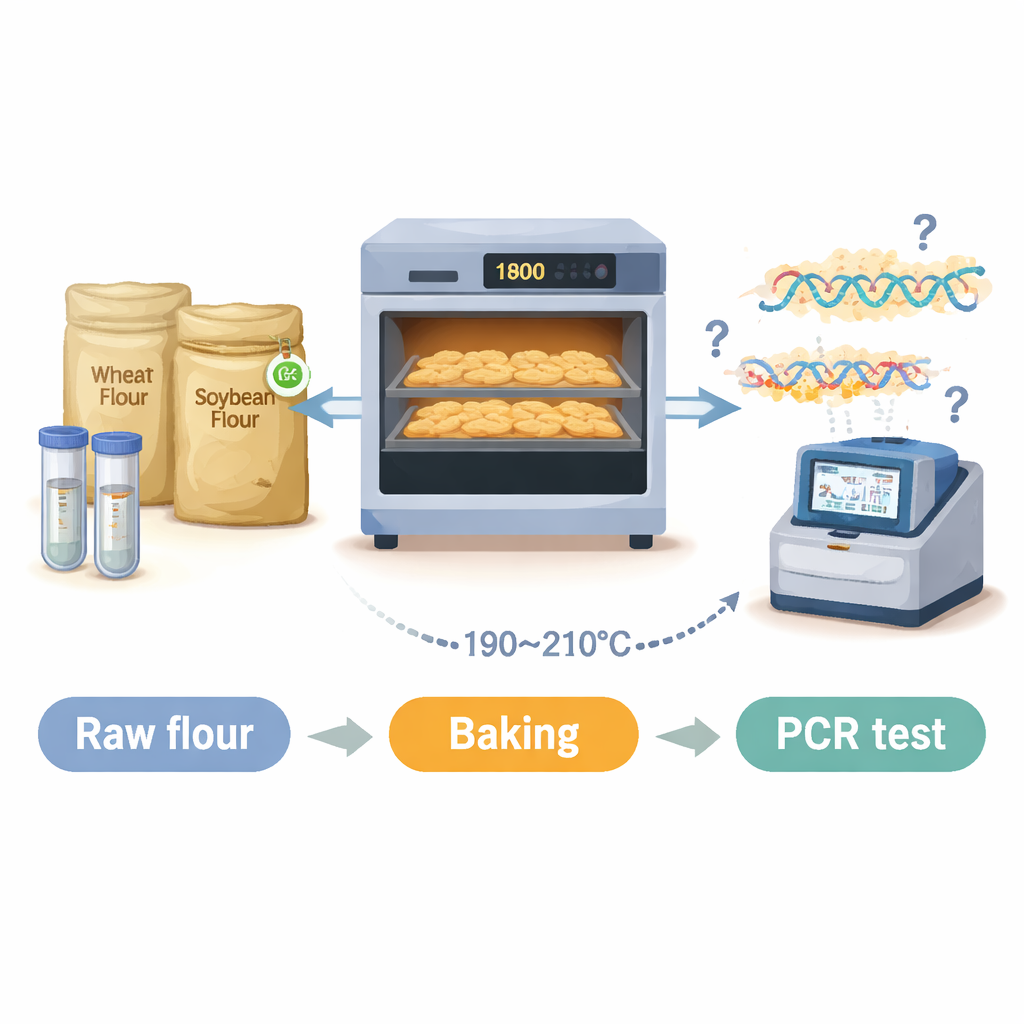
From soybean field to oven to test tube
The researchers focused on a widely grown genetically modified soybean, engineered to survive the herbicide Roundup®. They milled this soybean into flour and used it to replace part or all of the wheat flour in biscuit dough at levels ranging from tiny traces (0.1%) up to 100% soybean. The biscuits were then baked under realistic industrial conditions: 10 minutes at 190 °C, 200 °C, or 210 °C. Both the raw dough and the baked biscuits were sent through a common testing pipeline used in food control labs. First, DNA was extracted with two commercial kits. Then a real-time PCR machine looked for three specific DNA sequences: a soybean “housekeeping” gene called lectin, a common GMO control element (the CaMV 35S promoter), and the cp4 epsps gene that gives the plant its herbicide tolerance.
When heat breaks the genetic trail
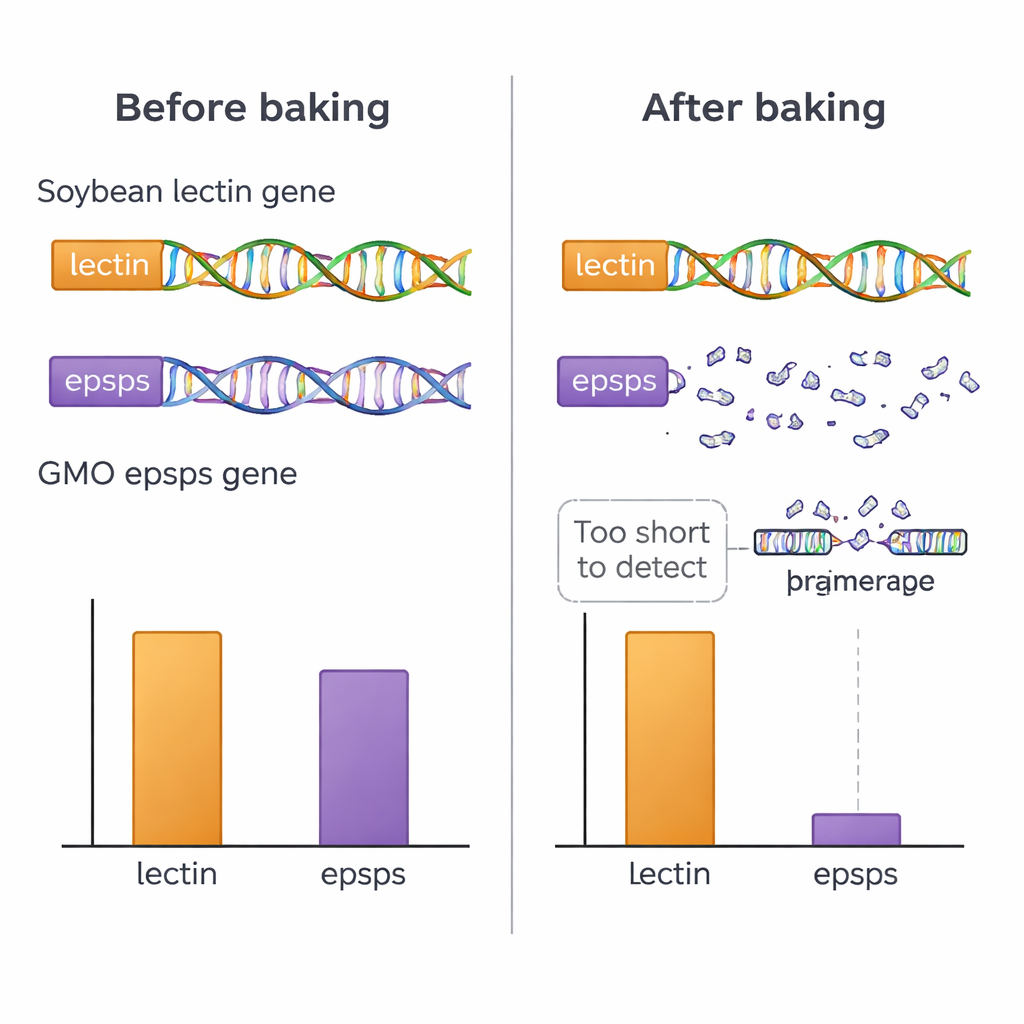
Baking turned out to be more than a culinary step; it was also a powerful DNA shredder. The team found that DNA from baked biscuits was more fragmented than DNA from raw dough, and that not all sequences broke down in the same way. The soybean lectin gene, a standard reference marker, remained relatively easy to amplify even after baking. In contrast, the GMO-linked 35S promoter and the cp4 epsps gene degraded more severely, especially at higher temperatures. This meant that the machine often had to cycle longer before detecting these GMO sequences, and in some cases they were not detected at all, even when soybean DNA was clearly present. The upshot is that spectrophotometer readings showing “good” DNA purity did not guarantee that the DNA was intact enough for reliable GMO testing.
Why the usual math starts to mislead
Modern GMO tests often rely on a comparative real-time PCR method, sometimes called ΔΔCq, which assumes that both the target (for example, the cp4 epsps transgene) and a reference gene (such as lectin) are damaged in roughly the same way during processing. Under that assumption, the ratio between the two should reflect how much GMO is in the sample. This study shows that in baked biscuits this assumption breaks down. Because the GMO gene fragments faster than the reference gene, the calculated “percent GMO” signal drops as baking temperature rises, even when the soybean flour is 100% genetically modified. Instead of measuring true GMO content, the test begins to measure how much heat damage the transgene has suffered. Around regulatory thresholds like the European Union’s 0.9% labeling limit, this bias could turn a borderline positive into an apparent negative.
Complicated recipes, complicated measurements
The biscuit itself turned out to be part of the problem. Unlike purified flour, a finished cookie is a dense, reactive mixture of sugars, proteins, and fats. High heat triggers browning reactions and cross-links between molecules that can trap or shield DNA. The authors show that such complex food matrices can make it harder for PCR enzymes to access and copy the GMO DNA, even when it is still present in tiny fragments. Automated software sometimes misread noisy signals, wrongly flagging a GMO-free control biscuit as positive until the scientists manually corrected the curves. Together, these findings underline that both the chemistry of the food and the details of data analysis can distort how much GMO the test appears to detect.
What this means for consumers and regulations
For everyday eaters, the takeaway is not that GMO labels are meaningless, but that they are harder to interpret for heavily processed foods than for raw grains or simple flours. This study shows that in baked soybean biscuits, heat can selectively damage the very DNA sequences used to prove a GMO is present, making standard math-based methods underestimate GMO levels or miss them entirely near legal cutoffs. The authors argue that the real challenge is no longer just detecting GMOs, but correctly interpreting those detections when the DNA has been battered by processing. They call for testing methods and regulatory rules that are tailored specifically to processed foods—using shorter DNA targets, better internal quality checks, and matrix-aware standards—so that labels remain both scientifically sound and trustworthy for consumers.
Citation: Hüyük, Ö., Baran Ekinci, M. Heat processing compromises GMO detection in soybean-enriched biscuits. Sci Rep 16, 6867 (2026). https://doi.org/10.1038/s41598-026-35280-4
Keywords: GMO detection, soybean biscuits, DNA degradation, thermal processing, real-time PCR