Clear Sky Science · en
Research on the mechanism of improving environmental information cognition and environmental awareness in site ecological virtual laboratory
Why a Virtual Campus Matters for the Real Planet
Climate change, extreme weather and shrinking biodiversity can feel like distant headlines rather than everyday realities for students. This study explores a new way to change that: a site‑scale ecological virtual laboratory (SEVL) built from a real university campus. Inside this digital twin, students can redesign lawns, trees and ponds, watch environmental indicators respond in real time, and in the process deepen both their understanding of nature and their sense of responsibility toward it.
From Textbook Facts to Lived Experience
Traditional environmental education often relies on lectures and written materials. These methods convey basic concepts, but they rarely show how many factors—water, air, plants, buildings and people—interact in one place. The authors argue that students need three qualities in their environmental understanding: breadth (seeing many factors at once), accuracy (grounding ideas in data) and depth (grasping underlying causes and chains of effects). Without instruments, measurements and spatial context, many learners stay at a superficial level, which is not enough to support lasting environmental ethics or informed action.
A Digital Twin of the Campus
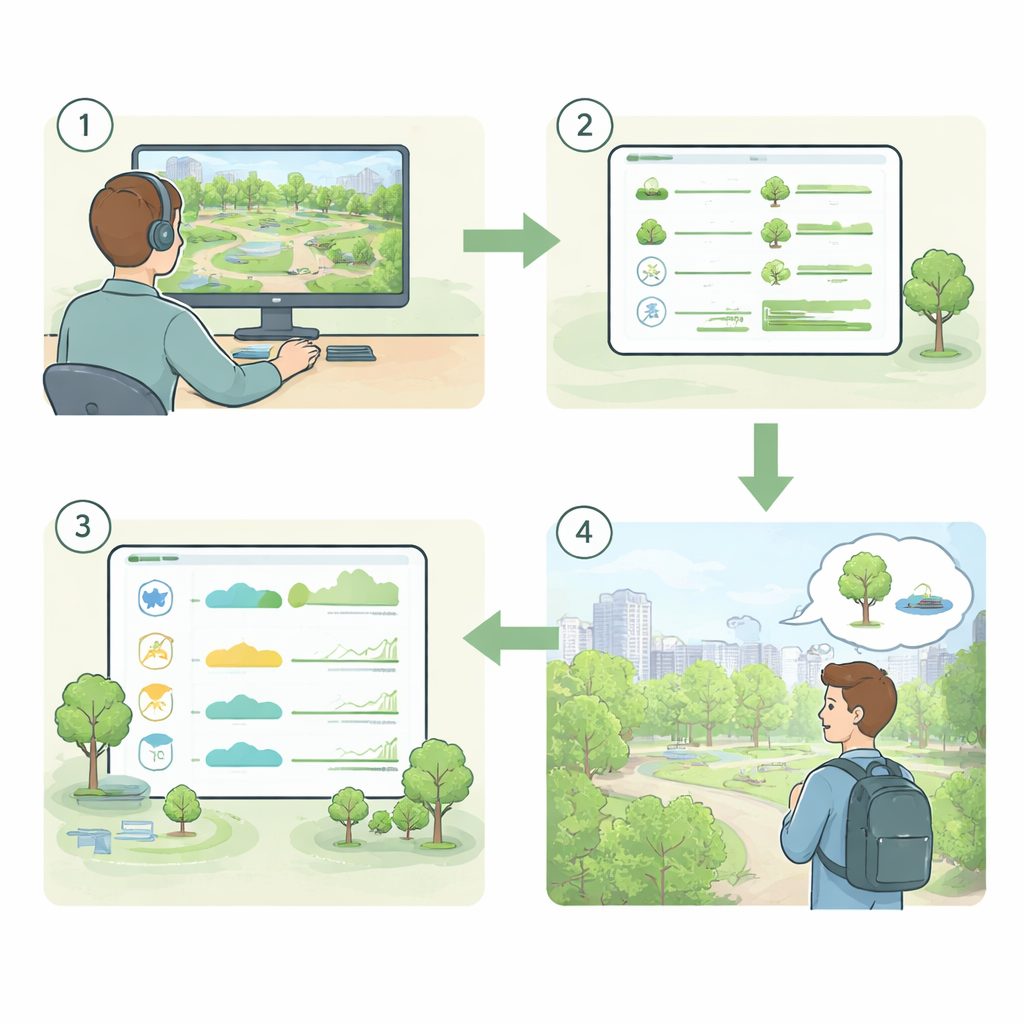
To tackle this gap, the team created the Site‑scale Ecological Virtual Laboratory. Using campus maps, aerial photographs and 3D modeling software, they built a realistic virtual landscape. They then measured real‑world features—such as vegetation, surfaces and comfort indicators—and used a machine‑learning algorithm to estimate how these elements influence ecological factors like stormwater, temperature and habitat. Students enter the SEVL on a computer, choose design goals such as stormwater management, biodiversity conservation, temperature control, air quality or noise reduction, and then adjust trees, paving and other features. The system shows changes in environmental indicators instantly, helping students move from trial‑and‑error tinkering to understanding deeper ecological relationships.
Testing the Learning Pathway
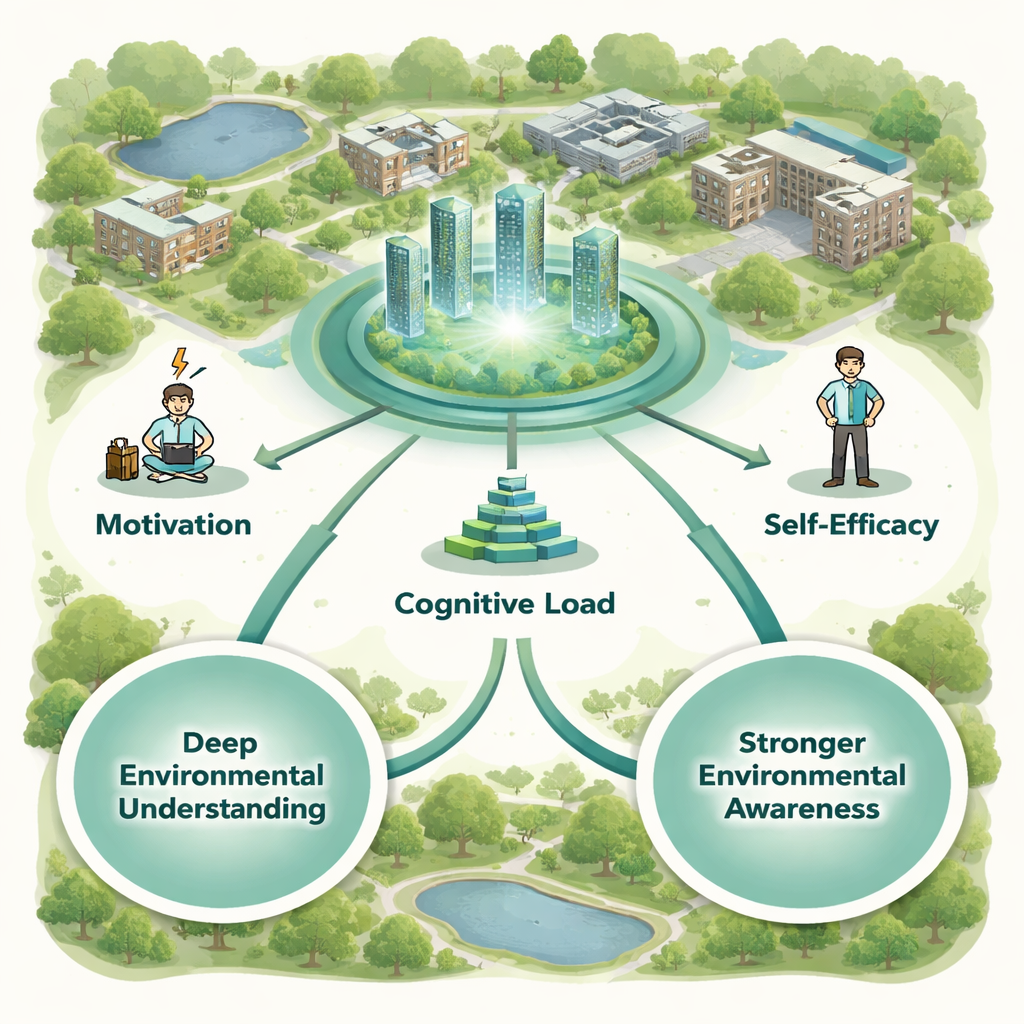
To find out whether SEVL really improves learning, the researchers drew on a game‑based learning framework. In this view, the virtual lab is the “input” that triggers an internal “process” of learning, which then leads to “output” in the form of better knowledge and attitudes. They focused on three psychological levers inside the process: learning motivation (how much students want to engage), cognitive load (how mentally demanding the task feels) and self‑efficacy (students’ belief that they can succeed). After eight weeks of preparation and training, 146 landscape architecture students carried out a two‑hour SEVL session and then completed a detailed questionnaire. Using a statistical method called partial least squares structural equation modeling, the team tested how these factors relate to each other.
How the Virtual Lab Changes Minds
The results show that the SEVL has a clear and positive effect on students’ learning experience and outcomes. First, using the virtual lab boosts students’ motivation and adjusts their cognitive load to a manageable level. Both of these, in turn, raise self‑efficacy: students feel more capable of tackling complex ecological design tasks. Higher motivation, better‑managed mental effort and stronger self‑belief all contribute to deeper understanding of environmental information. Students report that they can see more factors at once, interpret quantitative data and explain how changes ripple through the system. This deeper understanding then strongly predicts higher environmental awareness, including a sense of nature as an interconnected whole, recognition of order and process in landscapes, and appreciation of real‑world functions such as flood control or cooling.
What This Means for Future Learning
For non‑specialists, the message is straightforward: carefully designed virtual environments can do more than entertain or impress—they can rebuild how people think and feel about the environment. By allowing students to experiment safely, see immediate feedback and experience success in solving realistic problems, tools like SEVL make it easier to learn difficult concepts and easier to care about their consequences. The study concludes that when virtual labs are grounded in real places and supported by thoughtful pedagogy, they can move environmental education beyond memorizing facts toward genuine understanding and lasting environmental awareness.
Citation: Gao, W., Chen, P., Hu, S. et al. Research on the mechanism of improving environmental information cognition and environmental awareness in site ecological virtual laboratory. Sci Rep 16, 5289 (2026). https://doi.org/10.1038/s41598-026-35279-x
Keywords: virtual environmental lab, environmental education, game-based learning, environmental awareness, virtual campus