Clear Sky Science · en
Separate silicon cells from end-of-life bifacial glass photovoltaic modules using continuous lasers
Why old solar panels still matter
Solar power is spreading across rooftops and deserts worldwide, but those gleaming panels do not last forever. As the first generations of solar farms reach retirement age, millions of tons of end-of-life panels will need to be handled safely. Buried or burned, they can leak toxic substances and waste valuable metals and high‑purity silicon. This study explores a cleaner way to take apart a newer type of panel, called a bifacial glass module, using carefully tuned laser light so that the key components can be recovered and reused instead of thrown away.
What makes these solar panels different
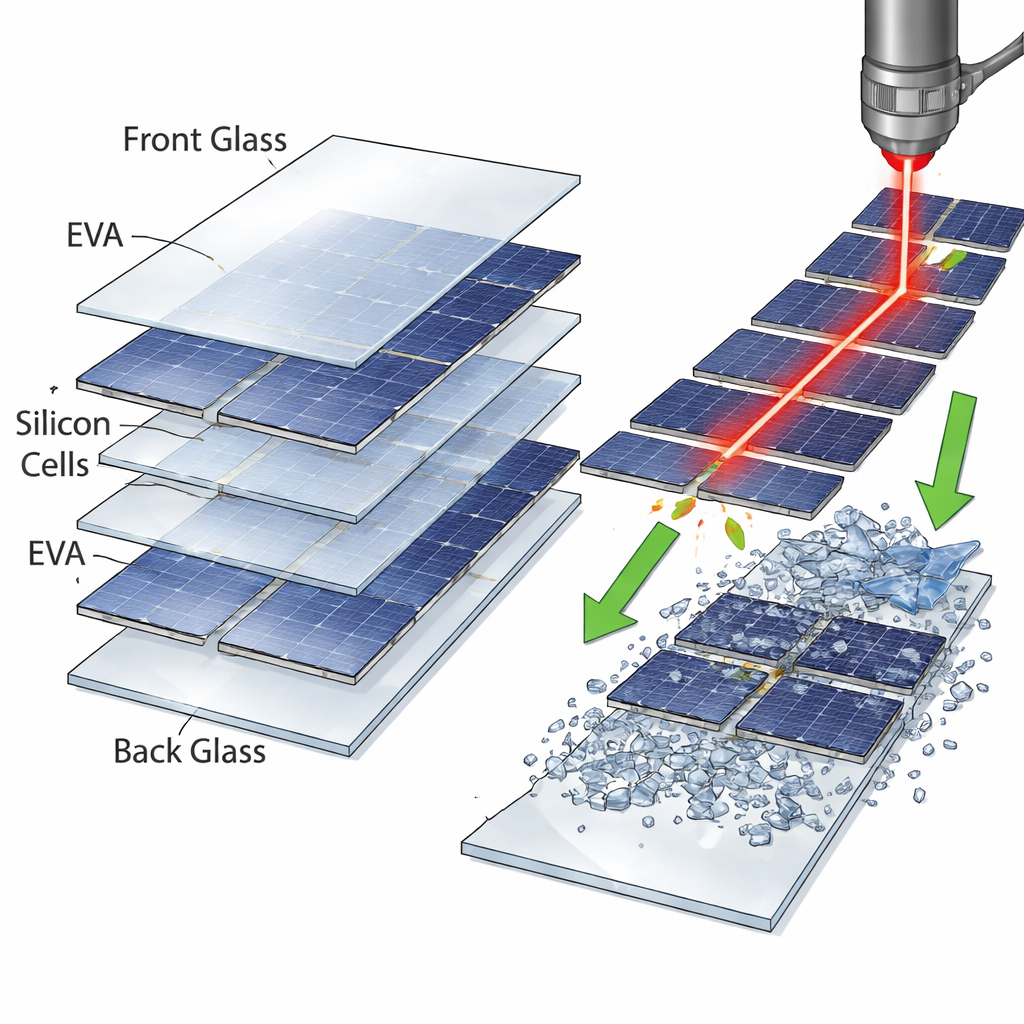
Traditional solar panels collect light from one side and usually have a plastic backing. Bifacial modules, by contrast, are made of glass on both sides and can harvest light from the front and the back, boosting electricity output. Sandwiched between the glass layers are thin silicon cells held in place by a transparent plastic called EVA, plus delicate anti‑reflection coatings that help the cells catch light more efficiently. This extra glass and coating raise manufacturing costs but lower the cost of each kilowatt-hour over the panel’s life. As bifacial designs rapidly gain market share, finding a safe, efficient way to dismantle these more complex stacks at the end of their life has become urgent.
Why current recycling routes fall short
Today, recyclers mainly rely on three routes to separate the layers inside solar panels. Thermal methods heat panels until the EVA decomposes, which works but consumes a lot of energy and can release harmful fumes that require extra treatment. Chemical methods soak panels in organic solvents that dissolve or swell the EVA; they are slow, rely on large volumes of costly chemicals, and produce contaminated liquid waste. Physical methods crush the panels and then separate the pieces by size, charge, or density, which mixes materials together and makes it hard to recover pure, high‑value products like intact silicon cells. None of these approaches is ideally suited to double‑glass bifacial modules, which are tougher to break apart cleanly.
Using laser light as a precision tool
The researchers developed a different strategy: shine a powerful but carefully controlled continuous laser through the glass and EVA so that it is absorbed mainly by the silicon cells. Because the panel has no wires connected during processing, the absorbed light turns into heat right at the cell surface. By adjusting the laser power, frequency, and “on–off” timing, the team raised the local temperature enough to weaken the bonds without burning the plastic or creating smoke. Under optimized settings (1200 W power, 2000 Hz frequency, 5% duty cycle), the laser ruptures the thin anti‑reflection coating and slightly alters a very thin layer of EVA in contact with the cell. This dual effect removes the “grip points” where EVA clings to the silicon while leaving the bulk of the plastic and glass intact.
What happens inside the panel
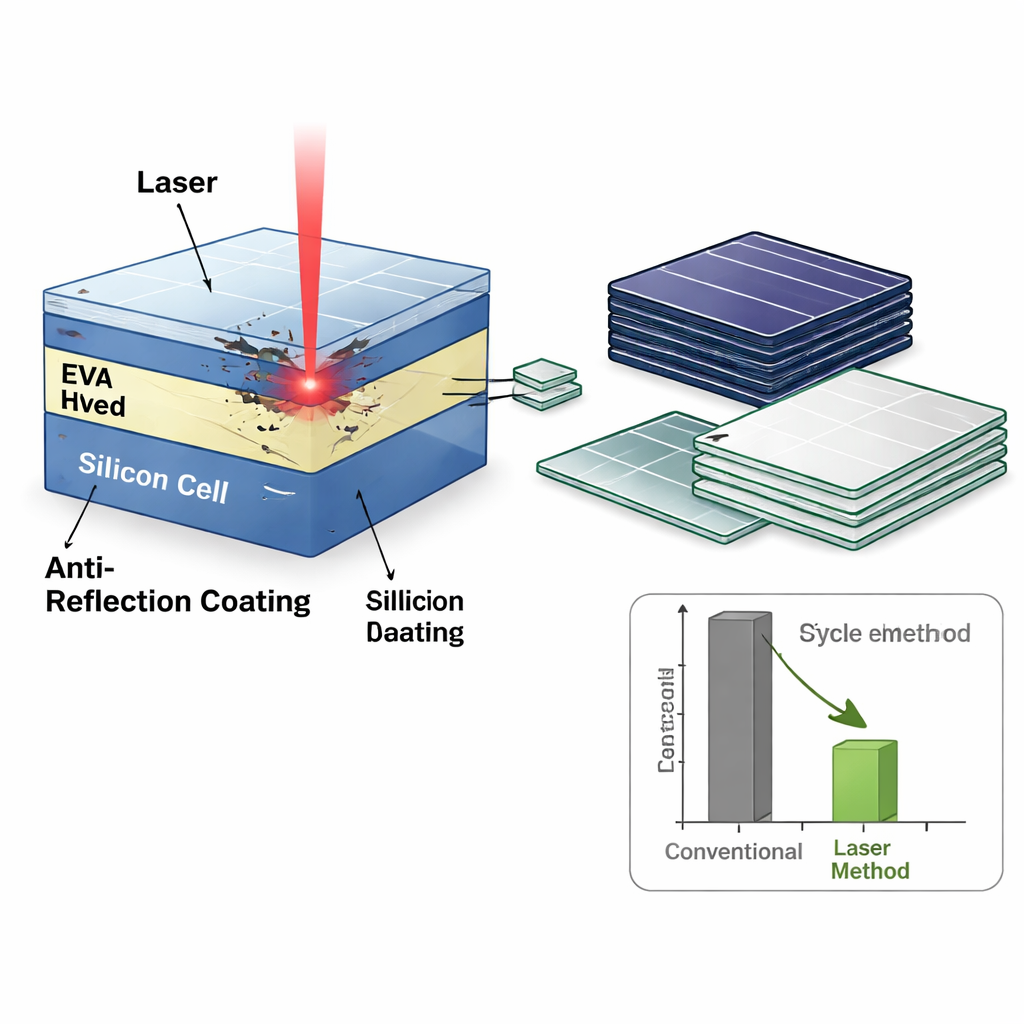
Microscope images and surface chemistry measurements showed that on the laser‑exposed side, the anti‑reflection coating made of silicon nitride is progressively destroyed and partly turned into silicon oxide. As that coating disappears, the force needed to peel EVA away from the cells drops toward zero. At the same time, tests on the EVA revealed that only a tiny interfacial layer is affected: some chemical bonds break and small molecules like acetic acid are released, briefly lowering stickiness, but the main network of the polymer remains sound. In practical terms, when the treated panel is opened, the glass and EVA on the laser side lift off cleanly, leaving virtually no residue on the silicon cells, which mostly stay attached to the opposite, untreated EVA layer as intact pieces instead of shattered fragments.
Greener recycling with room to grow
To understand the broader impact, the authors compared their laser approach with earlier chemical and thermal‑mechanical recycling schemes using a life‑cycle assessment. For processing the same mass of panel material in a lab‑scale setup, the laser method avoided the use of solvents and high‑temperature furnaces, cutting fossil fuel use and reducing emissions linked to climate change, air pollution, and toxicity. Because the process is fast and can be automated by moving a scanning head over large modules, it could be scaled up for industrial lines. The trade‑off is extra investment in laser equipment and the fact that the method only works where silicon cells are present. Overall, the study shows that smart use of light can turn old bifacial solar panels into a cleaner source of reusable silicon and glass, helping solar power remain sustainable from installation to retirement.
Citation: Zhang, C., Zhao, Z., Wang, R. et al. Separate silicon cells from end-of-life bifacial glass photovoltaic modules using continuous lasers. Sci Rep 16, 4986 (2026). https://doi.org/10.1038/s41598-026-35277-z
Keywords: solar panel recycling, bifacial photovoltaics, laser processing, silicon cell recovery, electronic waste