Clear Sky Science · en
A comprehensive study on tic additions and sliding speed effects governing wear in aluminium matrix composites
Why tougher, lighter metals matter
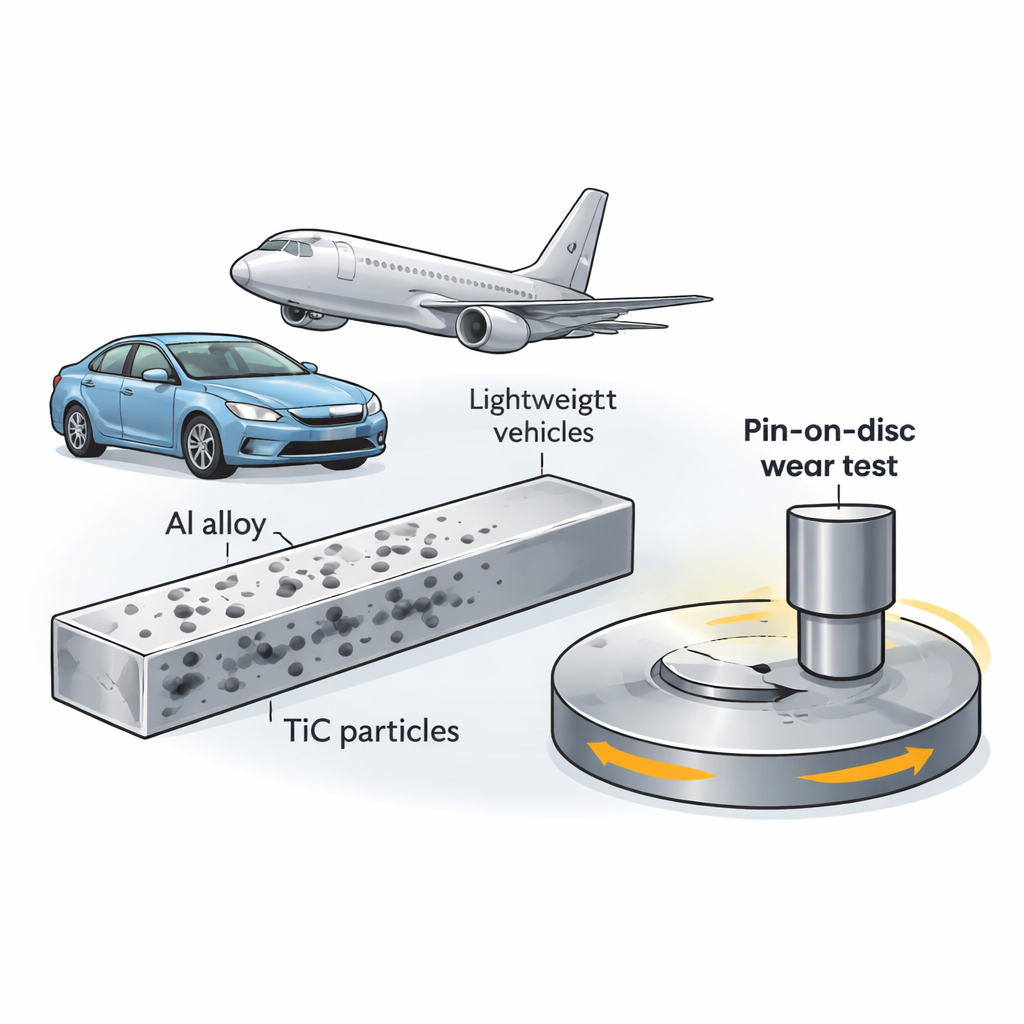
From airplanes and electric cars to factory robots, engineers constantly hunt for metals that are both light and tough. Lighter vehicles use less fuel and produce fewer emissions, but their parts still have to survive years of rubbing, bending and impact without failing. This study looks at a promising recipe: mixing tiny, ultra-hard ceramic particles into aluminium to make it stronger and more wear‑resistant, and then testing how fast-moving contact affects how quickly it wears out.
Building a metal with a ceramic backbone
The researchers focused on a common aluminium alloy called AA8011, already popular for lightweight structural parts. They reinforced it with microscopic particles of titanium carbide (TiC), a very hard ceramic often used in cutting tools. Using a process known as stir casting, they melted the aluminium and vigorously stirred in TiC powders at four levels: 0%, 3%, 6% and 9% by weight. Careful heating and stirring helped spread the particles through the molten metal before it solidified into bars that could be machined into test samples.
Checking strength, hardness and toughness
Once the composite bars were made, the team measured three key mechanical properties. First, microhardness tests, which press a tiny diamond into the surface, showed that adding TiC consistently made the alloy harder, meaning more resistant to scratching and indentation. Second, tensile tests, which pull a metal sample until it breaks, revealed that ultimate tensile strength rose from about 150 to 216 megapascals as more TiC was added, indicating the metal could carry more load before failing. Third, impact tests, which strike the material suddenly, showed that its ability to absorb shock also improved at moderate TiC levels, though too much reinforcement risks particle clustering that can create weak spots.
Putting the composite through real-world rubbing
Strength on paper is not enough; many parts in engines, brakes and machinery fail because of wear—gradual loss of material as surfaces slide against each other. To mimic these conditions, the researchers used a pin‑on‑disc machine: a small cylindrical pin of the composite was pressed against a hardened steel disc and spun at different speeds, while the force and wear were measured. They tested sliding speeds from 0.75 to 3 meters per second, under a constant load and over a fixed distance, then examined the worn surfaces under a microscope to see how the material had been damaged.
How speed and particles change wear and friction
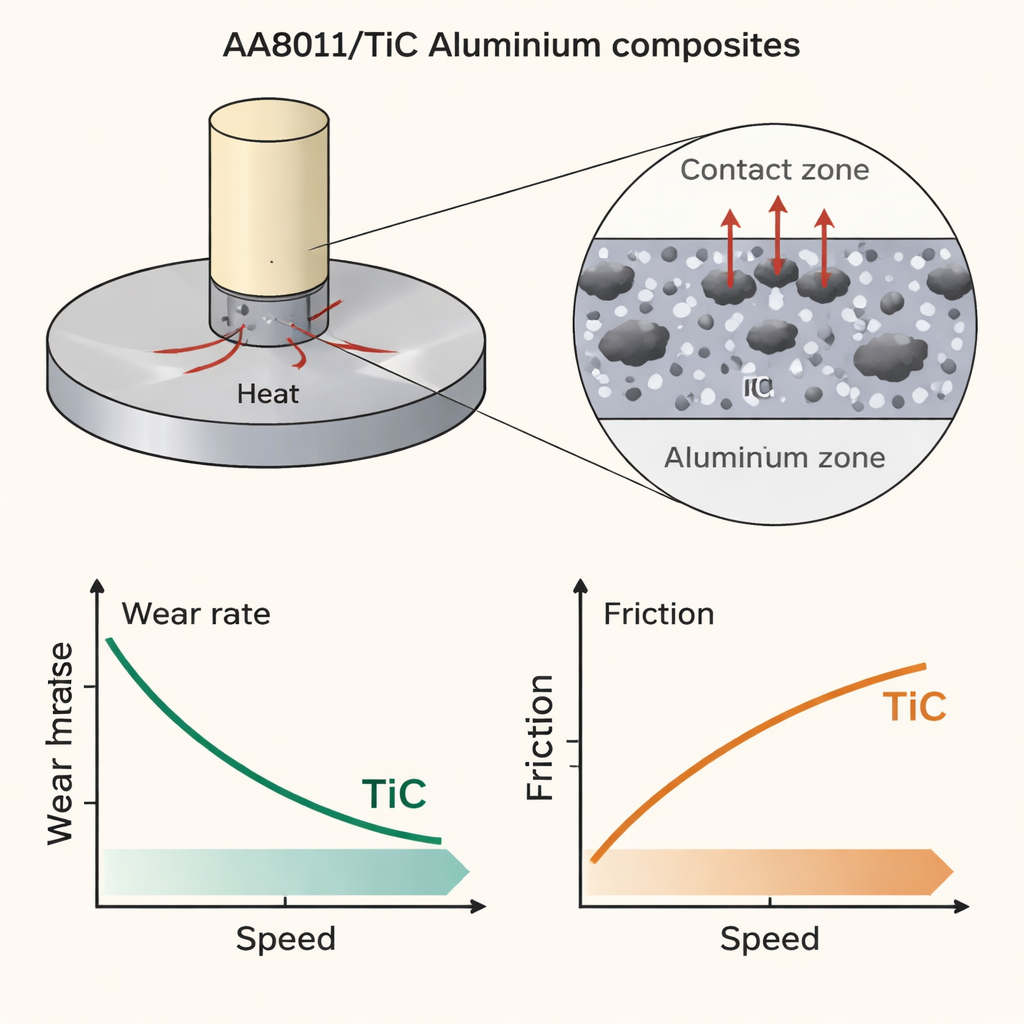
The results show a subtle balance between protection and damage. Adding more TiC generally reduced how much material was lost, especially at higher speeds, because the hard ceramic particles supported more of the load and resisted cutting and ploughing by the steel disc. At the same time, increasing speed generated more frictional heat, which softened the aluminium around the particles and promoted peeling and delamination at the surface, raising the wear rate. The coefficient of friction—the measure of how “grippy” the contact is—went up with speed, as surfaces heated and the contact layer formed and broke repeatedly. However, for any given speed, samples with more TiC tended to have a lower friction coefficient, likely because the hard particles changed how the surfaces slid past one another and limited direct metal‑to‑metal sticking.
What this means for future lightweight machines
For non‑specialists, the main message is that carefully adding ceramic particles to aluminium can create a metal that is stronger, harder and more resistant to wear, but how fast parts move and how hot they get are just as important as the recipe itself. The AA8011–TiC composites in this study performed particularly well at higher reinforcement levels, offering improved durability for components in cars, aircraft and industrial equipment that experience constant sliding contact. By tuning both the amount of TiC and the operating conditions, designers can build lighter machines that last longer, helping to save energy and reduce maintenance without sacrificing reliability.
Citation: Bhowmik, A., Packkirisamy, V., Kumar, R. et al. A comprehensive study on tic additions and sliding speed effects governing wear in aluminium matrix composites. Sci Rep 16, 4829 (2026). https://doi.org/10.1038/s41598-026-35274-2
Keywords: aluminium matrix composites, titanium carbide reinforcement, wear and friction, lightweight engineering materials, sliding speed effects