Clear Sky Science · en
Tolerance driven lightweight design and interface robustness of multi material aircraft horizontal tail structures
Why lighter, tougher tails matter
Every commercial flight burns thousands of kilograms of fuel, and a surprising amount is spent simply holding the airplane itself in the air. Shaving weight from large parts like the tail can save fuel, cut emissions, and extend range. But the tail also keeps the aircraft stable, so any redesign must be both lighter and at least as stiff and safe as today’s metal structures. This study explores a new mix of advanced materials for an aircraft’s horizontal tail and asks a practical question: how do the tiny imperfections that creep in during manufacturing affect safety and performance—and how can engineers design around them?
A smart mix of materials inside the tail
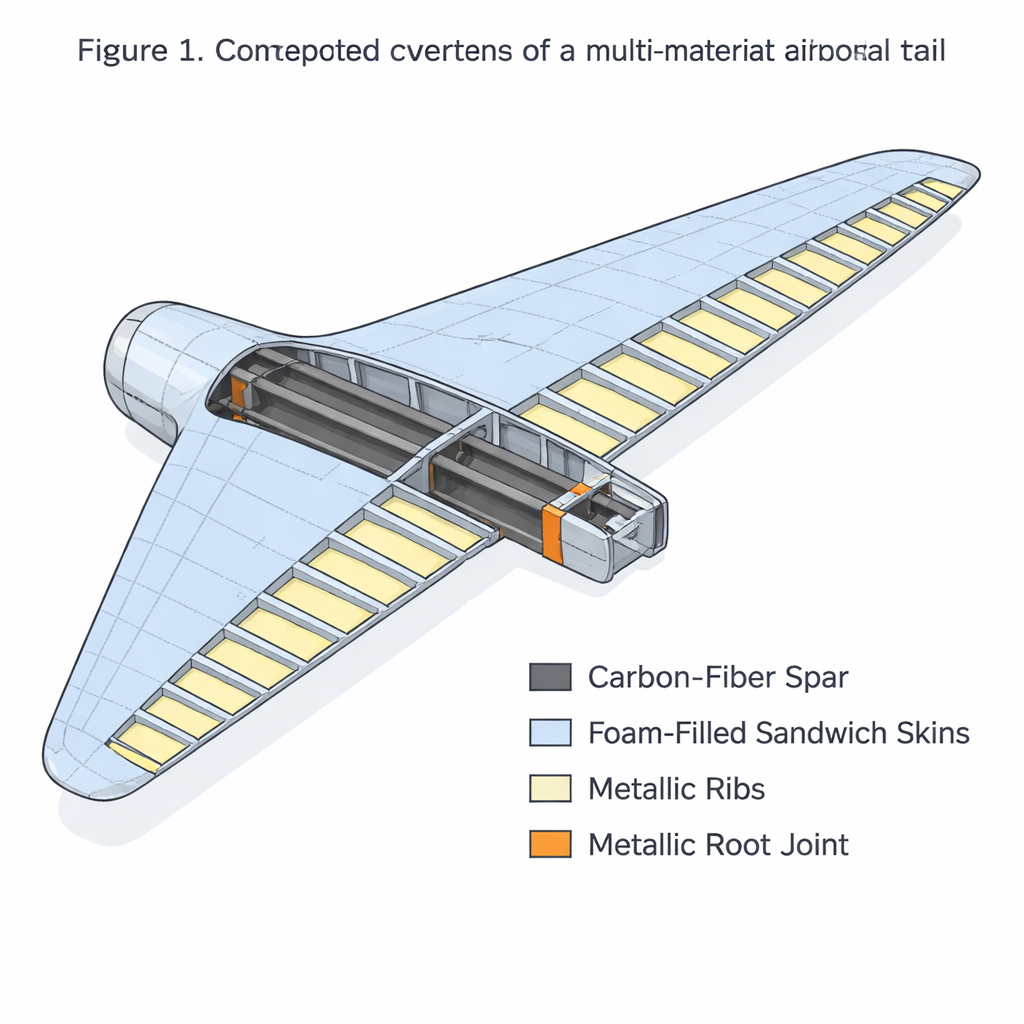
The researchers replaced a traditional all-aluminum tail with a carefully arranged combination of materials, each chosen for a different job. The main "backbone" of the tail is a carbon-fiber spar that carries most of the bending loads. The upper and lower surfaces are built as sandwich panels: thin carbon-fiber skins bonded to a lightweight foam core that adds stiffness without much mass. Aluminum ribs and joints tie these pieces together and connect the tail to the fuselage. Using a detailed 3D computer model, the team checked how this hybrid tail bends and strains under a representative aerodynamic load, making sure the tip deflection stayed below a set safety limit.
Lighter than metal, but sensitive to tiny gaps
Compared with an all-aluminum design of similar size and stiffness, the new layout cut the mass of a single tail half to about 17.8 kilograms—a 32% reduction—while still keeping the tip displacement under 200 millimeters. However, simulations also revealed that the places where materials meet are weak links. In particular, the interface between aluminum ribs and carbon-fiber skins showed high local strain, a sign that abrupt changes in stiffness can concentrate loads. Even more importantly for real-world manufacturing, the model showed that seemingly small variations—like changing the thickness of the glue layer by just two-tenths of a millimeter—could boost shear stresses at the interface by more than 20%.
How manufacturing variation ripples through the structure
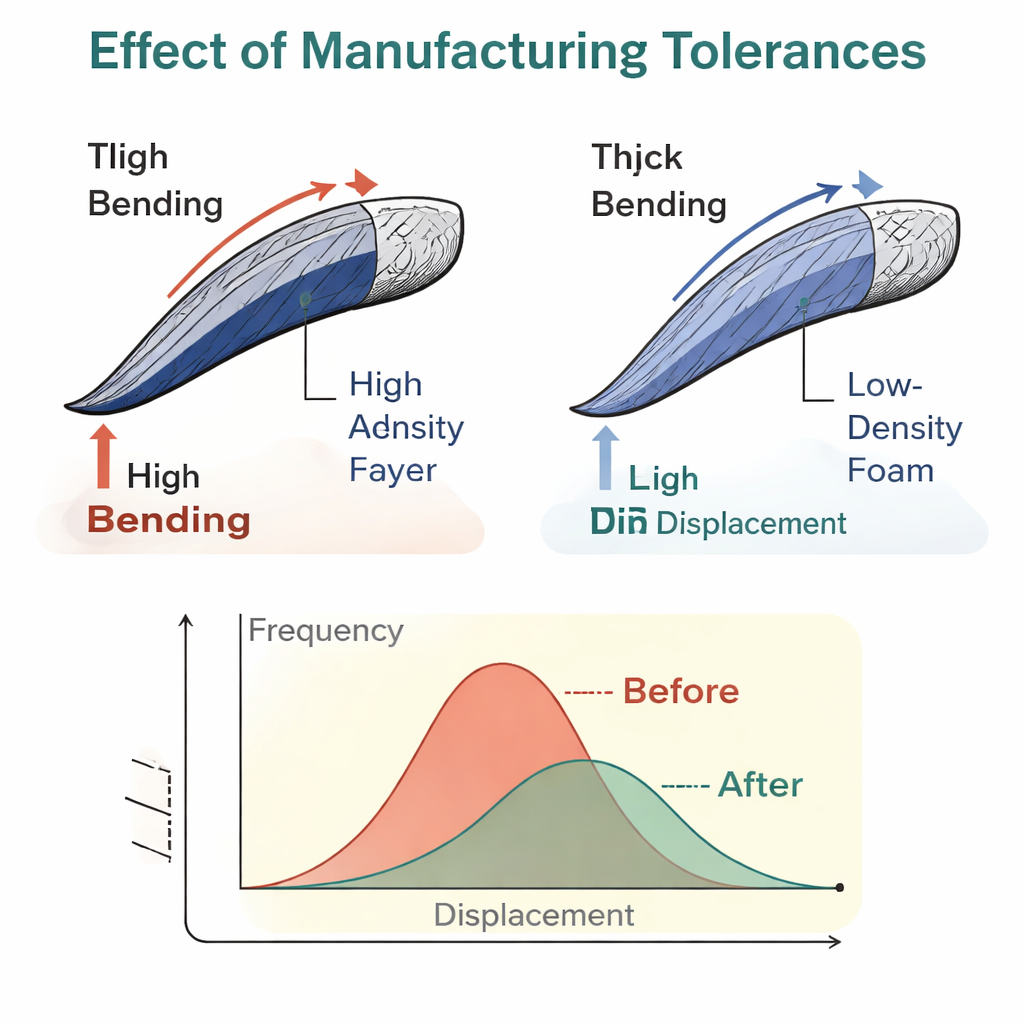
To move beyond one-off calculations, the team treated key manufacturing details as uncertain rather than fixed. They focused on two that are hard to control perfectly in a factory: the thickness of the adhesive layer that bonds parts together and the density of the foam core. By running hundreds of simulations with these inputs randomly varied within realistic tolerance bands, they built up statistical distributions of outcomes such as tip displacement and peak strain. A global sensitivity study showed that variability in adhesive thickness dominated, explaining about two-thirds of the spread in overall displacement, while foam density had a smaller but still noticeable effect, especially on local crushing of the core.
Designing for steadier performance, not just low weight
Armed with this information, the authors shifted from simply minimizing weight to designing for robustness: a structure that performs consistently even when the factory cannot hit every target exactly. They adjusted skin thickness locally, refined the layup of carbon-fiber plies near the joints, and set more precise targets for glue thickness. Using a combined objective that penalized both average displacement and its variability, they found a design that slightly increased mass by about 7% but cut the scatter in tip displacement in half. In other words, most real tails built to this recipe would cluster much more tightly around the desired behavior, with a very low chance of exceeding strain or deflection limits.
Putting the model to the test
To check whether their simulations reflected reality, the team built scaled prototype tails using the proposed material mix and manufacturing processes. They deliberately introduced controlled variations in glue thickness and foam properties, then loaded the prototypes while measuring strain and deflection with strain gauges and laser sensors. Initial differences between measured and predicted responses were traced to subtle gradients in foam density along the span—something not captured in a simple uniform model. After updating the computer model to include these measured density variations and a more detailed representation of the adhesive, the match improved strongly, with a coefficient of determination (R²) of about 0.96 between simulated and experimental load–displacement curves.
What this means for future aircraft
For non-specialists, the key message is that making aircraft tails lighter is not just a matter of swapping in exotic materials. Small, unavoidable variations in glue thickness or foam quality can significantly change how a structure bends and where stresses build up. This work shows that by combining advanced simulations, statistical analysis, and real-world tests, engineers can anticipate those variations and design tails that are both substantially lighter and reliably stiff. The approach could guide future multi-material aircraft components, helping airlines save fuel and reduce emissions without compromising safety, provided that the methods are confirmed at full scale and with other material combinations.
Citation: Lin, M., Wang, B. & Lin, C. Tolerance driven lightweight design and interface robustness of multi material aircraft horizontal tail structures. Sci Rep 16, 4836 (2026). https://doi.org/10.1038/s41598-026-35265-3
Keywords: aircraft tail design, composite materials, lightweight structures, manufacturing tolerances, structural reliability