Clear Sky Science · en
Investigating property-porosity relationships for micro-architected lattice structures
Building Strong, Lightweight Materials
From aircraft parts to artificial hips, engineers increasingly rely on materials that are mostly empty space yet surprisingly strong. This article explores how a popular class of 3D "lattices"—intricate internal architectures produced by metal 3D printing—actually carry load as their porosity changes. Understanding this hidden structure–strength link can help designers create safer medical implants, lighter vehicles, and more efficient energy absorbers without exhaustively testing every possible design.
Why Holes Can Make Metals Better
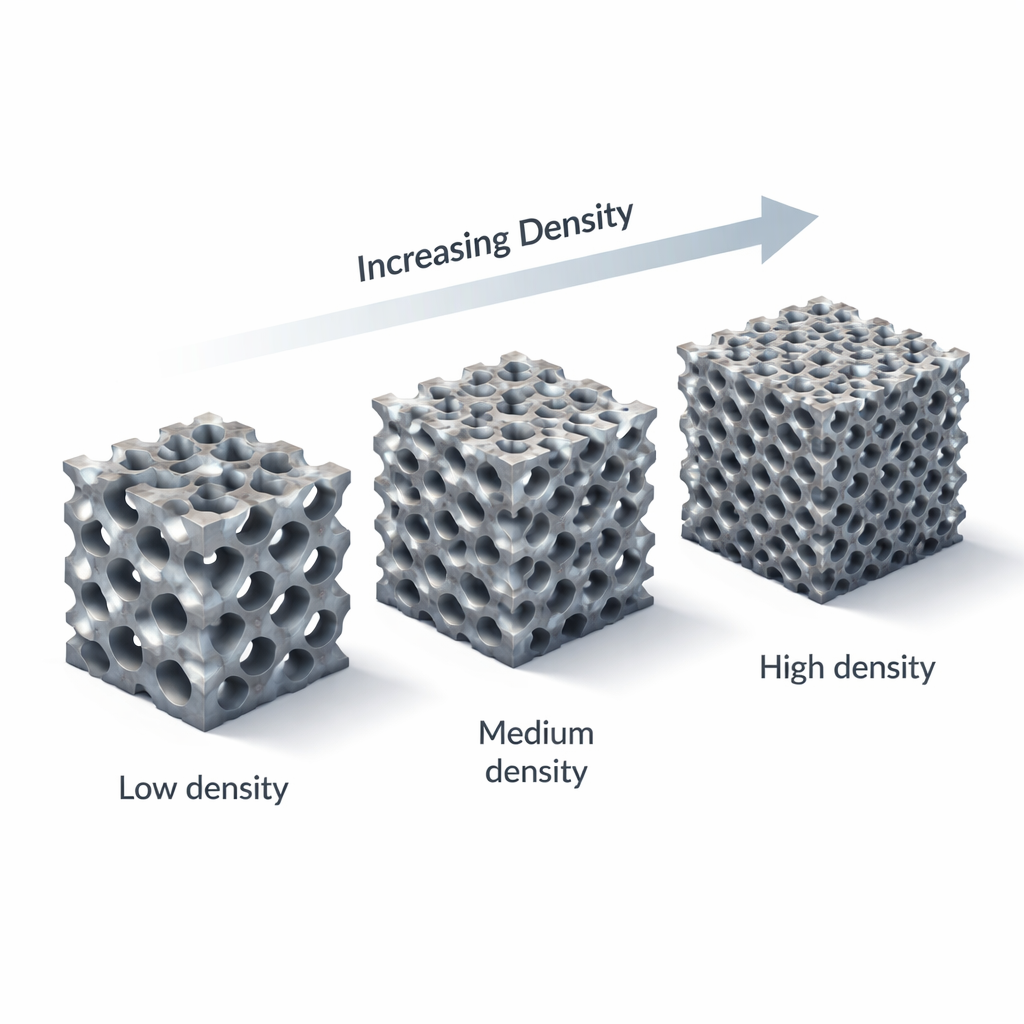
Modern metal 3D printers can build parts that are not solid, but instead filled with repeating internal patterns, much like a microscopic scaffolding. One especially promising pattern is the gyroid, a smoothly wavy, maze-like surface that repeats in all directions. By thickening or thinning the gyroid’s walls, engineers can tune the "relative density"—how much of the volume is solid metal versus empty space. Low relative density means a foamy, lightweight structure; high relative density approaches a nearly solid block. The central question of the study is how stiffness (resistance to elastic stretching) and strength (the stress at which yielding begins) change as the relative density is varied over almost the entire possible range.
Probing Gyroid Lattices in the Lab and on the Computer
The researchers 3D printed titanium alloy (Ti–6Al–4V) gyroid samples using laser powder bed fusion, a process that melts thin layers of metal powder with a scanning laser. They produced 22 different geometries, varying relative density from about 3% to 60%, wall thicknesses from hundreds to several thousand micrometers, and the number and size of repeating unit cells, while keeping the overall sample size constant. After heat treatment, they compressed the samples slowly in a test machine, measuring how stress rose with strain, when yielding began, and how the structures deformed and eventually failed. In parallel, they ran detailed finite element simulations with a high-fidelity code, using realistic models of the titanium alloy’s behavior, to extend the results to even higher densities (up to 90%) and to idealized, defect-free structures.
What Really Controls Stiffness and Strength
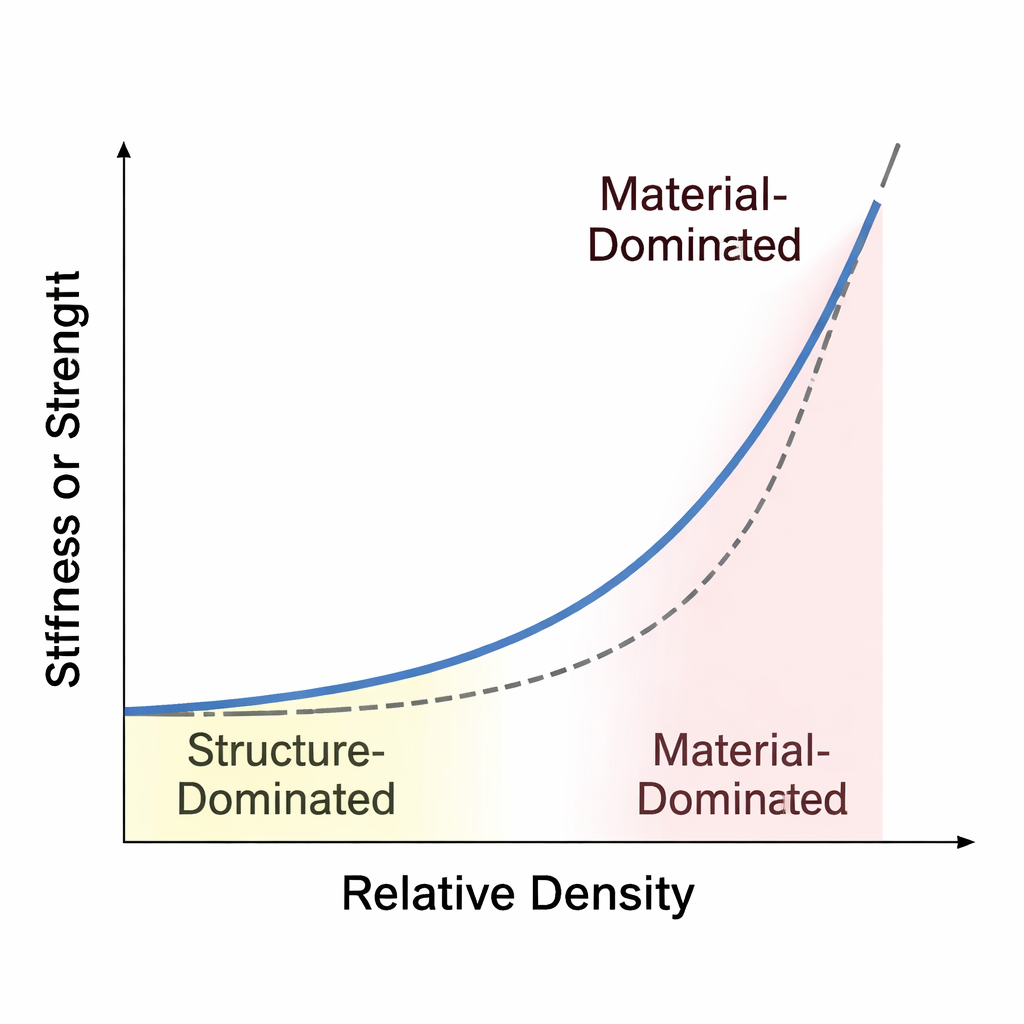
Intuitively, one might expect that wall thickness or the number of cells would each have their own distinct influence on mechanical properties. The experiments and simulations tell a different story. When the researchers plotted stiffness and yield strength directly against wall thickness, the data broke into several separate trends depending on the cell arrangement. But when they reorganized the same data in terms of relative density, all those trends collapsed into smooth single curves. This showed that, for these gyroids, relative density successfully captures the combined effect of wall thickness and cell size. However, a widely used "power-law" formula, known from Gibson and Ashby’s work on cellular solids, fit the low-to-moderate density data very well yet failed badly when extrapolated toward solid metal—it underpredicted both stiffness and strength at high density.
From Structure-Dominated to Material-Dominated Behavior
By examining both stress–strain curves and the evolving geometry as pores fill in, the authors argue that there are two distinct regimes. At low relative densities, the response is "structure-dominated": how the gyroid shape bends, buckles, and redistributes load largely determines stiffness and strength. In this regime, a simple power law can describe the scaling and even hint at whether beams are bending or stretching. At high relative densities, the picture changes. The gyroid pattern blurs into something closer to a nearly solid but slightly porous metal, so the response becomes "material-dominated"—governed mainly by the base titanium’s behavior and the small amount of remaining void space. Here, the same power law no longer applies, and the mechanical properties increase more steeply with density than the classical model allows.
A Better Way to Predict Properties
To bridge the full range from almost empty to almost solid, the team turned to a different type of equation called a property–porosity model. Instead of trying to read physical mechanisms from its parameters, this model is designed simply to match how a property changes as pores are added or removed, while correctly reaching zero stiffness at zero density and the known solid value at full density. The authors found that a model originally derived by Zhao and co-workers, based on treating pores as inclusions inside a solid, captures the entire curve for both stiffness and yield strength of gyroid lattices far better than a single power law. It also works well for another lattice type, the octet truss, suggesting broad relevance for many 3D-printed architectures.
What This Means for Real-World Design
For non-specialists, the takeaway is that you cannot safely use one simple rule to predict how "foamy" metals behave as they transition toward being solid. Gyroid and similar lattices smoothly shift from acting like delicate frameworks to behaving like slightly porous solids as their pores close, and any meaningful model must reflect that transition. The study shows that relative density is the key design knob, and that property–porosity models like Zhao’s provide a more reliable way to estimate stiffness and strength when only a limited set of tests is available. This, in turn, can speed the design of lighter, safer components in aerospace, biomedical implants, and beyond, without requiring exhaustive experimentation for every new lattice geometry.
Citation: Zimmerman, B.K., Carlton, H.D., Lind, J. et al. Investigating property-porosity relationships for micro-architected lattice structures. Sci Rep 16, 5521 (2026). https://doi.org/10.1038/s41598-026-35262-6
Keywords: lattice metamaterials, gyroid structures, relative density, additive manufacturing, porous metals