Clear Sky Science · en
Iterative localization method for multiple jammers in UAV collaborative jamming attacks
Keeping Drone Teams Safe in a Noisy Sky
As fleets of unmanned aerial vehicles (UAVs) spread into disaster response, farming, and security, they rely on fragile radio and GPS links to stay coordinated. Malicious radio “jammers” can deliberately flood the airwaves, blinding an entire swarm and forcing missions to fail. This paper tackles a practical question at the heart of UAV safety: when several hidden jammers are attacking at once, can the swarm work out where they are and how many there are, quickly and accurately enough to fight back?
Why Many Hidden Signal Blockers Are So Hard to Find
In the real world, interference rarely comes from a single, neat point. Several ground devices, hostile drones, or urban reflectors can all distort the same patch of sky, causing signal zones to overlap and blend together. That makes it extremely difficult to tease apart which parts of the disturbance belong to which jammer. Traditional methods tend to assume a known number of jammers, clean radio conditions, or lots of computing power—assumptions that break down when dozens of drones are under attack in a cluttered city or on a battlefield. The authors focus on this messy multi-jammer setting and design a method that can both count and locate multiple attackers using only what the affected drones can measure.
Using the Swarm’s Own Senses as a Clue
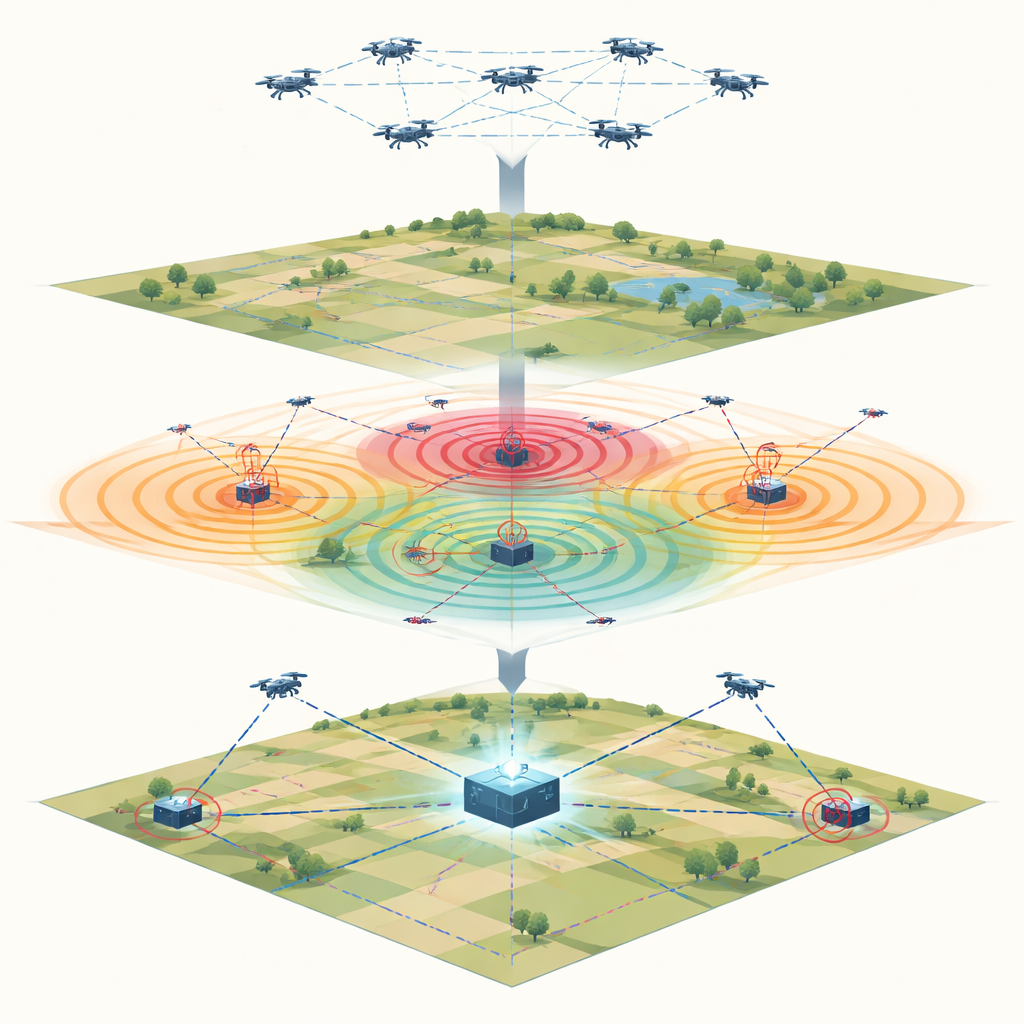
The framework begins by modeling how a UAV swarm behaves under attack. Drones are grouped into three types: those unaffected, those completely cut off, and “boundary” drones that sit on the edge of the jammed zones. These boundary drones are crucial: they can still talk to a central coordinator and report how strong the interference feels at their location. The heart of the method is an “error minimization” idea. The system guesses some jammer positions and powers, predicts what signal strength each boundary drone should see, and then compares that to what the drones actually measured. The better the guess, the smaller the mismatch. Multi-jammer localization is thus turned into a single score—how big the error is—that the algorithm tries to drive down as far as possible.
Grey Wolves as Digital Hunters
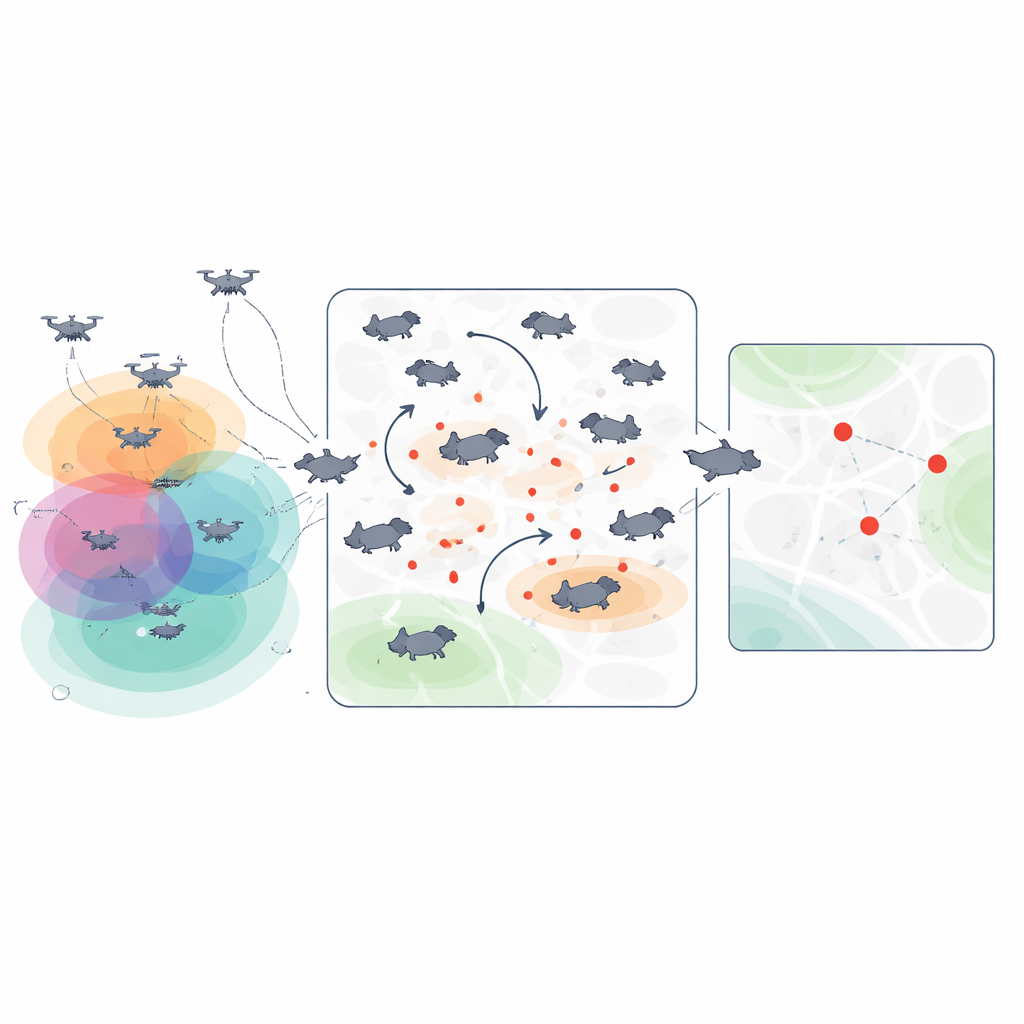
To search efficiently through all the possible jammer layouts, the authors rely on a nature-inspired technique called the Grey Wolf Optimizer. In this approach, a collection of candidate solutions behaves like a pack of hunting wolves: several “leader” candidates guide the rest toward more promising areas in the search space. The paper introduces a strengthened version, called the Multi-Strategy Improved Grey Wolf Optimizer (MSIGWO). It lets the “wolves” roam widely at first and then gradually tighten their focus using a curved, rather than straight, schedule for how quickly they close in. It also borrows ideas from evolutionary algorithms and chaos theory to gently shake the pack out of dead ends and preserve diverse, high-quality candidates instead of letting them all converge too early on a poor guess.
From Tested Algorithm to Jammer Map
Finding several jammers at once means not only pinpointing their locations but also figuring out how many there are. The proposed system tackles this by working through a series of assumptions: first it pretends there are two jammers, then three, then four, and so on up to a reasonable upper limit. For each case, MSIGWO searches for the arrangement that best explains the drones’ measurements and records the smallest error it can achieve. The case with the lowest overall error is taken as the most likely reality: it tells both how many jammers are present and where they are. Extensive computer simulations show that this combined strategy is more accurate and faster to converge than several leading alternatives, and it stays robust even when jamming zones overlap strongly or when jammers operate at different power levels.
What This Means for Future Drone Operations
The work concludes that a carefully tuned, wolf-inspired search strategy can give UAV swarms a powerful new tool: the ability to turn fragmentary, noisy signal readings into a reliable map of multiple hidden attackers. In tests, the method not only estimated jammer positions with higher precision than competing approaches, it also did a better job at correctly counting how many jammers were present. While the authors note that more realistic radio models and faster implementations are still needed for demanding real-time missions, their results suggest that tomorrow’s drone fleets could use algorithms like MSIGWO to keep flying safely even in hostile, interference-heavy skies.
Citation: Huang, L., Xiong, L., Huang, S. et al. Iterative localization method for multiple jammers in UAV collaborative jamming attacks. Sci Rep 16, 7927 (2026). https://doi.org/10.1038/s41598-026-35259-1
Keywords: UAV swarms, radio jamming, jammer localization, metaheuristic optimization, wireless security