Clear Sky Science · en
Volumetric additive manufacturing of complex geometries around complex inserts
Printing Shapes Inside Shapes
Imagine being able to grow a custom plastic structure directly around a metal tool, an electronic sensor, or a piece of bone—without gluing, screwing, or molding separate parts together. This paper explores a new 3D printing strategy that can do just that, even when both the inner object and the surrounding shell have very complicated shapes. The work shows how carefully choosing the orientation of these objects during printing can make the difference between a clean, accurate part and a failed, half-formed one.
A Different Kind of 3D Printing
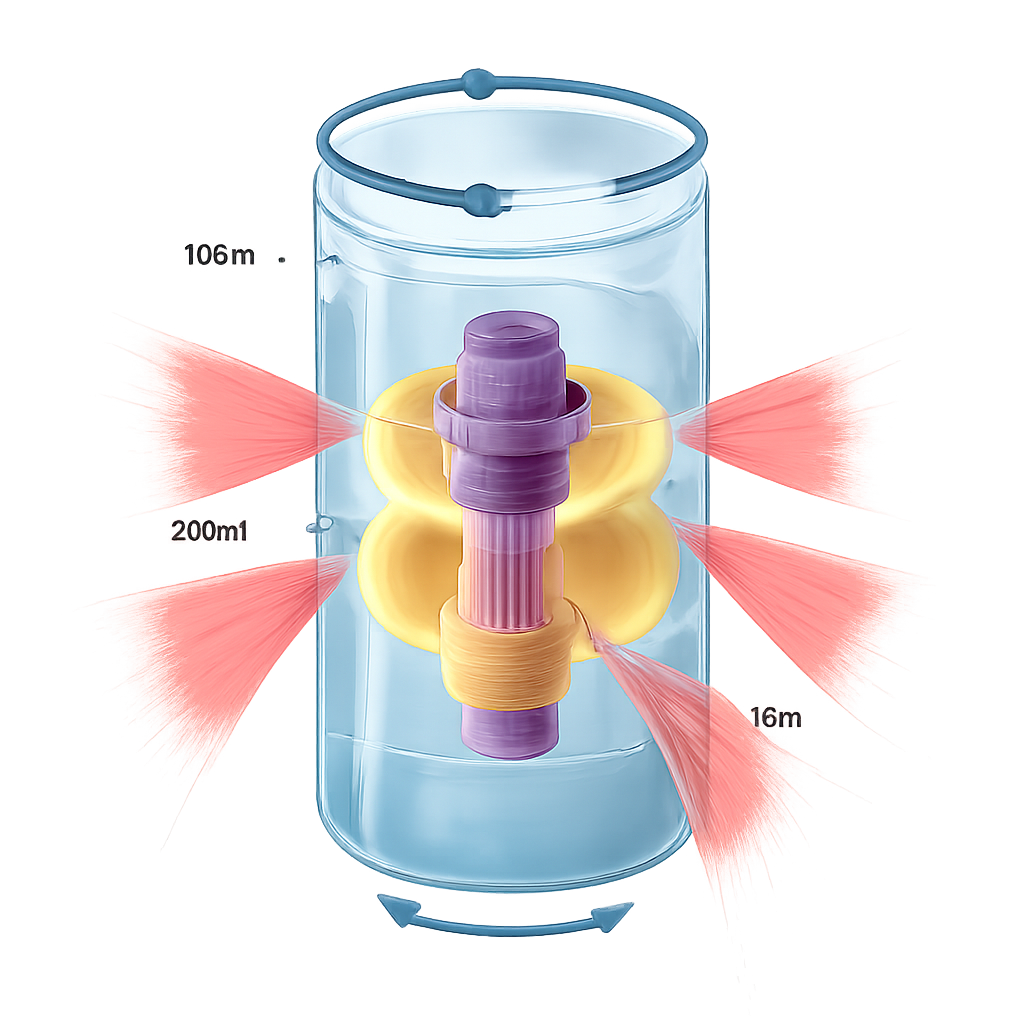
Most 3D printers build objects layer by layer, like stacking pancakes. That approach struggles when you want to print around something that is already there—an “insert”—because moving parts can crash into the insert, and light-based printers can cast shadows that stop the material from hardening in key regions. Tomographic Volumetric Additive Manufacturing (VAM) avoids these problems. Instead of drawing layers, it shines patterns of light from many directions into a rotating cylinder of liquid resin. Wherever the resin has absorbed enough light, it hardens all at once. Because there are no moving print heads inside the volume and light comes from many angles, VAM is naturally suited to printing around pre-existing inserts.
Why Shadows Matter
When an insert sits in the resin, it blocks some of the light. For simple shapes—say, a smooth metal hemisphere—our intuition is often good enough to place it in a “good” orientation where most regions still see the light they need. But for intricate inserts with twists, holes, and internal recesses, that intuition breaks down. In those cases, some parts of the desired printed shell may sit in deep shadow, never receiving enough light to harden, while other regions are accidentally overexposed and grow where they should not. The authors show that in VAM, the key factor is how many different directions each tiny volume element (a voxel) of the planned part can see the light from. More directions usually means better control over where the resin cures.
Letting the Computer Pick the Best Angle
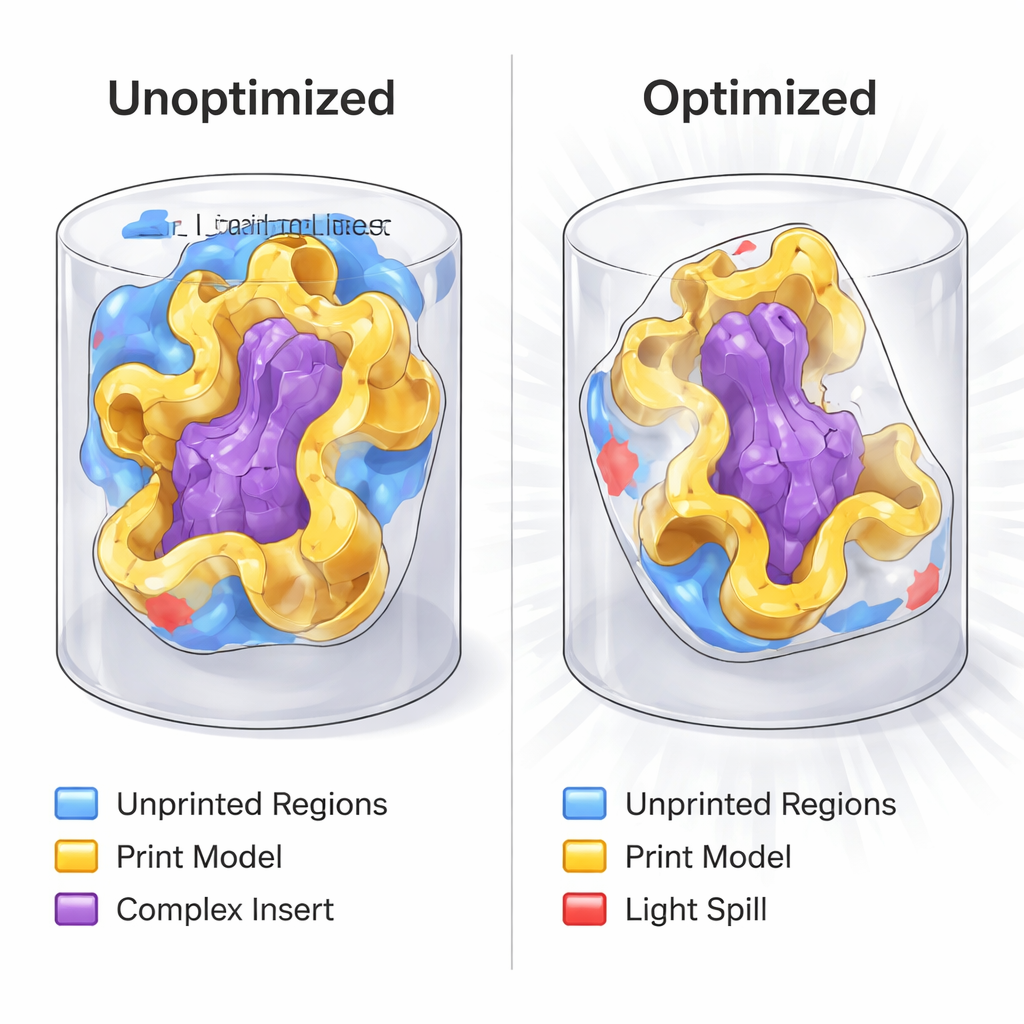
To tackle this, the researchers built four test cases combining one complex, hollow outer structure with four very different insert shapes, ranging from a simple hemisphere to a highly intricate “gyroid” lattice. They then defined a cost function that scores any given orientation by counting, for every voxel of the desired part, from how many directions it can receive light without being blocked. Orientations where many voxels see light from only a few angles are penalized; orientations where most voxels see light from many angles score better. Using an optimization algorithm called differential evolution, the computer searched through possible rotations of the insert-plus-part assembly to find orientations that minimize this cost—essentially, those that best reduce the impact of optical shadows.
From Simulation to Real Parts
The team first tested their orientation strategy in computer simulations that mimic how light travels through the resin. They compared the predicted printed shapes with the intended designs using measures of accuracy, including the Jaccard index, which quantifies how much the simulated print overlaps with the target model. For three of the four benchmarks, optimizing orientation clearly improved these scores, especially for the most complex inserts. In the next step, they built a custom VAM setup using a commercial dental resin modified to cure under blue light and actually printed the parts. Micro-CT scans—essentially tiny 3D X-rays—confirmed the simulation trends: when orientation was optimized, more of the desired structure formed correctly, fewer regions were missing, and the cured material reached deeper into the recesses of complex inserts.
What This Means for Future Devices
For a non-specialist, the main takeaway is that the authors have shown a practical recipe for “growing” complex plastic structures around equally complex inner components simply by choosing the right printing orientation. Their method does not require redesigning the printer or the insert; it instead uses software to predict where shadows will appear and rotate the assembly to minimize them. This makes it more feasible to embed electronics, mechanical parts, or biomedical scaffolds inside a protective, custom-shaped plastic body. As tomographic VAM matures, such orientation-aware printing could help engineers build stronger tools, smarter sensors, and patient-specific implants that would be difficult or impossible to make with conventional manufacturing methods.
Citation: Bagheri, A., Zakerzadeh, M.R., Sadigh, M.J. et al. Volumetric additive manufacturing of complex geometries around complex inserts. Sci Rep 16, 6522 (2026). https://doi.org/10.1038/s41598-026-35258-2
Keywords: volumetric additive manufacturing, 3D printing around inserts, light-based 3D printing, orientation optimization, embedded electronics