Clear Sky Science · en
Diagnostic significance of rhythmicity in postural hand tremor
Why shaky hands matter
Many people notice that their hands shake a little when they hold them out straight. For most, this faint tremor is harmless. But in conditions like Parkinson’s disease and essential tremor, the shaking is strong enough to interfere with everyday tasks such as drinking from a cup or writing. Doctors often judge these tremors partly by how steady and metronome‑like they look. This study asked a simple but crucial question: does the smoothness, or rhythmicity, of hand tremor really help doctors tell different tremor disorders apart?
Different kinds of shaking
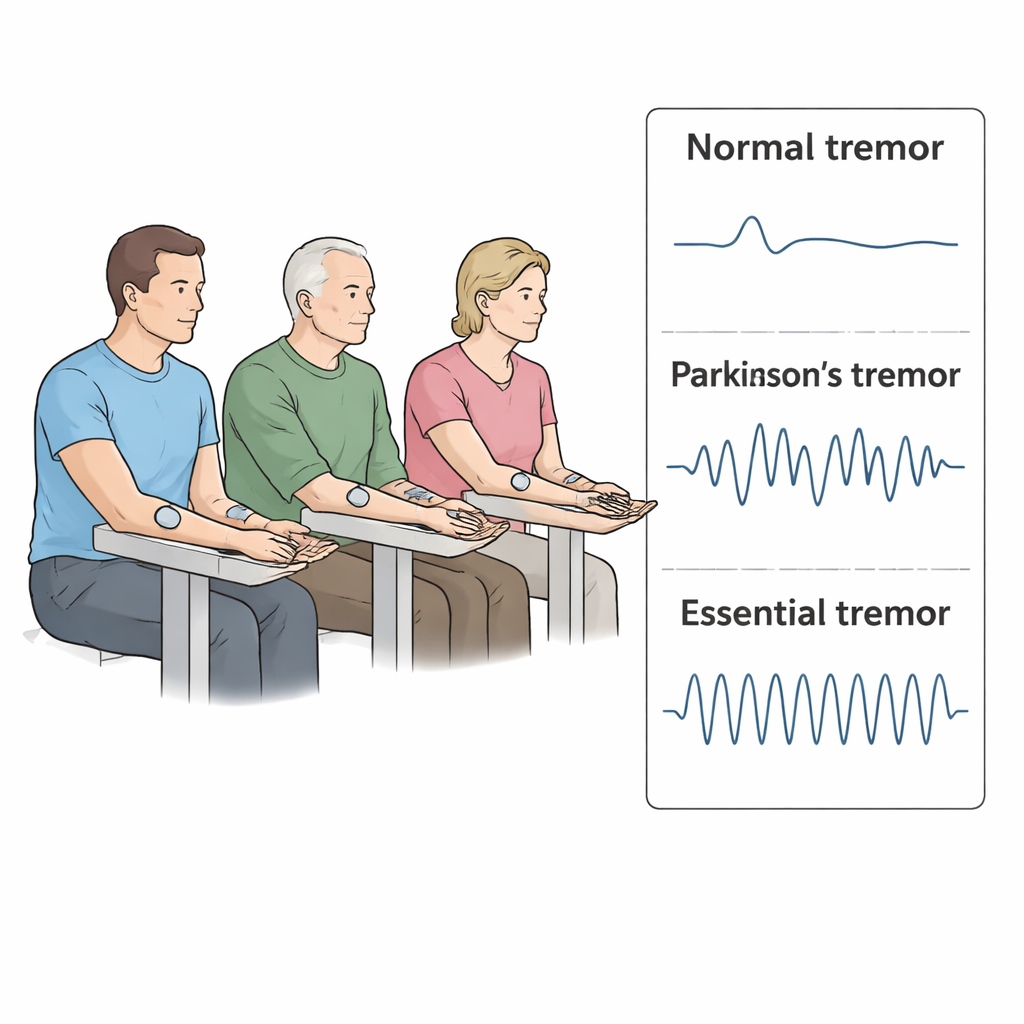
Not all hand tremors are the same. Healthy people have what is called physiological tremor—a very small, usually invisible shaking that comes from natural muscle and blood‑flow noise and the mechanics of the joints. In contrast, tremors in Parkinson’s disease and essential tremor arise mainly from abnormal rhythmic activity in brain circuits that control movement. Clinicians have long felt that some tremors look more regular than others, and they hoped that this visual impression of rhythmicity might be a useful diagnostic clue. The authors of this paper set out to test whether rhythmicity is truly tied to the underlying disease, or whether it is mostly a side effect of how strong and well‑synchronized the tremor is.
Measuring tremor in the lab
The research team recorded postural hand tremor—that is, tremor while the hand is held out against gravity—from 49 healthy volunteers, 78 people with Parkinson’s disease, and 133 with essential tremor. Tiny accelerometers on the back of the hand measured the motion, while surface electrodes on the forearm muscles recorded electrical activity. In some trials, a one‑kilogram weight was strapped to the hand to change how the wrist moved mechanically. Instead of relying on the eye alone, the scientists used four mathematical measures to capture rhythmicity: how wide the main tremor peak was in the frequency spectrum, how much the tremor frequency changed from one cycle to the next, and how predictable the overall signal was over time. They also measured how large the tremor was and how tightly the muscle activity and hand motion were linked, a sign of how strongly the nerve cells driving the tremor were “marching in step.”
What the numbers revealed
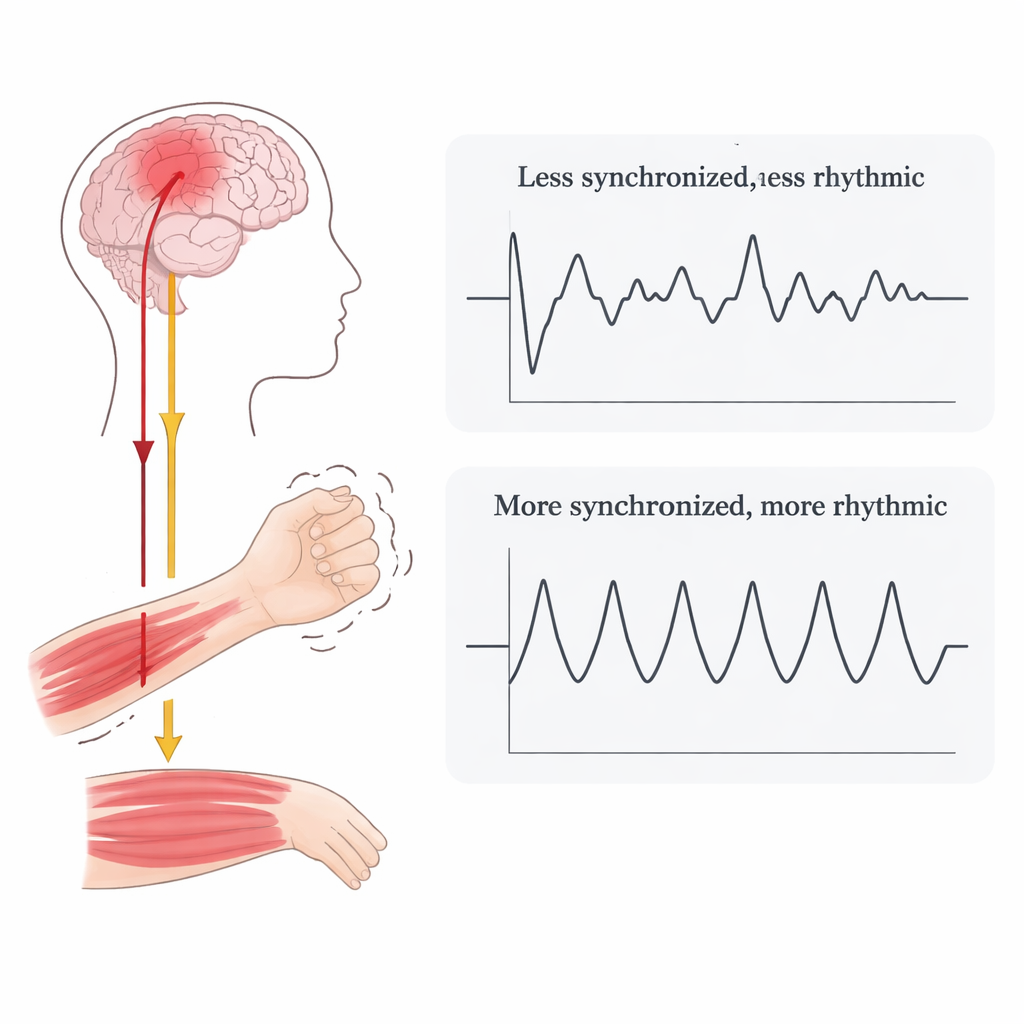
When they compared the groups, a clear pattern emerged. Normal physiological tremor was less rhythmic: the shaking was more irregular and less predictable than in either Parkinson’s tremor or essential tremor. However, the two disease groups did not differ from each other on any of the rhythmicity measures. In other words, once tremor became clearly abnormal, its regularity stopped being a reliable fingerprint of which disorder was present. Instead, rhythmicity rose in step with how big the tremor was and how strongly the muscles and hand were synchronized. The more powerful and coherent the shaking, the more it resembled a steady, clock‑like oscillation—regardless of whether the person had Parkinson’s disease or essential tremor.
What happens when you add weight
Adding a weight to the hand is a common bedside trick: in healthy people it slows their natural tremor, while in Parkinson’s disease and essential tremor it usually does not change the tremor frequency much. The study confirmed this and found that weighting the hand made normal tremor slightly more predictable, as if the added mass acted like a mechanical filter that smoothed out some of the randomness. By contrast, the same loading had little or no effect on the key measures of rhythmicity in Parkinson’s disease or essential tremor. This suggests that once tremor is driven by strong, synchronized brain activity, changing the mechanics of the hand and wrist does relatively little to alter how regular the shaking looks.
What it means for patients and doctors
For people living with tremor and the clinicians who care for them, these results carry a practical message. The regular, drum‑like quality of pathological tremor mainly reflects how strongly the nerve cells involved are oscillating together, not which specific disorder a person has. The study shows that several sophisticated rhythm scores, taken by themselves, cannot reliably separate Parkinson’s postural tremor from essential tremor. To compare tremor patterns between patients or diseases, researchers must take into account basic factors like tremor size and how tightly muscles and movement are coupled. In short, while rhythmicity helps distinguish normal, barely visible tremor from clearly abnormal shaking, it is not a stand‑alone diagnostic tool for telling one common tremor disorder from another.
Citation: Weede, P., Deuschl, G., Elble, R.J. et al. Diagnostic significance of rhythmicity in postural hand tremor. Sci Rep 16, 1954 (2026). https://doi.org/10.1038/s41598-026-35257-3
Keywords: hand tremor, Parkinson disease, essential tremor, movement disorders, tremor rhythmicity