Clear Sky Science · en
Collaborative harm reduction efforts lead to the first detection of 5-cyano isotodesnitazene in illicit street drugs
Why a Hidden Opioid Matters to Everyone
The opioid crisis is no longer just about heroin or fentanyl. A new family of man‑made painkillers, called nitazenes, has quietly entered street drug markets and is causing deadly overdoses around the world. This article reports the first confirmed detection of one such compound—5‑cyano isotodesnitazene—in a street drug. Beyond the chemistry, it shows how cooperation between drug‑checking services and university laboratories can spot dangerous new drugs early enough to save lives.
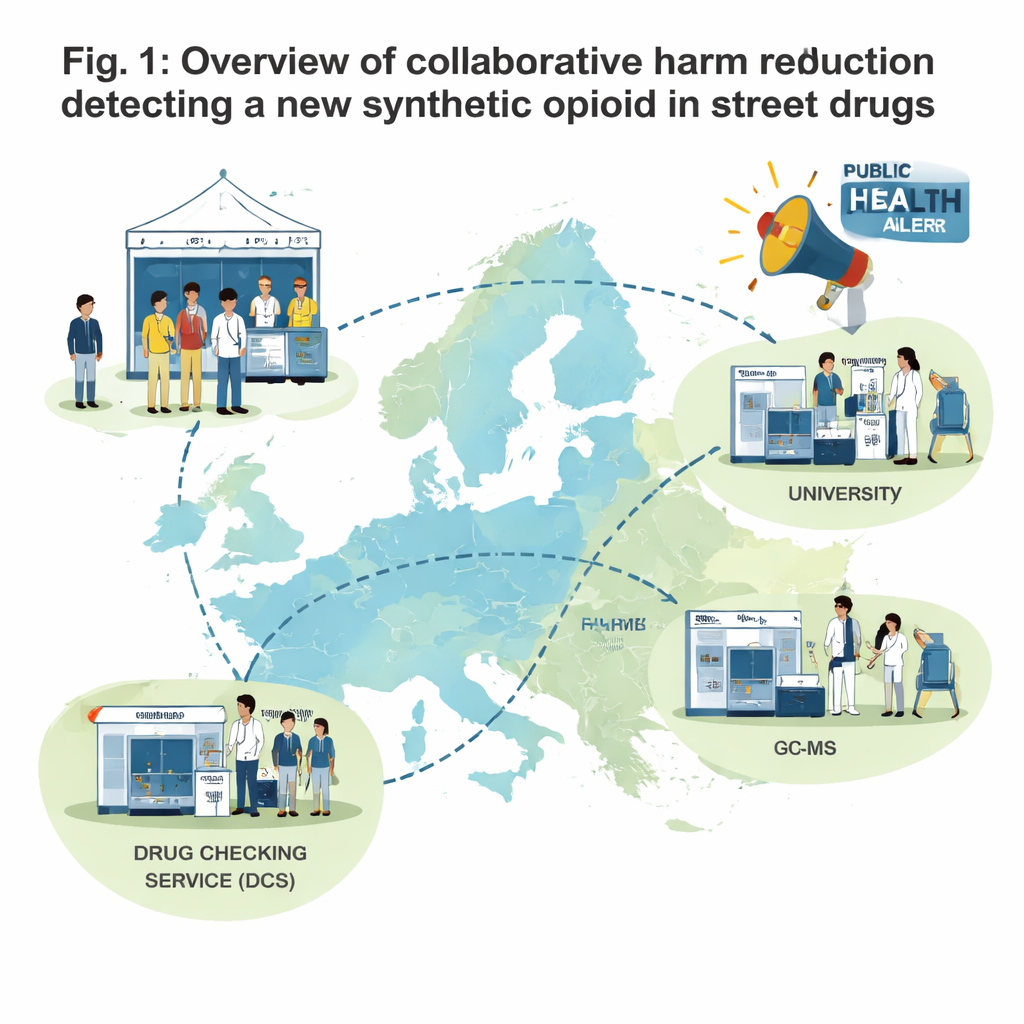
A New Wave of Powerful Street Opioids
Nitazenes were first invented in the 1950s as potential pain medicines but were never approved because they were too risky. Unlike morphine or fentanyl, they have a different chemical backbone, yet can be even more potent. Since 2019, dozens of nitazene variants have appeared in illicit markets across Europe, North America, and Australia. In some countries, nitazenes were found in nearly half of opioid‑related deaths in 2023, sometimes turning up unexpectedly in drugs sold as heroin or in fake prescription tablets. Lawmakers struggle to keep up because minor tweaks to the molecule can create a “new” drug that is not yet controlled by existing laws.
How Drug‑Checking Protects People Who Use Drugs
Drug‑checking services (DCS) offer people who use drugs the chance to anonymously submit small samples for chemical analysis. In return, they receive information about what is really in their pills or powders, and health agencies receive early warnings about new threats. The authors describe how two such services, working with three academic laboratories in different countries, formed a rapid‑response network. When a suspicious white powder arrived at a DCS, the sample was shared with partner labs that had the advanced instruments needed to identify entirely new compounds, not just known ones in standard databases.
Detecting a Mystery Compound
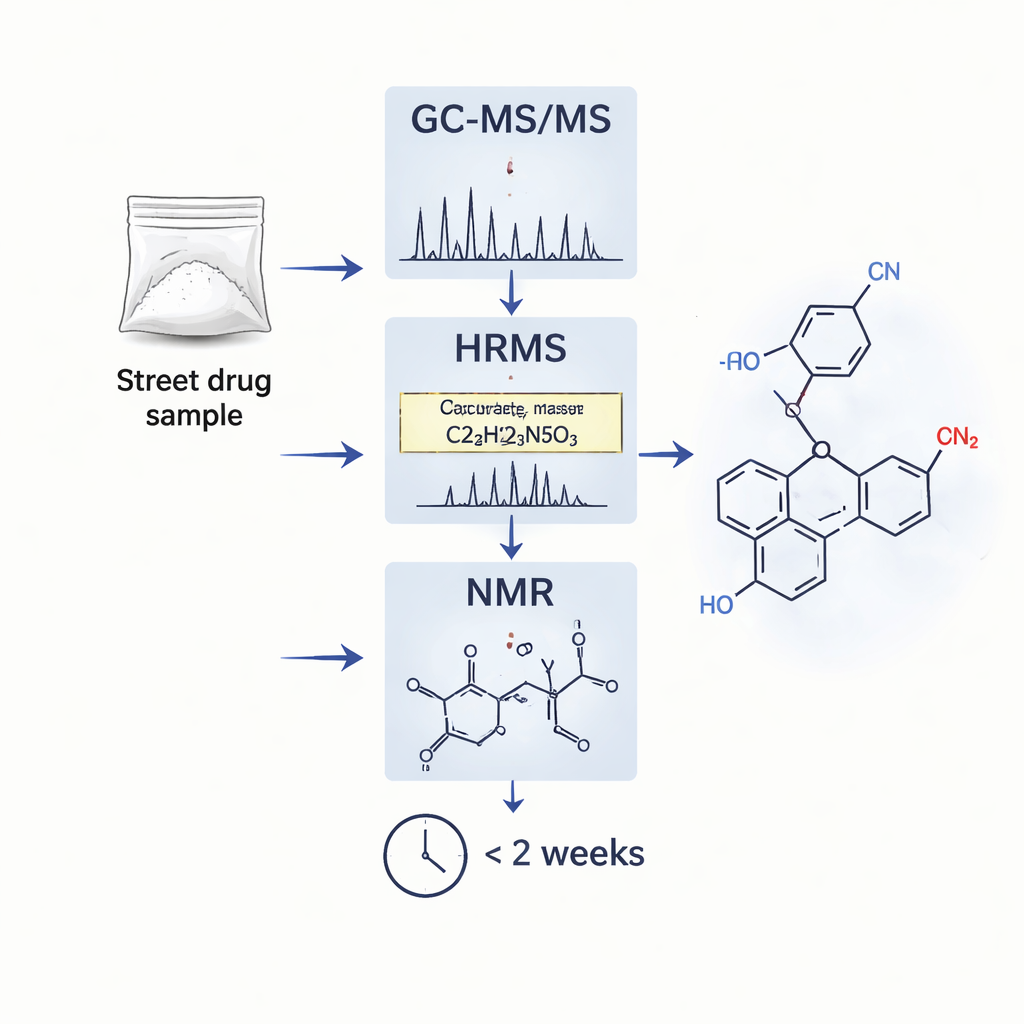
The team used three complementary laboratory techniques to solve the mystery. First, gas chromatography–mass spectrometry (GC‑MS/MS) separated the mixture and recorded its pattern of fragments, suggesting that the main ingredient was a nitazene‑type opioid but not a known one. High‑resolution mass spectrometry (HRMS) then weighed the molecule with extreme precision and confirmed its overall formula, narrowing the possibilities to just two related candidates. Finally, nuclear magnetic resonance (NMR) spectroscopy provided a detailed “fingerprint” of how atoms were connected, allowing the researchers to unambiguously identify the compound as 5‑cyano isotodesnitazene. They also found that the powder contained citric acid, likely used to help dissolve the drug for use.
From Lab Data to Forensic Intelligence
Importantly, this entire process—from first suspicion in the drug‑checking lab to full structural confirmation in universities—was completed in less than two weeks, without a commercial reference standard for comparison. That speed matters: once identified, the information can be fed into international early‑warning systems, added to spectral libraries, and shared with hospitals, coroners, and law‑enforcement agencies. The paper places this case within a broader movement known as forensic intelligence, in which data from clinical toxicology, wastewater, drug seizures, and drug‑checking are combined to track new substances and support timely public‑health alerts.
What This Means for the Opioid Crisis
For people outside the lab, the take‑home message is clear: new, extremely strong synthetic opioids are emerging faster than traditional control systems can track them. This study shows that when harm‑reduction services and academic scientists work hand in hand, they can spot these drugs early, even when they have never been seen before. Identifying 5‑cyano isotodesnitazene in a street sample is not just a chemical achievement; it is a proof of concept for a rapid, collaborative warning network that can help reduce overdoses and guide smarter drug policy in a rapidly changing drug market.
Citation: Barra, B.F.C., Pereira, J.R.P., Ferreira, D.R. et al. Collaborative harm reduction efforts lead to the first detection of 5-cyano isotodesnitazene in illicit street drugs. Sci Rep 16, 5163 (2026). https://doi.org/10.1038/s41598-026-35256-4
Keywords: synthetic opioids, nitazenes, drug checking, harm reduction, forensic toxicology