Clear Sky Science · en
Proteomic analysis revealed the potential usefulness of faecal extracellular vesicles in colorectal cancer diagnosis
Why a stool-based cancer test matters
Colorectal cancer is one of the world’s deadliest cancers, yet it is often curable when caught early. Today’s screening tools, such as colonoscopy and tests that look for hidden blood or DNA in stool, save lives but still miss many early tumors and advanced polyps. This study explores a new, surprisingly rich source of information in our stool—tiny particles called extracellular vesicles—to see whether they can reveal early warning signs of colorectal cancer in a simple, non-invasive test.
Tiny messengers leaving the colon
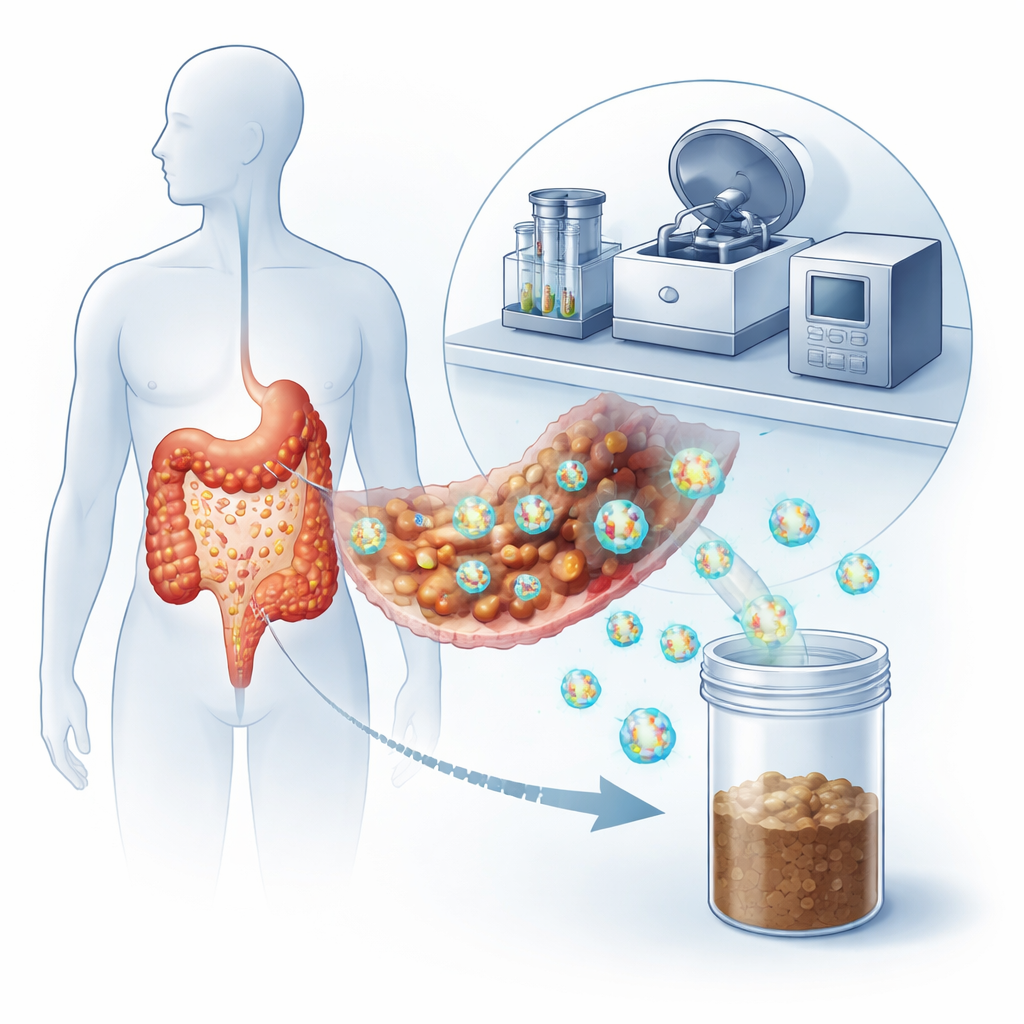
All cells in our body constantly release microscopic bubbles, known as extracellular vesicles, that carry proteins and genetic material. These vesicles act as messengers, reflecting what is happening inside the cells that produced them. The researchers reasoned that cells lining the colon, including tumor cells, should shed many such vesicles directly into the gut, where they end up in faeces. If those vesicles could be separated from the rest of the stool, their protein contents might provide a clearer snapshot of colon health than current stool tests that mostly look for blood or fragments of DNA.
Separating signal from the stool “noise”
Stool is a notoriously difficult material to analyze because it is complex, variable from person to person, and packed with bacteria. To overcome this, the team used a multi-step centrifugation process to isolate faecal extracellular vesicles—abbreviated as fEVs—from samples donated by healthy volunteers and patients with colorectal cancer. They checked each fraction using several established vesicle marker proteins and particle-size measurements, confirming that two specific fractions contained most of the vesicles. Those purified fractions were then pooled and compared with unfractionated stool suspensions from the same individuals.
Colon-specific proteins stand out in vesicles
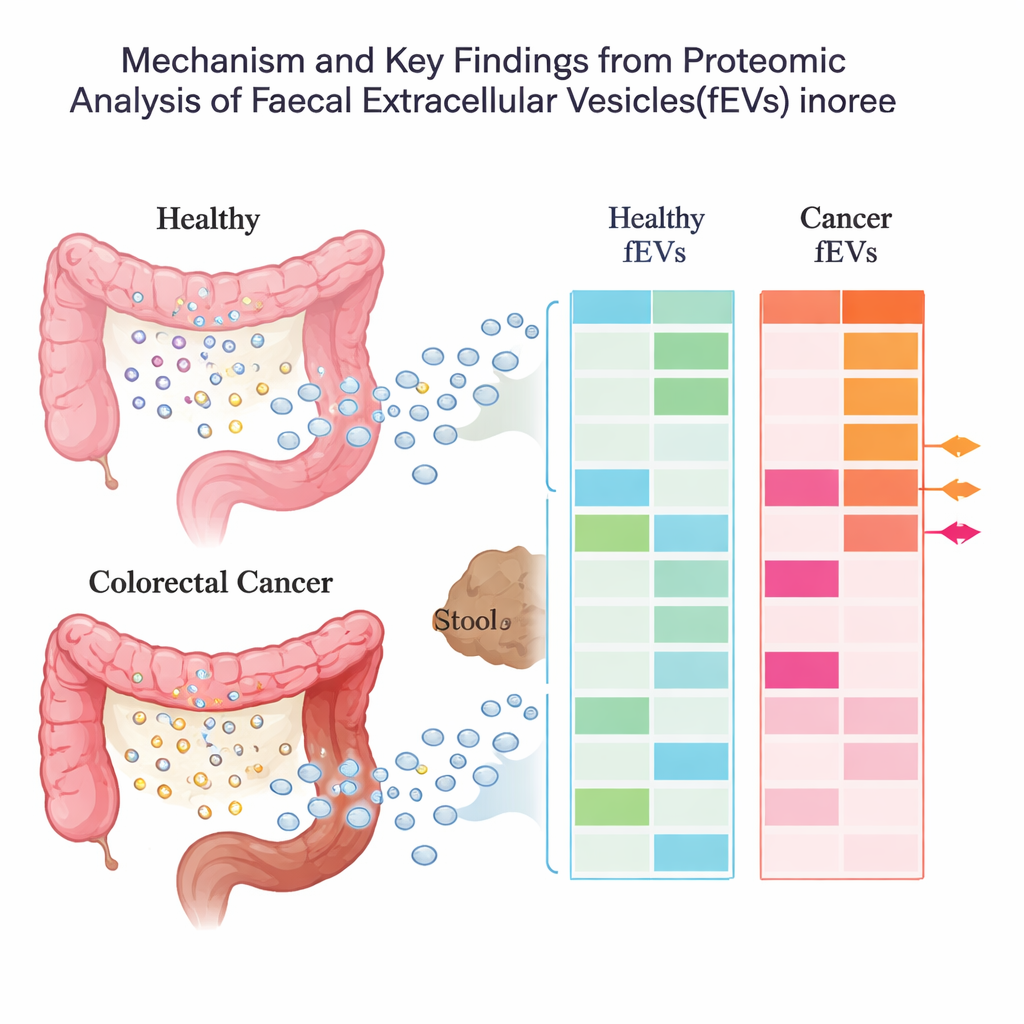
Using a sensitive mass spectrometry technique, the researchers identified just over 2,000 different proteins across all samples. Importantly, many more proteins were found in the purified vesicles than in whole stool suspensions, especially in samples from people with cancer. When they asked where these proteins normally come from in the body, a striking pattern emerged: proteins detected only in the vesicle fraction were strongly enriched for those originating in colon tissue. In contrast, proteins seen only in the bulk stool showed no such colon-specific signature. This pattern was consistent in both healthy individuals and cancer patients, suggesting that fEVs provide a focused window into what is happening specifically in the colon wall.
Spotting promising protein clues
To test whether fEVs could help diagnose colorectal cancer, the team cross-referenced their data with medical literature on proteins known to change in vesicles released from colorectal tumors. From 155 such candidates, 57 were present in the faecal vesicle data, and 42 of these differed by at least twofold between healthy people and cancer patients. Four proteins—OLFM4, LAMP1, LGALS3BP, and S100A9—stood out as especially promising. In follow-up experiments using western blotting, all four were clearly higher in the vesicles from cancer patients than in those from healthy volunteers. When the researchers tested additional healthy samples and carefully adjusted for the total vesicle amount in each, two proteins, OLFM4 and LGALS3BP, showed statistically significant increases in the cancer group.
From lab discovery to future testing
Although this study involved only a small number of patients and lacked detailed clinical information such as tumor stage, it demonstrates several important points for future screening. First, carefully purified faecal vesicles carry many more colon-specific proteins than whole stool, making them an attractive target for biomarker discovery. Second, the identified proteins, particularly OLFM4 and LGALS3BP, behave in ways that are consistent with a potential role in non-invasive colorectal cancer testing. Larger studies, including people with early-stage disease and advanced polyps, will be needed to confirm how well these markers perform. If successful, analysing proteins in faecal extracellular vesicles could complement existing stool tests and offer a more sensitive, user-friendly way to detect colorectal cancer before it becomes deadly.
Citation: Murakami, Y., Sakamaki, N. & Ohiro, Y. Proteomic analysis revealed the potential usefulness of faecal extracellular vesicles in colorectal cancer diagnosis. Sci Rep 16, 4863 (2026). https://doi.org/10.1038/s41598-026-35255-5
Keywords: colorectal cancer screening, stool biomarkers, extracellular vesicles, proteomics, early cancer detection