Clear Sky Science · en
Bioremediation of alkaline corn wastewater with Haematococcus pluvialis under laboratory and 100 L raceway pond conditions
Turning Tortilla Wastewater into a Resource
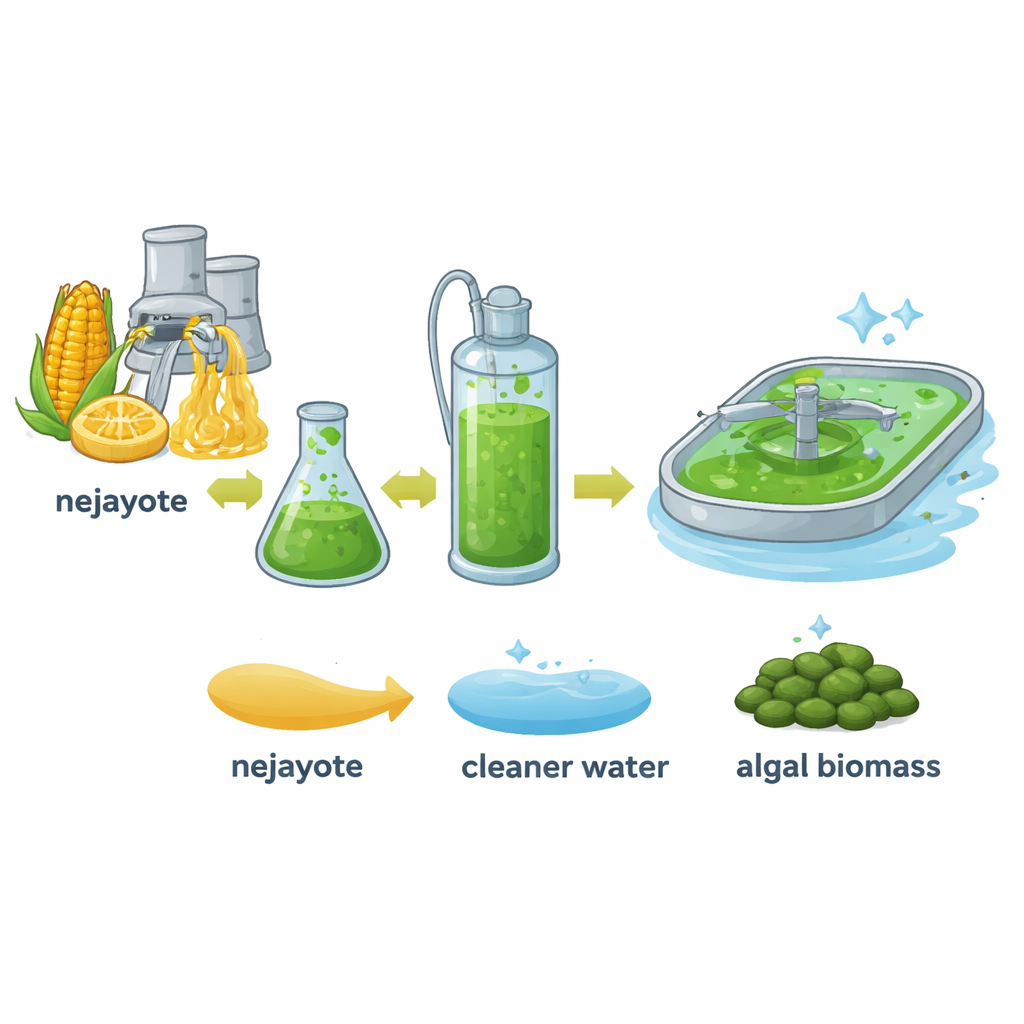
Every day in Mexico, millions of tortillas are made using an ancient cooking method called nixtamalization. This process creates a harsh, alkaline wastewater known as nejayote. Usually seen as a troublesome waste that can pollute rivers and lakes, nejayote is also packed with nutrients. This study explores how a microscopic freshwater organism, the green microalga Haematococcus pluvialis, can transform this problem into an opportunity: cleaning the water while producing a nutrient-rich biomass that could be used as fertilizer or animal feed.
Why Corn Wastewater Is a Hidden Problem
Nixtamalization improves the flavor and nutrition of corn, but it leaves behind huge volumes of wastewater—over 14 million cubic meters per year in Mexico alone. This liquid is strongly alkaline, cloudy, and loaded with organic matter, nitrogen, phosphorus, and suspended solids. When dumped untreated into drains or streams, it fuels algal blooms, lowers oxygen levels, and harms aquatic life. Large industrial producers have started using filters and advanced treatment systems, but small and medium tortilla shops often cannot afford such technology. As a result, most nejayote still leaves factories untreated, creating a widespread but largely invisible environmental burden.
Using Tiny Algae as Natural Clean-Up Crews
The research team turned to microalgae, which can thrive in nutrient-rich waters while absorbing excess nitrogen, phosphorus, and organic carbon. From five candidate species, Haematococcus pluvialis stood out for its ability to survive and perform well in undiluted nejayote. To help this alga cope with such an extreme liquid, the scientists first “toughened up” the culture by briefly exposing it to UV-C light, killing most cells and selecting the hardiest survivors. They then slowly increased the share of nejayote in the growth medium—from 15% up to 100%—until the algae were fully acclimated. This careful preparation allowed the microalgae to use nejayote not as a poison, but as food.
From Lab Flasks to a Pond in a Greenhouse
Scaling up from a small laboratory flask to a 100-liter raceway pond is not as simple as just making everything bigger. The algae need enough gas exchange—especially for oxygen release and carbon dioxide supply—to grow steadily and keep treating the wastewater. The researchers used a practical engineering measure called the “apparent kLa,” which reflects how efficiently gases move between the air and the liquid. By measuring this value in a small flask and then adjusting stirring and paddlewheel speeds in a 5-liter bioreactor and a 100-liter open pond, they aimed to maintain comparable gas transfer conditions at each size. Measurements in the pond showed that mixing was strongest near the paddlewheel and weaker farther away, revealing that real ponds behave more like flowing channels than perfectly stirred tanks.
How Clean Does the Water Get?
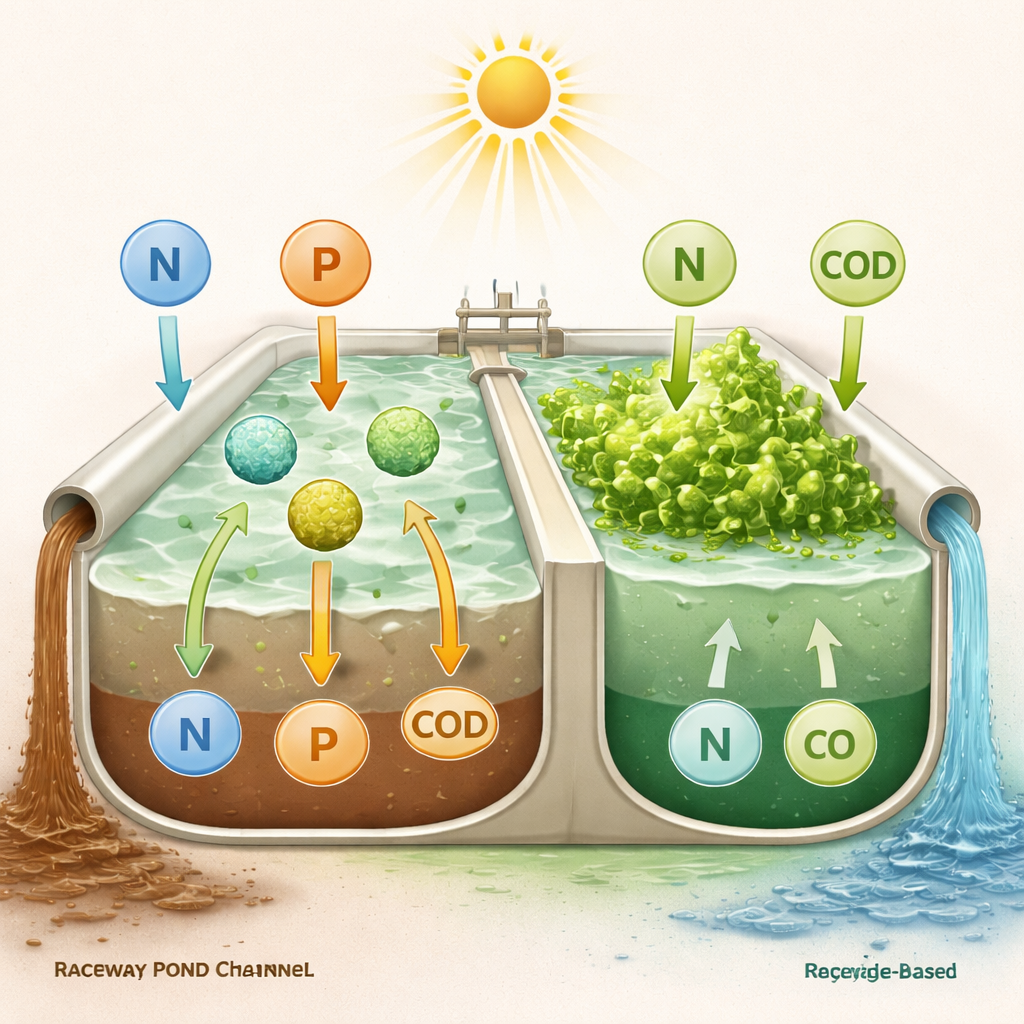
Under controlled lab conditions, the adapted algae performed impressively. They removed about 96% of total nitrogen, essentially 100% of phosphorus, and more than 92% of the chemical oxygen demand (COD), a measure of organic pollution. When the process was transferred to the 100-liter outdoor raceway pond, removal stayed high but dipped slightly: around 87% for nitrogen, 99% for phosphorus, and 90% for COD. The drop was mainly linked to evaporation concentrating the remaining pollutants and to changing outdoor light and temperature. While nitrogen and phosphorus fell below Mexican discharge limits, COD stayed above regulatory thresholds. The authors suggest adding simple follow-up steps, such as coagulation with natural flocculants or activated-carbon filtration, to polish the water to meet standards.
From Wastewater to Useful Biomass
Besides cleaning the water, the process produced a sizeable amount of microalgal biomass. Analysis showed that this dried material was rich in protein and minerals, especially calcium, making it a potential ingredient for biofertilizers or animal feeds. In the lab, the algae contained almost 39% protein, which dropped to about 27% in the larger outdoor pond, while mineral content (measured as ash) rose from roughly 31% to 47%. The increase in minerals reflects the naturally high calcium content of nejayote and the concentrating effect of evaporation. Although trace metals were present, their levels were low, and the authors note that simple washing or other post-treatments could further improve safety and quality.
A Practical Path Toward Cleaner Tortilla Production
For a non-specialist, the main takeaway is that a microscopic plant can turn a problematic food-industry wastewater into cleaner water and a useful by-product. By carefully training and scaling up Haematococcus pluvialis, the researchers showed that small and medium tortilla producers could, in principle, adopt a relatively simple pond-based system that fits within a circular bioeconomy model. Although an extra polishing step is still needed to fully meet discharge standards, the study demonstrates a robust, scalable foundation for greener tortilla production that protects waterways while generating value from what was once just waste.
Citation: Najar-Almanzor, C.E., García-Cayuela, T., Gutierrez-Uribe, J. et al. Bioremediation of alkaline corn wastewater with Haematococcus pluvialis under laboratory and 100 L raceway pond conditions. Sci Rep 16, 5340 (2026). https://doi.org/10.1038/s41598-026-35251-9
Keywords: nejayote wastewater, microalgae bioremediation, Haematococcus pluvialis, circular bioeconomy, corn processing