Clear Sky Science · en
Curcuma longa debranched starch assisted synthesis of cerium oxide nanoparticles and its antioxidant, anticancer, antimicrobial, and anti-biofilm activities
Turning Kitchen Spices into Tiny Medical Helpers
Turmeric, the golden spice in many kitchens, may have a surprising future beyond cooking. Scientists have used starch from Curcuma longa (the plant that gives us turmeric) to build ultra‑small particles of cerium oxide, a mineral already used in industry. These tiny particles, only a few billionths of a meter wide, showed promise as antioxidants, cancer‑fighting agents, and powerful blockers of harmful bacteria and their protective slime layers. This work hints that everyday plant materials could help create gentler, greener ingredients for future medicines and medical coatings.
A Greener Way to Make Tiny Particles
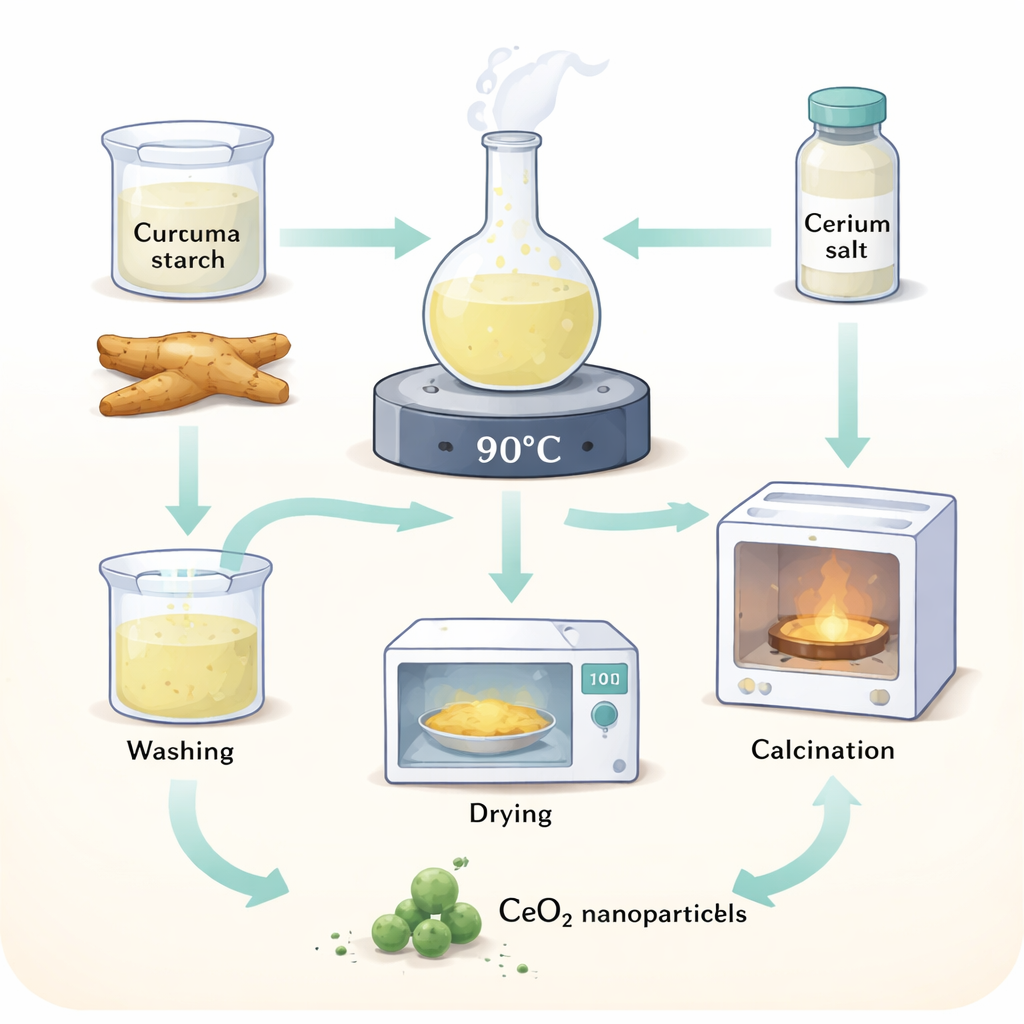
Many current methods for making metal‑based nanoparticles rely on high temperatures, harsh chemicals, or extra additives to keep particles stable. These steps can be costly, complex, and unfriendly to the environment. In this study, the researchers turned to Curcuma longa debranched starch as a natural “toolkit” to both build and stabilize cerium oxide nanoparticles. Using a relatively simple sol‑gel process in water at 90 °C, the plant starch helped convert a dissolved cerium salt into a soft, yellow resin that could be washed, dried, and gently baked into solid nanoparticles. The starch acted like a natural scaffold and protective coat, preventing the particles from clumping together and keeping their size in the 2–4 nanometer range—far smaller than most bacteria and even many other engineered nanomaterials.
Peering Inside the New Material
To be sure they had made what they intended, the team subjected the particles to a battery of tests normally reserved for advanced materials science. Light‑absorption measurements showed a clear signature peak consistent with cerium oxide at the nanoscale. X‑ray diffraction confirmed that the particles had a well‑ordered crystal structure, while electron microscopes revealed nearly spherical shapes and a very narrow size distribution. Chemical analysis verified that cerium and oxygen were the main elements, with a small amount of carbon likely coming from the plant coating. Surface‑sensitive measurements indicated a mix of two cerium states (Ce³⁺ and Ce⁴⁺) and many oxygen “vacancies”—tiny defects that turn out to be crucial for how these particles interact with reactive oxygen molecules in living systems.
Fighting Free Radicals, Cancer Cells, and Germs
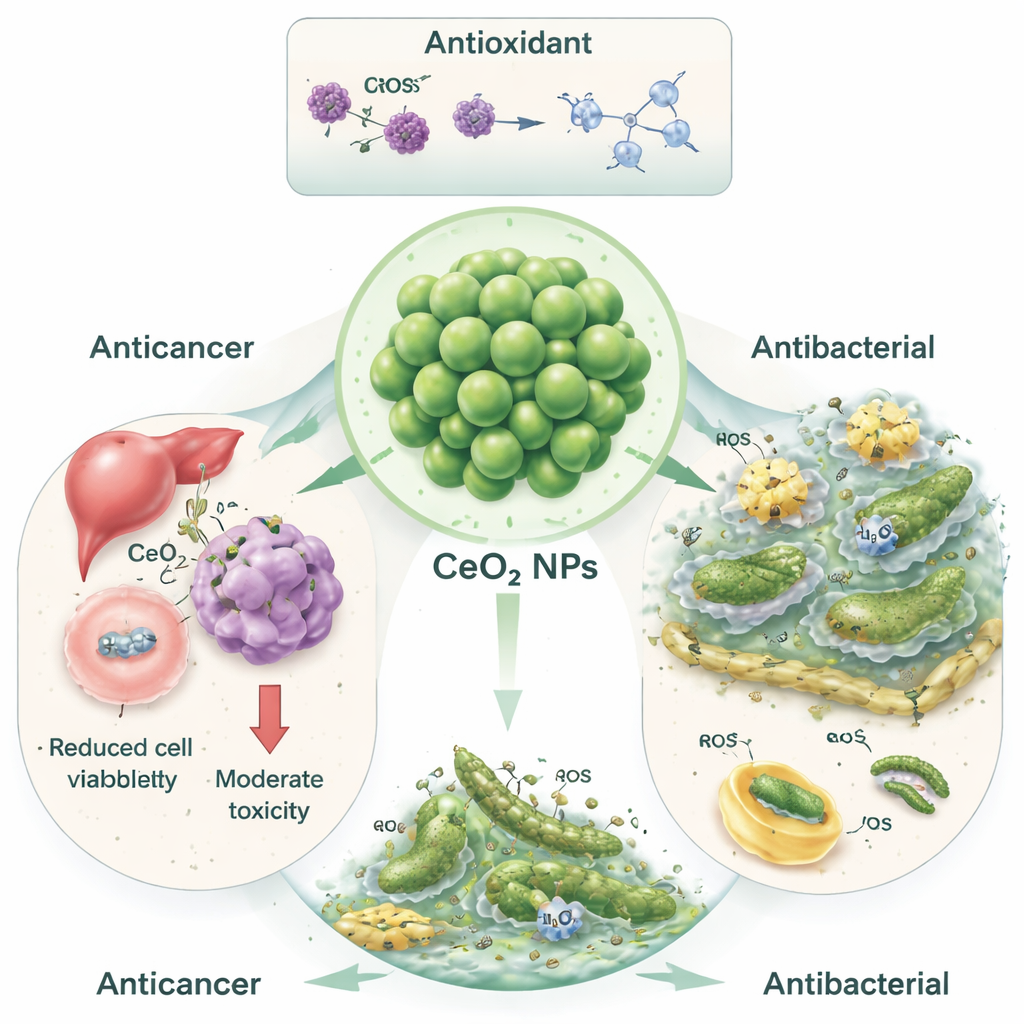
Because cerium oxide can switch between its two states, it can soak up or release oxygen‑based reactive molecules, often called free radicals. In test‑tube antioxidant assays, the Curcuma‑starch‑based particles were very efficient at neutralizing two standard types of free radicals (DPPH and ABTS), working at far lower doses than common reference antioxidants like vitamin C and Trolox. The particles were also tested on human liver cancer cells (HepG2). As the nanoparticle dose increased, cancer cell survival dropped in a clear, dose‑dependent way, although the particles were less toxic than a standard chemotherapy drug, cisplatin. This suggests a moderate but meaningful anticancer effect that might be tuned further in future designs.
At the same time, the nanoparticles showed notable activity against several disease‑causing bacteria, including Escherichia coli, Salmonella typhi, Klebsiella pneumoniae, and Corynebacterium diphtheriae. In standard “zone of inhibition” tests, higher nanoparticle doses suppressed bacterial growth, and additional experiments determined the lowest concentrations needed to stop and then kill the microbes. Electron microscope images of treated bacteria showed rough, damaged cell surfaces compared with the smooth outlines of untreated cells. The particles also strongly disrupted bacterial biofilms—the sticky, protective layers that make infections on medical devices and tissues stubborn and difficult to treat—indicating that they can interfere with both free‑swimming and community‑style bacterial life.
Early Signs of Blood Compatibility and Safety
Any material meant for medical use must be tested for how it interacts with blood. The researchers examined whether the nanoparticles would cause red blood cells to burst, a process known as hemolysis. On their own, the particles did not drive strong cell rupture; in fact, they reduced the damage caused by a harsh detergent commonly used as a positive control. This suggests that, at the levels tested, the plant‑coated cerium oxide particles may be relatively gentle toward blood cells, although far more detailed safety studies in animals and eventually humans would be needed before any clinical use.
What This Could Mean for Future Medicine
Together, these results show that cerium oxide nanoparticles created with the help of turmeric starch can act as versatile micro‑tools: they mop up free radicals, show selective toxicity toward cancer cells, and attack harmful bacteria and their biofilms, all while appearing reasonably compatible with blood in early tests. For lay readers, the key message is that ingredients derived from familiar plants can help build advanced materials with multiple health‑related functions, potentially reducing our reliance on harsh synthetic chemicals. While the work is still at the laboratory stage and not ready for medical use, it points toward a future where eco‑friendly nanotechnology might support new coatings for implants, smarter wound dressings, or supplemental therapies that exploit the dual antioxidant and antimicrobial power of these tiny, turmeric‑assisted particles.
Citation: Sana, S.S., Mishra, V., Vadde, R. et al. Curcuma longa debranched starch assisted synthesis of cerium oxide nanoparticles and its antioxidant, anticancer, antimicrobial, and anti-biofilm activities. Sci Rep 16, 5538 (2026). https://doi.org/10.1038/s41598-026-35249-3
Keywords: green nanotechnology, cerium oxide nanoparticles, turmeric starch, antibacterial biofilm control, nanoparticle antioxidant