Clear Sky Science · en
Enhanced power capture for the wind turbine system via a novel second-order nonsingular fast terminal sliding mode control strategy
Why smoother wind power matters
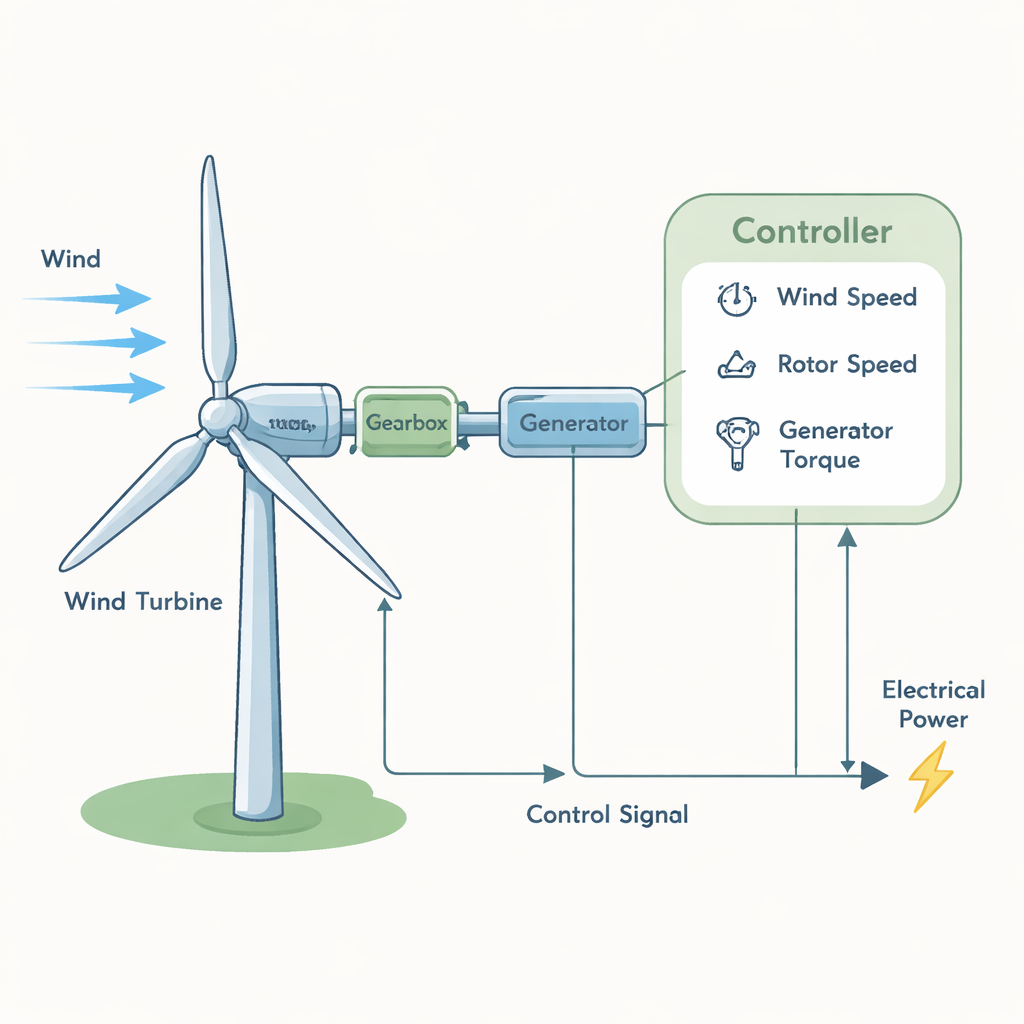
Wind power is now a major player in the global energy mix, but real winds are gusty and unpredictable. Those rapid changes in wind speed make turbines work hard: the control system must constantly adjust how fast the rotor and generator turn to grab as much energy as possible without overstressing the machine. If the control is too rough, it causes damaging vibrations and shortens the turbine’s life. This paper introduces a new way to control variable-speed wind turbines that aims to squeeze more power from the wind while keeping the turbine’s mechanical parts under gentler, smoother loads.
Keeping the turbine at its sweet spot
Modern turbines are designed to operate most of the time in a so‑called "maximum power" region, where the goal is to keep the rotor spinning at just the right speed for any given wind. In this region, small errors in rotor speed translate directly into lost energy. Traditional controllers, often based on simple proportional–integral–derivative (PID) rules, struggle because the turbine is a highly nonlinear machine and the wind can change abruptly. Other, more advanced nonlinear methods exist, but each tends to fix only one issue at a time—either they converge quickly, or they are robust to disturbances, or they reduce high‑frequency "chattering" in the control signal, but rarely all three together.
A smarter way to tell the turbine what to do
The authors design a new controller that blends several powerful ideas into a single scheme. At its core is a PID-like structure that keeps track of how far the actual rotor speed is from its ideal value, how fast that error is changing, and how it has behaved in the recent past. On top of this, they add a more sophisticated "sliding" strategy that forces the system’s behavior onto a carefully chosen path and keeps it there. This sliding design is of second order and "nonsingular fast terminal" type: in plain terms, it is engineered so the error shrinks to zero within a guaranteed finite time, without running into mathematical dead ends, and without demanding unrealistically large control forces. The second‑order form smooths the control signal, which directly helps to avoid rapid on–off switching that would otherwise shake the drive train.
Testing under gusts, glitches, and faults
To see how well the new method works, the researchers build a detailed computer model of a variable‑speed wind turbine, including the aerodynamics, the flexible low‑speed shaft, the gearbox, and the generator. They then compare their controller with three advanced alternatives reported in the literature. The tests cover demanding situations: highly turbulent random wind, sharp step‑like changes in wind speed, uncertainties in mechanical parameters such as generator inertia, added sinusoidal disturbances, and even a gradual loss of actuator effectiveness that mimics a partially failing generator torque actuator. Across these scenarios, they measure how closely rotor speed follows its target, how large the generator and shaft torques become, and how much these torques fluctuate over time.
More power, less mechanical punishment
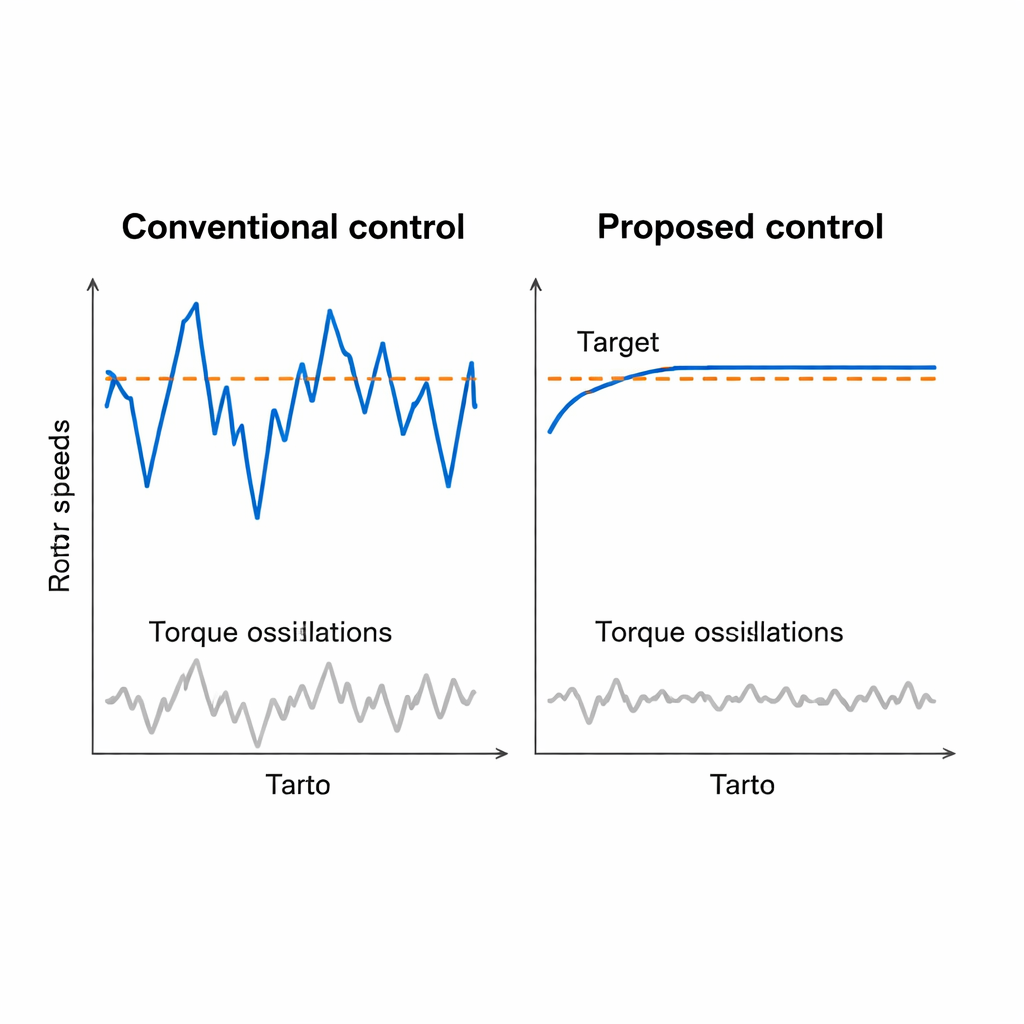
The simulations show that the new controller tracks the optimal rotor speed more accurately than the three benchmark methods, cutting a key error measure (mean squared error) by about 46%. Because the rotor speed stays closer to its ideal curve, the turbine extracts slightly more useful aerodynamic power from the wind, while electrical efficiency remains high and comparable to the best existing methods. At the same time, the new control signals are noticeably smoother. High‑frequency components associated with chattering are strongly reduced, and the variations in shaft and generator torques are slightly but consistently smaller. These reductions in oscillation mean less mechanical wear on the drive train and, over years of operation, a potentially longer turbine lifespan.
What this means for future wind farms
In everyday terms, the proposed control strategy helps a turbine behave more like a well‑tuned car on a bumpy road: it responds quickly enough to keep speed where it should be, but gently enough to avoid rattling the machinery. By combining fast convergence, strong robustness to disturbances and faults, and low‑chatter control in a single design, the method offers a promising path to getting more energy out of the same wind while cutting maintenance needs. So far, the results come from simulations; the authors suggest that the next step is to test the controller in real time using hardware‑in‑the‑loop setups, and eventually on operating turbines in the field.
Citation: Shalbafian, A., Amiri, F. Enhanced power capture for the wind turbine system via a novel second-order nonsingular fast terminal sliding mode control strategy. Sci Rep 16, 4801 (2026). https://doi.org/10.1038/s41598-026-35245-7
Keywords: wind turbine control, maximum power point tracking, sliding mode control, renewable energy systems, drive train fatigue