Clear Sky Science · en
Biases in cultural transmission of information about a minimal ingroup
Why small group labels matter
Even the simplest labels—like belonging to the “Green village” or the “Blue village”—can change how we talk about one another. This study asks a deceptively simple question: when people pass along information about their own group versus another group, do they subtly reshape that information in different ways over time? The answer helps explain how mild everyday bias can, generation by generation, harden into polarized views of “us” and “them.”

Turning strangers into simple groups
The researchers created “minimal groups” in an online experiment. Volunteers were randomly told they belonged either to the Green village or the Blue village—groups with no history, politics, or real differences. Each village had been rated on a set of everyday personality traits, such as being friendly, lazy, or busy. For each trait, participants saw clear numbers showing what percentage of each village supposedly had that characteristic. Their job was to memorize these percentages and then pass them on to another anonymous participant by clicking on a line marked from 0% to 100%.
Playing scientific broken telephone
This set‑up formed “transmission chains” that worked much like the children’s game of broken telephone. The first person in a chain saw the original percentages (“seed” values) and tried to reproduce them on the line. The next person only saw this reproduction, not the original numbers, and tried to pass it on again, and so on, for ten “generations.” By comparing how the numbers drifted across many such chains, and across positive, neutral, and negative traits, the authors could see what kinds of distortions tended to build up when people talked about their own group (ingroup) versus the other group (outgroup).
General fading and a hidden response quirk
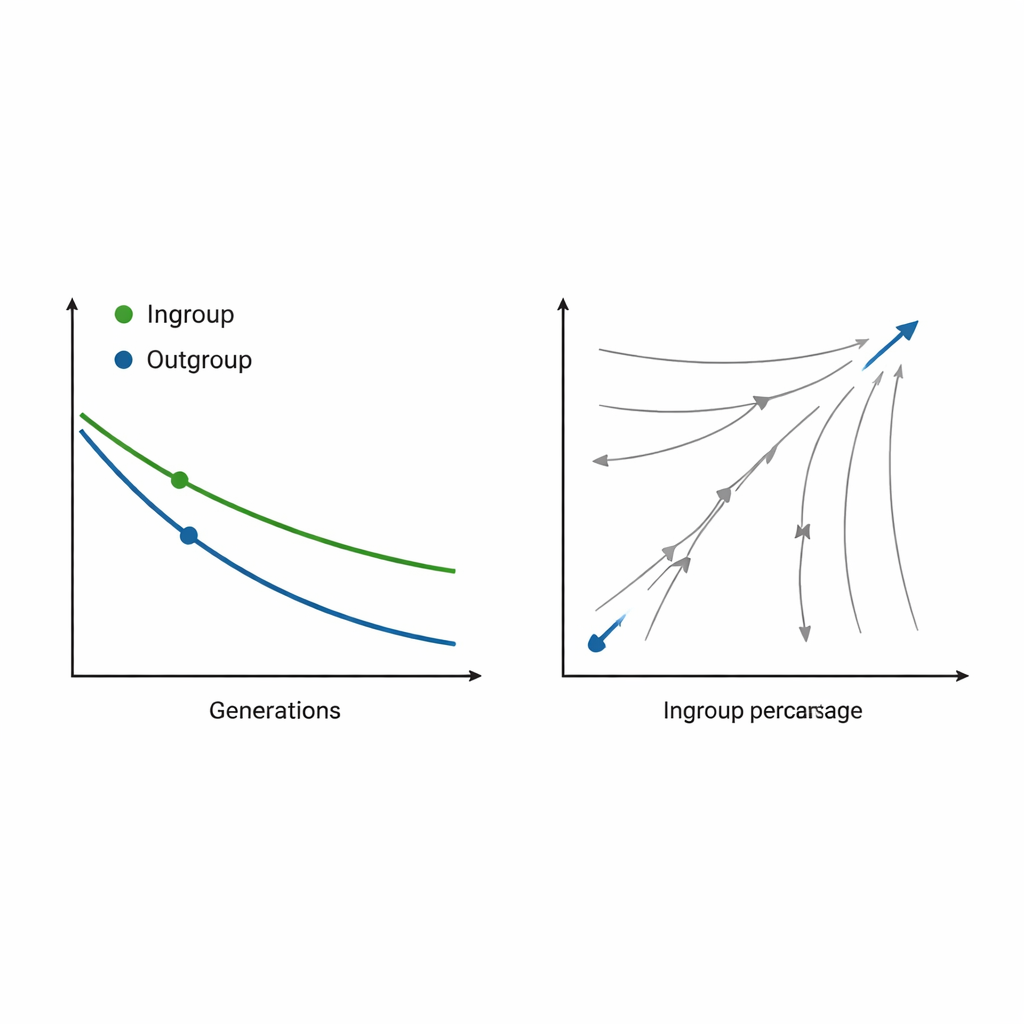
Across the board, reported percentages shrank over generations. Traits that started out at, say, 60% often slid toward 40% or even lower as the information travelled along the chain. However, a control experiment showed that this overall drop did not reflect something special about group prejudice. Instead, it came from a low‑level response bias: when people are asked to place numbers on an unlabeled line, they naturally underestimate values below 50%. In other words, part of the “cultural evolution” seen in the experiment was built into the measuring tool itself, not just into people’s attitudes.
Ingroup warmth and accuracy
Once this general fading was taken into account, a telling pattern emerged. For positive and neutral traits—like being friendly, creative, or busy—the decline over generations was noticeably slower when those traits described the ingroup than when they described the outgroup. In simple terms, people held on to flattering and neutral descriptions of their own group more stubbornly than they did for the other group. For negative traits—such as being corrupt or cowardly—this protective effect was weaker and not consistently reliable. The authors suggest that two psychological forces are likely at work together: people tend to process and remember information about their own group more carefully, and they are also motivated to present their group in a relatively favorable light, especially when describing it for an unknown audience that might include outsiders.
How small biases can shape big divides
By tracking tiny shifts in simple percentage estimates, this research shows how even minimal, artificial group identities can steer the flow of information over time. When stories about “us” and “them” are passed along again and again, flattering or at least harmless traits about our own side are more likely to survive the journey. Meanwhile, positive information about the other side fades faster. Although the groups in this study were as bare‑bones as possible, the same kinds of subtle biases could, in real societies, help drive growing gaps in how we see nations, political camps, or cultural communities. Small, often unnoticed distortions in what we share about our own group and others may slowly build the foundations for stereotypes, polarization, and conflict.
Citation: Woźniak, M., Charbonneau, M. & Knoblich, G. Biases in cultural transmission of information about a minimal ingroup. Sci Rep 16, 4959 (2026). https://doi.org/10.1038/s41598-026-35241-x
Keywords: ingroup bias, cultural transmission, social identity, stereotypes, group polarization