Clear Sky Science · en
Utilization of wastes from bioethanol production for the fabrication of new adsorbents for the removal of toxic dye in water
Turning Farm Waste into a Water Protector
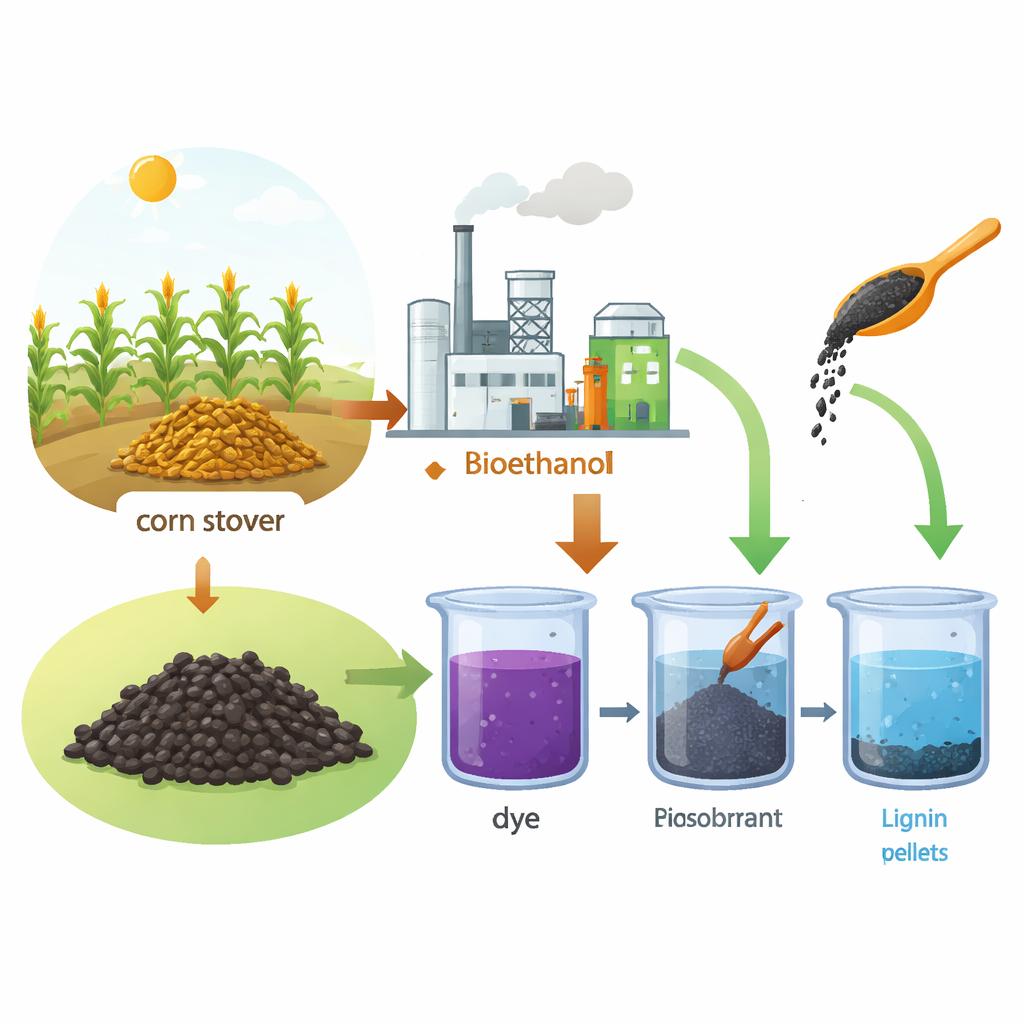
Colorful dyes make our clothes, paper, and plastics look appealing, but when they end up in rivers and lakes, they can poison fish, pollute drinking water, and even harm human health. This study shows how an agricultural leftover from making bioethanol fuel—corn stalk waste—can be transformed into a powerful sponge that quickly pulls a toxic purple dye, crystal violet, out of water. It is a story of tackling two problems at once: managing farm and factory waste while cleaning up contaminated water.
Why Bright Dyes Can Be Dark Pollutants
Dyes such as crystal violet are used in textiles, printing, and even biology labs because they are intense and long-lasting. Those same properties make them stubborn pollutants. Even at low levels, crystal violet can damage organs, irritate skin and the digestive system, and harm aquatic life. Many advanced water-treatment technologies exist, but they can be expensive or complex. Adsorption—a process in which contaminants stick to the surface of a solid—offers a simpler approach. The challenge is to find cheap, abundant, and efficient materials that can act like reusable "molecular Velcro" for these dyes.
From Corn Stalks to Smart Sponges
After corn plants are harvested for grain, their stalks and leaves, known as corn stover, can be used to make bioethanol fuel. During this process, much of the woody component called lignin is left behind as a low-value byproduct. The researchers took this lignin and upgraded it in stages. First, they isolated and dried it (L). Then they added sulfur-containing groups in a step called sulfonation, creating a more water-friendly version (LS). Finally, they built a porous network around the sulfonated lignin using two small molecules, resorcinol and formaldehyde, forming a hybrid material called LSR-F. This last step produces tiny hard beads with many internal pockets and special chemical groups that attract dye molecules.
How Well the New Material Cleans Water
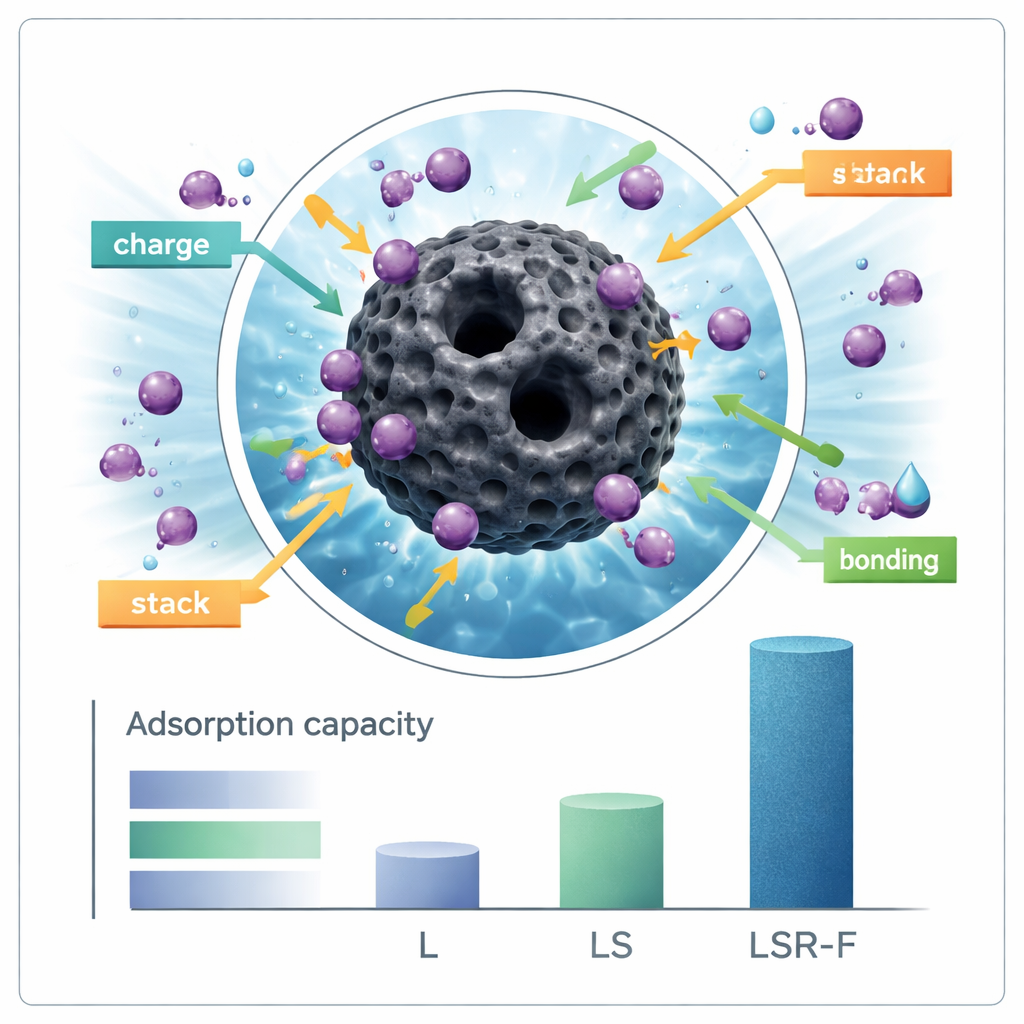
The team tested all three materials—L, LS, and LSR-F—by mixing them with water contaminated with crystal violet and measuring how much dye remained. LSR-F clearly stood out. Under conditions similar to slightly basic tap water (pH 8) and at room temperature, just 0.1 grams of LSR-F in a small volume of dye solution removed about 98% of the color in only 15 minutes. Detailed measurements showed that the material can hold up to about 73.5 milligrams of dye per gram of adsorbent, a higher capacity than many other lignin-based materials reported in the literature. After use, the material could be washed with a mild acid solution and reused several times, keeping most of its cleaning power over repeated cycles.
What Happens at the Microscopic Level
To understand why LSR-F works so well, the researchers examined its structure and behavior with tools such as infrared spectroscopy, electron microscopy, and thermal analysis. They found that LSR-F is rich in carbon and contains plenty of oxygen- and sulfur-bearing groups spread over a rough, porous surface. In water, these groups carry negative charges that strongly attract the positively charged crystal violet molecules. The dye first rushes to the outer surface and then moves into tiny pores inside the particles. Mathematical models of how fast and how much dye is removed suggest that several forces are at play: electrostatic pull between opposite charges, stacking interactions between ring-shaped dye molecules and the aromatic rings in lignin, hydrogen bonding, and weaker "stickiness" such as van der Waals forces. The process is spontaneous and works slightly better at warmer temperatures.
Cleaner Water and Less Waste
By turning corn stover leftovers from bioethanol production into an efficient dye-catching material, this work links clean energy, waste reduction, and water protection. The new LSR-F sorbent acts quickly, holds a large amount of dye, and can be reused, making it a promising option for treating colored wastewater from industry, especially in regions where low-cost solutions are essential. In simple terms, the study shows how yesterday’s farm waste can become tomorrow’s water filter, helping advance global goals for clean water, responsible production, climate action, and healthy aquatic ecosystems.
Citation: Eltaher, K., AbdElhafez, S.E., Ali, R.M. et al. Utilization of wastes from bioethanol production for the fabrication of new adsorbents for the removal of toxic dye in water. Sci Rep 16, 3473 (2026). https://doi.org/10.1038/s41598-026-35236-8
Keywords: wastewater treatment, dye pollution, lignin adsorbent, bioethanol byproducts, crystal violet removal