Clear Sky Science · en
A novel Hankel norm approximation-based AGC for a hydro-dominated power system
Keeping the Lights On with Cleaner Power
Modern power grids must constantly balance how much electricity is produced with how much people use, second by second. As we add more clean energy, especially from rivers and dams, this balancing act becomes harder to simulate and control in real time. This study shows how a mathematical shortcut called model reduction can greatly simplify the control of a hydro-based power system, without losing the details that matter for keeping frequency stable and lights on.
Why Simulating Big Power Systems Is So Hard
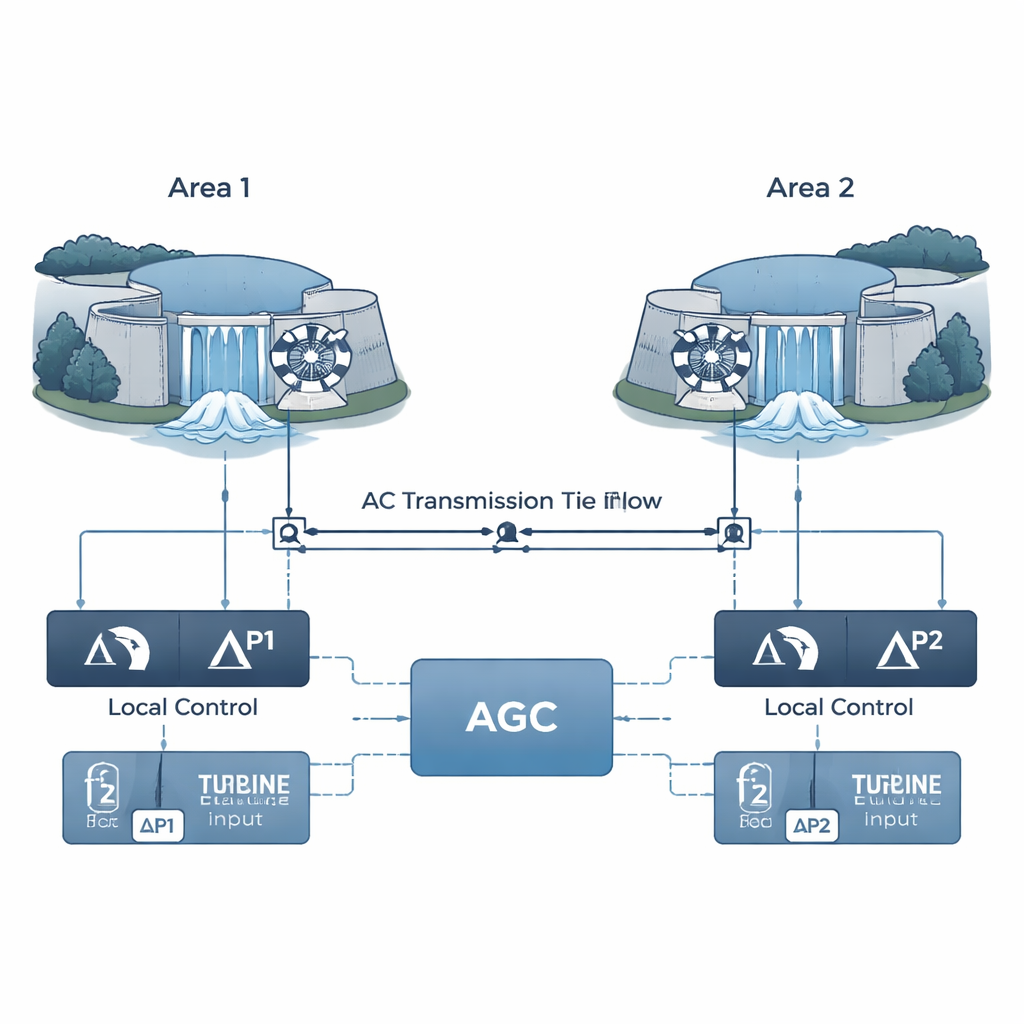
To predict how a power grid will react to disturbances—such as a sudden jump in electricity demand—engineers solve large sets of differential equations. For hydroelectric systems, these equations become especially complicated because water flow through turbines, mechanical parts, and control devices all respond with delays and time lags. When engineers try to design automatic generation control (AGC)—the layer that adjusts power plant output to keep frequency steady—these heavy calculations can slow down both research and real-world deployment. The authors argue that without simpler, yet accurate models, it is difficult to build practical control strategies for complex, renewable-heavy grids.
A Smarter Way to Shrink Complex Models
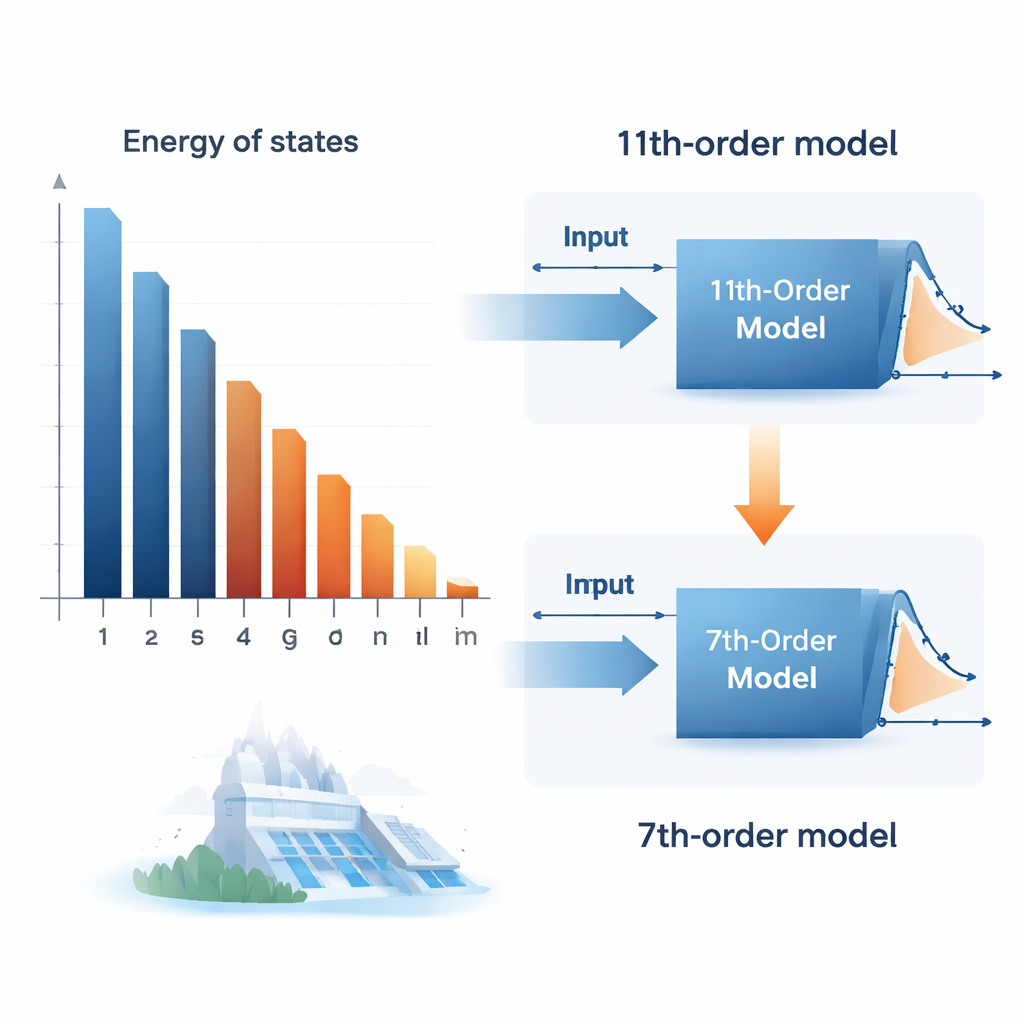
Instead of working with the full, detailed description of the system, the researchers use a technique called Hankel norm approximation. In simple terms, this method measures how much each internal “state” of the system contributes to the overall input–output behavior—how strongly it responds to changes and how visible it is in the output. High-energy states matter a lot; low-energy ones matter very little. By ranking these states, the method lets engineers keep the important parts and safely discard the rest, while still guaranteeing that the simplified model behaves stably and stays close to the original across a range of conditions.
From Eleven Dimensions Down to Seven
The team studies a two-area hydro power system, where two identical hydropower plants are linked by an AC transmission line and jointly regulated by AGC. The full mathematical description of this setup has eleven internal states, capturing generator speeds, governor actions, water flow dynamics, and tie-line power exchange between the two areas. Using Hankel norm approximation, the authors compute the “energy” of each state and find that the first seven dominate the system’s behavior, while the last four contribute very little. This insight allows them to build simplified models with nine, eight, and seven states and then compare their performance with the original.
How Well Do the Simplified Models Behave?
To test the reduced models, the authors simulate sudden load changes in either of the two areas and track key quantities: frequency in each area, the power shared over the tie-line, and the power commanded by the governors. They compare peak values, settling times, and final steady levels. The nine- and eight-state versions closely follow the original eleven-state system, with almost overlapping curves. The seven-state version still captures the main swings and trends, but small differences appear in peak magnitude and steady-state error for some signals. Even so, the seven-state model remains stable and reproduces the essential behavior well enough to be useful for controller design and analysis.
Comparing Two Shortcuts: Hankel vs. Truncation
The study also evaluates a more traditional shortcut called balanced truncation, which reduces the model by balancing how easily each state can be influenced and how easily it can be observed. When both methods are asked to produce a seven-state model, they give similar short-term responses, but differ in accuracy at long times. The Hankel-based reduced model shows noticeably smaller steady-state errors in frequency and tie-line power than the truncation-based model. This means it does a better job of predicting how well AGC will restore the system after a disturbance, while still offering the same kind of computational savings.
What This Means for Future Clean Grids
For a non-specialist, the takeaway is that we can safely compress a complex hydropower control model from eleven key variables down to seven, gaining speed without sacrificing the realism needed for AGC studies. Among the tested approaches, Hankel norm approximation retains crucial behavior more faithfully than a standard truncation method, especially in the final, steady response after a disturbance. As grids add more renewable sources like hydro, wind, and solar, such smart simplifications will be vital for designing fast, reliable control systems that keep the power system stable while relying on cleaner energy sources.
Citation: Naqvi, S., Ibraheem, Sharma, G. et al. A novel Hankel norm approximation-based AGC for a hydro-dominated power system. Sci Rep 16, 5522 (2026). https://doi.org/10.1038/s41598-026-35235-9
Keywords: hydropower, frequency control, model reduction, power system stability, renewable energy integration