Clear Sky Science · en
Isolation and purification of polysaccharides from Centella Asiatica followed by structural characterization and evaluation of antidiabetic activity
Healing Power in a Common Herb
Centella asiatica, better known as Gotu Kola or Brahmi, is a leafy herb used for centuries in Asian and African traditional medicine and even eaten fresh in salads and juices. As diabetes rates rise worldwide, scientists are looking to such familiar plants for gentler ways to help control blood sugar. This study digs into a specific group of large sugar molecules—polysaccharides—from Centella asiatica leaves to see what they look like at the molecular level and whether they can help manage diabetes by slowing the digestion of starches.
From Garden Leaf to Lab Bench
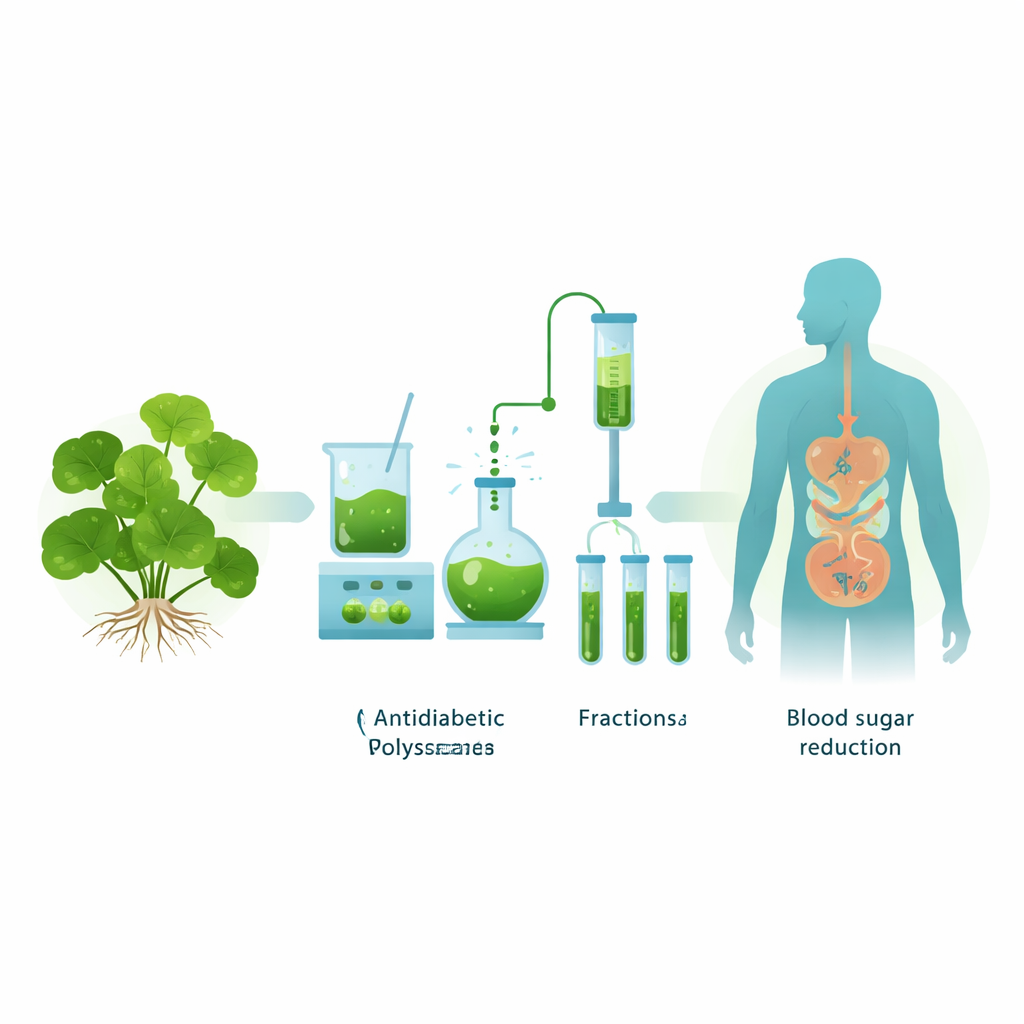
The researchers began by treating dried Centella asiatica leaves with hot water, much like making a strong herbal tea, then using alcohol and other standard steps to pull out the long-chain polysaccharides while washing away proteins and small molecules. They obtained a crude polysaccharide mixture, then passed it through a special column that separates molecules according to electrical charge. This process split the mixture into three distinct fractions, named P50-1, P50-2, and P50-3, each representing a slightly different blend of plant sugars. Such separation is crucial, because even subtle shifts in composition can change how these natural compounds behave in the body.
Finding the Most Active Sugar Blend
To test which fraction might help with diabetes, the team focused on two digestive enzymes: α-amylase and α-glucosidase. These enzymes break down dietary starch into glucose, contributing to the surge in blood sugar after a meal. All three Centella fractions could slow these enzymes to some degree, but P50-2 was clearly the strongest, cutting enzyme activity by about half at the highest tested dose. While it was still less powerful than the standard diabetes drug acarbose, its performance suggested that P50-2 contained a particularly promising combination of plant sugars, making it a prime target for further purification and analysis.
Zooming In on a Standout Molecule
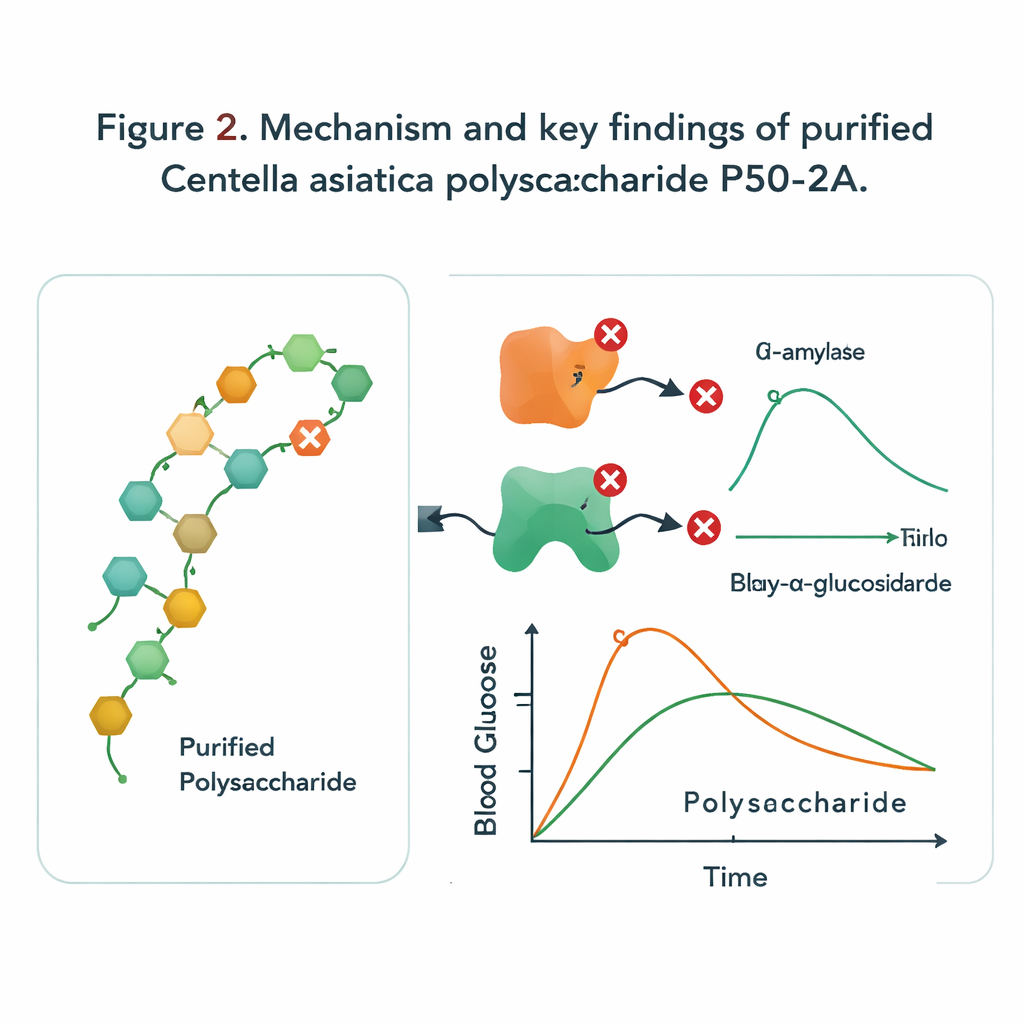
The researchers then purified P50-2 even further using a size-based filtering column, isolating a single, more uniform polysaccharide they named P50-2A. Tests confirmed that this fraction was free of protein and genetic material, meaning they were working with a clean carbohydrate. P50-2A turned out to be huge by molecular standards—about 3 million Daltons in mass—and built from a mix of simple sugars, including galactose, arabinose, glucose, mannose, and sugar acids. Using infrared spectroscopy and chemical “fingerprinting,” the team showed that P50-2A is a type of arabinogalactan, a branched, tree-like sugar structure. Electron microscopy revealed an irregular, spongy surface riddled with pores, while X-ray analysis showed that it has both ordered (crystalline) and disordered (amorphous) regions, a pattern often seen in natural plant materials.
How Purity and Shape Affect Blood Sugar Enzymes
When the scientists tested P50-2A on the same digestive enzymes, it outperformed the original P50-2 mixture, suggesting that cleaner, more uniform polysaccharides interact more effectively with the enzyme surfaces. At practical concentrations, P50-2A inhibited α-amylase and α-glucosidase strongly but still somewhat less than acarbose. Its rich content of sugar acids and branching points likely improves how it fits and sticks to the enzymes, blocking their ability to chop up starch into glucose. Because these plant polysaccharides are not simple sugars themselves but large, slowly processed molecules, they could help flatten blood sugar spikes after a meal without acting like an added sugar load.
What This Means for Everyday Health
In plain terms, this study shows that a carefully purified, complex sugar from Centella asiatica leaves can partially slow the enzymes that turn starchy foods into blood sugar. While it is not a replacement for diabetes medication, it could eventually become part of a “food as medicine” approach—built into functional foods, supplements, or nutraceutical products aimed at easing post-meal sugar surges. Just as important, the work provides a detailed map of P50-2A’s structure, giving researchers a blueprint to refine similar plant-based molecules and test them in animals and humans. For people seeking gentler, plant-derived options to support blood sugar control, Centella asiatica’s polysaccharides now look like promising candidates worthy of further study.
Citation: Li, M., Xiong, T., Bi, J. et al. Isolation and purification of polysaccharides from Centella Asiatica followed by structural characterization and evaluation of antidiabetic activity. Sci Rep 16, 5524 (2026). https://doi.org/10.1038/s41598-026-35232-y
Keywords: Centella asiatica, polysaccharides, diabetes, blood sugar control, natural remedies