Clear Sky Science · en
Effect of type of farming practices on the soil carbon sequestration and yield of some crops
Why how we farm matters for the air we breathe
Most of the carbon stored on land is hidden under our feet, locked away in soil. That underground reservoir plays a quiet but important role in climate change and in feeding the world. This study asks a simple but far-reaching question: can changing how we farm—from conventional chemical-intensive methods to organic or biodynamic approaches—help soil store more carbon, use water more wisely, and still deliver good harvests and profits for farmers?

Three ways to run the same farm
The researchers worked for five years on a sandy farm in Egypt, growing four familiar crops: maize, tomato, faba bean, and potato. They split the land into 27 plots and managed them using three distinct systems. Conventional plots received mineral fertilizers and synthetic pesticides. Organic plots relied on compost, compost tea, biogas manure, natural rock powders, and biological pest controls, with no synthetic chemicals. Biodynamic plots used the same organic inputs plus special biodynamic preparations, including small doses of horn manure and silica sprays. By keeping the crops, climate, and irrigation the same, they could focus on how the farming style itself shaped the soil, water use, yields, and economics.
What happened to the soil
Over the five years, the soil under organic and biodynamic management became physically and chemically healthier than under conventional farming. Bulk density—a measure of how compact and heavy the soil is—fell in all systems, but dropped most under biodynamic management, making the soil looser and better aerated. Water-holding capacity rose in every system, yet it climbed higher and faster in organic and biodynamic plots, meaning the soil could retain more moisture between irrigations. Chemically, conventional fertilization tended to push soil pH slightly higher and electrical conductivity (a marker linked to salinity) to the highest levels. In contrast, organic and biodynamic systems boosted soil organic matter and organic carbon, as well as key nutrients such as nitrogen, phosphorus, and potassium, all without the same rise in salinity.
Water, harvests, and efficiency
Irrigation water use told an interesting story. Across all four crops, conventional plots consistently consumed the most water, while organic and biodynamic plots used markedly less. Water savings with these alternative systems reached roughly 16–26% depending on the crop. Yields painted a more nuanced picture. At the start of the experiment, conventional plots generally produced higher harvests, reflecting the quick boost from mineral fertilizers. However, as soil conditions improved over time, yields rose in every system and the gap narrowed. By the fifth year, maize, tomato, faba bean, and potato yields had all increased noticeably under organic and biodynamic management, and water use efficiency—kilograms of crop per cubic meter of water—was higher in these systems than in the conventional plots.
Storing carbon and cutting emissions
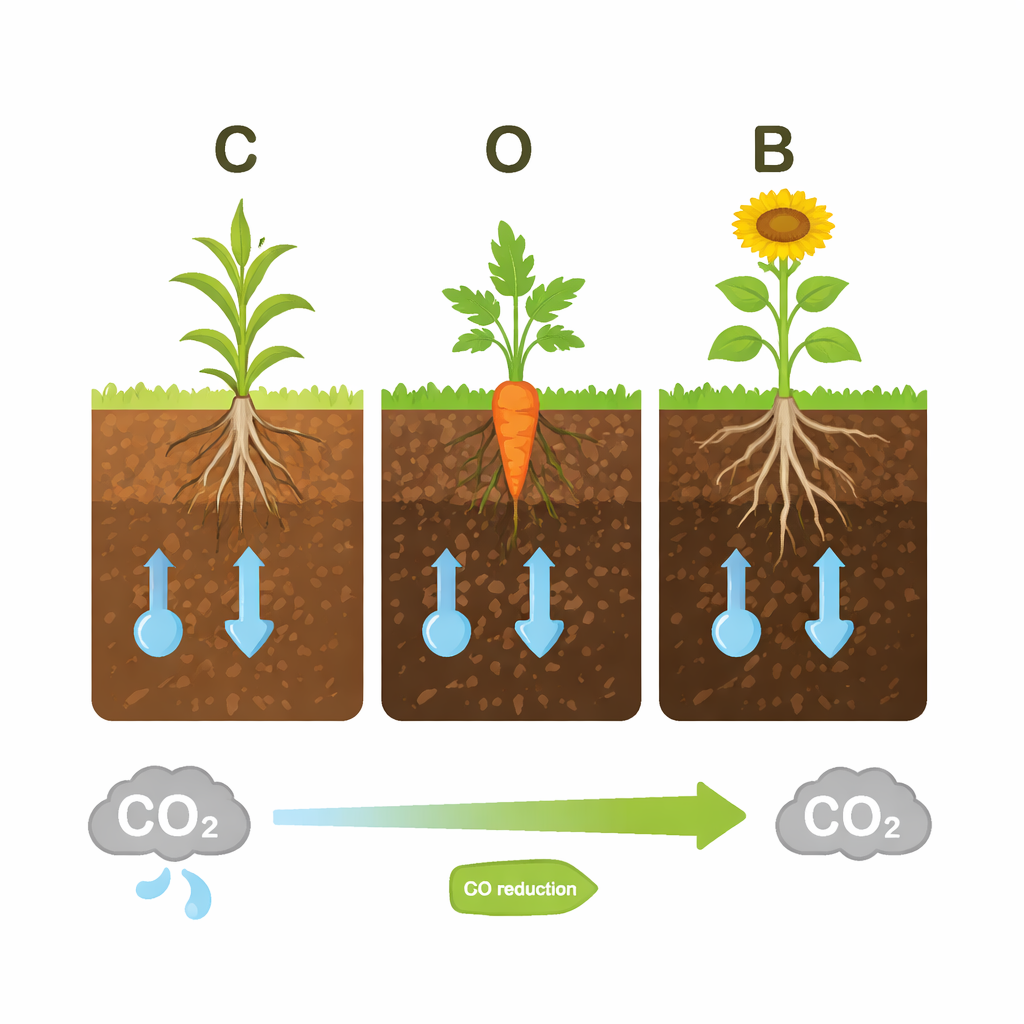
Because soil organic carbon is mostly made of plant-derived material, the team tracked how much extra carbon was being sequestered under each system. Organic and biodynamic plots stored substantially more carbon in the soil than conventional plots, especially by the third year. This extra storage translated into larger reductions in carbon dioxide emissions when expressed in climate terms. Over the five years, the amount of CO2 effectively pulled out of the atmosphere was much greater in the organic and biodynamic systems, turning these fields into more powerful climate allies. When the researchers converted these gains into carbon-market terms, the financial "carbon profit" was also highest for the biodynamic system.
Profits from healthier soil
Farming decisions ultimately hinge on money as well as environmental ideals, so the study carefully tallied all costs and returns. Total costs covered fertilizers, seeds, labor, energy, irrigation, and pest control. Despite sometimes higher input costs for biological products, organic and biodynamic systems benefited from improved soil, better water use, and—importantly—solid market value for their produce. After five years, organic farming delivered the highest total net profit for all four crops, even though the selling price in the analysis was kept the same across systems. Biodynamic farming, meanwhile, delivered the largest income from carbon sequestration. Together, these results suggest that moving away from conventional methods need not be a financial sacrifice; under the right conditions, it can be a path to both climate benefits and stronger farm incomes.
What this means for everyday food and climate
For non-specialists, the message is straightforward: how food is grown can change the soil from a carbon source into a carbon sink, while also saving water and keeping farms profitable. On this Egyptian farm, organic and biodynamic practices gradually built richer, more sponge-like soil that held more carbon and used less irrigation, yet still produced competitive harvests and higher long-term profits. If such approaches are scaled up and adapted to local conditions around the world, they could help secure food supplies, support farmer livelihoods, and quietly lock more climate-warming carbon safely underground.
Citation: Khater, ES., Bahnasawy, A., Hamouda, R. et al. Effect of type of farming practices on the soil carbon sequestration and yield of some crops. Sci Rep 16, 4368 (2026). https://doi.org/10.1038/s41598-026-35230-0
Keywords: soil carbon, organic farming, biodynamic agriculture, water use efficiency, climate-smart agriculture