Clear Sky Science · en
An evaluation system for regional cultural suitability of urban cross-river bridges: insights into the liberation bridge in Tianjin
Why Bridges Are More Than Just Roads in the Air
When most people cross a bridge, they think about getting from one side of the river to the other as quickly and safely as possible. Yet bridges also frame our views, host our memories, and help define how a city feels. This article explores a new way to judge urban cross-river bridges not only by how well they carry traffic, but by how well they express local culture and fit into everyday city life. Using Tianjin’s Liberation Bridge in China as a test case, the researchers show how numbers, expert opinions, and public surveys can be combined to measure a bridge’s “cultural suitability.” 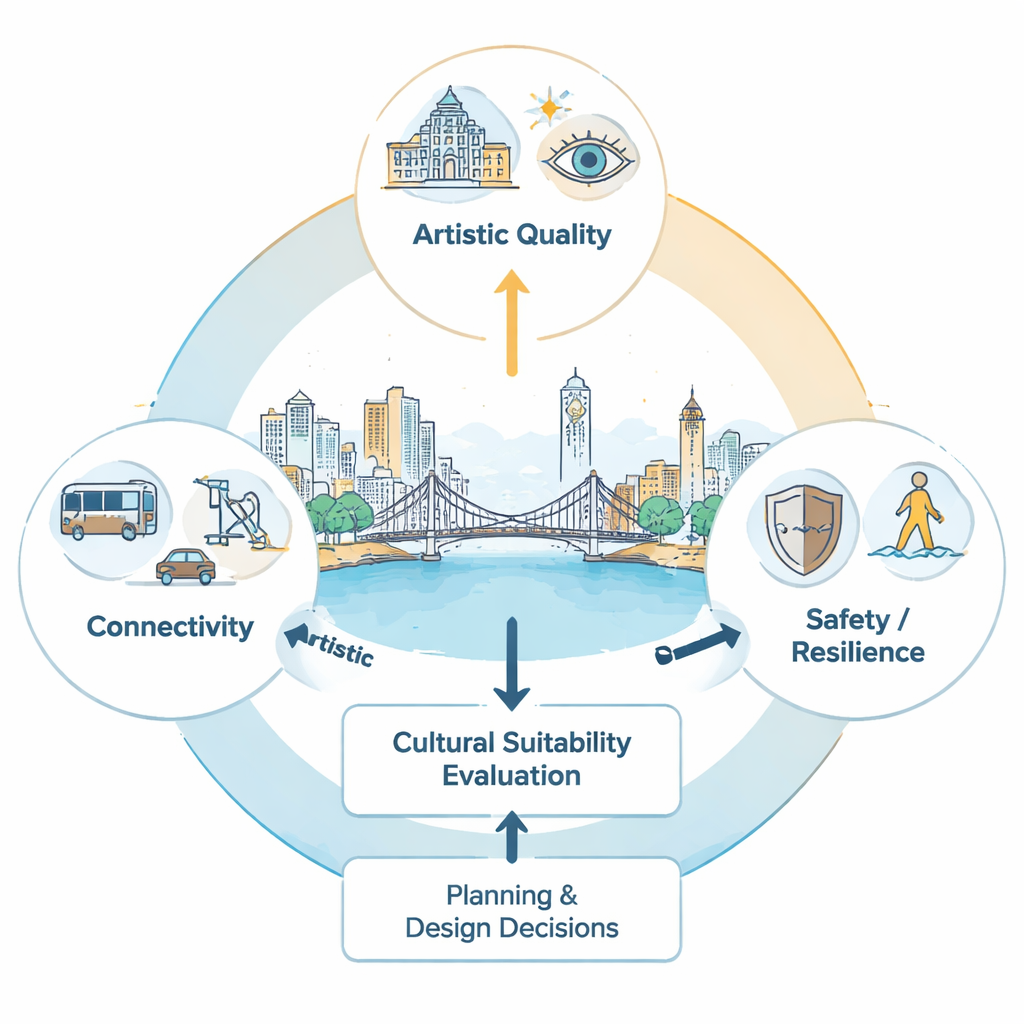
From Steel and Concrete to Stories and Identity
Urban bridges have long been treated as feats of engineering: they must be strong, durable, and able to handle heavy traffic. In many big cities, however, cross-river bridges have also become visual landmarks and cultural symbols. They shape skylines, attract tourists, and help residents feel connected to their city’s history. Despite this, most official evaluation systems still focus on things like load capacity and safety checks, leaving out questions such as: Does this bridge reflect local character? Does it create a pleasant place to walk, look around, and gather? The authors argue that this gap keeps cities from making the most of their bridges as cultural assets.
Turning Culture Into Something You Can Measure
To tackle this problem, the researchers propose an evaluation framework called the Regional Cultural Suitability of Urban Cross-River Bridges, or RCSUCRB. Instead of looking only at technical data, the framework brings together six dimensions that capture both everyday use and cultural meaning: spatial accessibility, network convenience, bridge quality, spatial integration, traffic rationality, and interactive participation. Behind these simple labels lies a carefully built index of 25 indicators, ranging from road density and accident rate to night lighting effects, historical associations, and how strongly people feel the bridge represents the city. Because judgments about culture are often vague and subjective, the team uses a “fuzzy” mathematical method and the Analytic Hierarchy Process to blend expert scores, field measurements, and survey responses into a single, balanced result.
A Closer Look at Tianjin’s Liberation Bridge
The Liberation Bridge, a double-opening bridge over the Haihe River in central Tianjin, offered an ideal testing ground. Surrounded by busy streets, historic districts, offices, and riverside promenades, it serves as both a traffic hub and a popular viewing point. The researchers mapped land use within 500 meters, collected hard data on traffic, flooding risk, and road layout, and surveyed nearly 300 residents and visitors about their experiences. People were asked how attractive they found the bridge, whether it helped express Tianjin’s identity, and how safe and convenient they felt when using it. The responses were translated into membership scores—degrees to which each indicator could be considered excellent, good, or poor—and then processed through the fuzzy evaluation model. 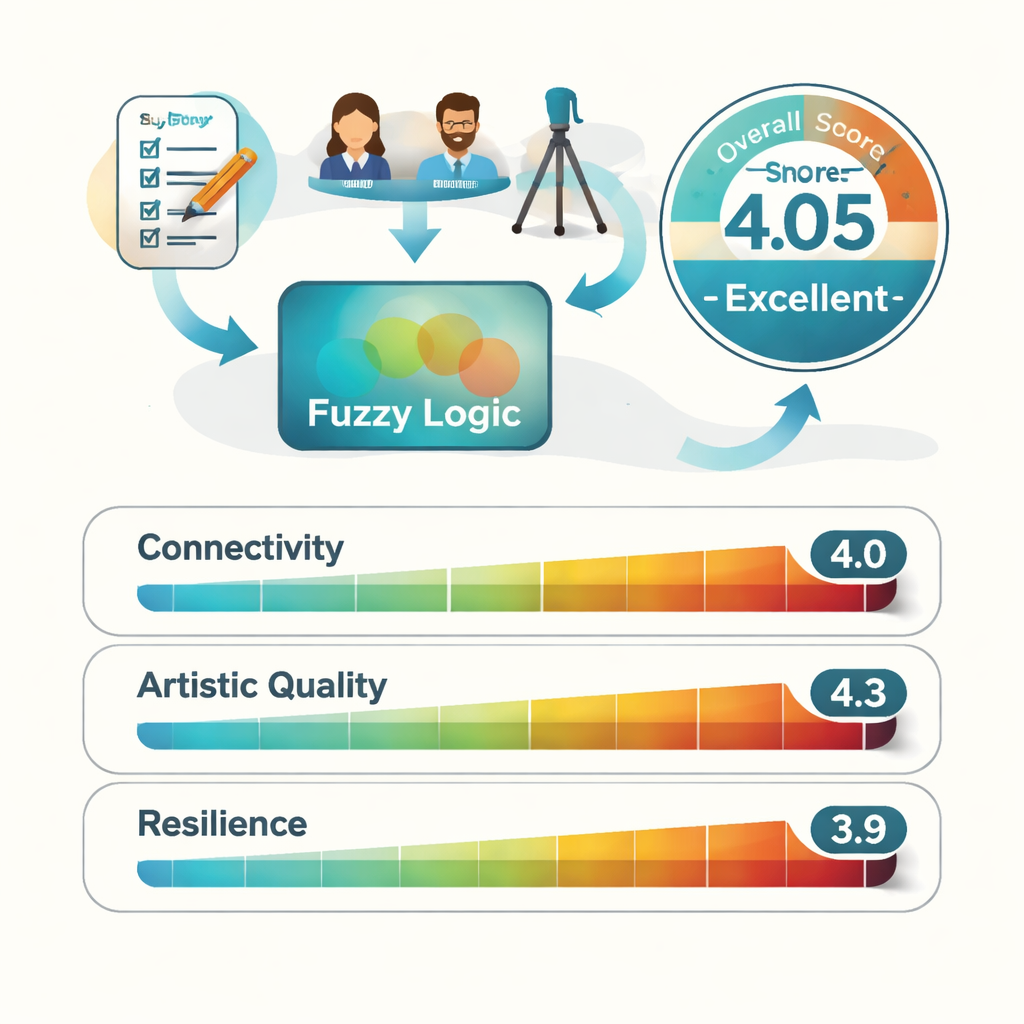
How the Bridge Scored and What It Reveals
The final results show that Liberation Bridge performs strongly as a cultural landmark. Its overall cultural suitability score is 4.054 on a five-point scale, placing it in the “excellent” category. Artistic quality stands out, with a score of 4.323, reflecting the bridge’s distinctive appearance, lighting, and strong reputation among locals. Spatial integration also ranks very high, meaning the bridge’s views, open spaces, and historical connections work well with the surrounding cityscape. Connectivity and resilience—how well the bridge fits into the transport network and handles safety and environmental risks—are rated slightly lower but still “good,” aided by dense public transport links, low accident rates, and dedicated pedestrian space. At the same time, the model exposes weaker points, such as older housing nearby and some indicators tied to how long people linger or stop around the bridge.
What This Means for Future Bridges
By proving that cultural factors can be described, weighed, and scored in a structured way, this study offers city planners and designers a new tool. The authors suggest that similar frameworks, adapted to local traditions and values, could guide decisions about building new bridges or upgrading old ones. For Tianjin, the findings support efforts to improve surrounding public spaces, traffic management, and cultural programming while preserving the bridge’s historic character. More broadly, the work underlines a simple message for non-specialists: a “good” bridge in today’s cities is not just safe and efficient; it also tells a local story, encourages people to walk and look around, and strengthens the bond between residents and the place they call home.
Citation: He, S., Liu, Z., Shang, X. et al. An evaluation system for regional cultural suitability of urban cross-river bridges: insights into the liberation bridge in Tianjin. Sci Rep 16, 5516 (2026). https://doi.org/10.1038/s41598-026-35225-x
Keywords: urban bridges, cultural suitability, Tianjin Liberation Bridge, bridge design, city identity