Clear Sky Science · en
Fuzzy optimization of municipal solid waste collection routing under uncertain emissions
Why Rethinking Trash Routes Matters
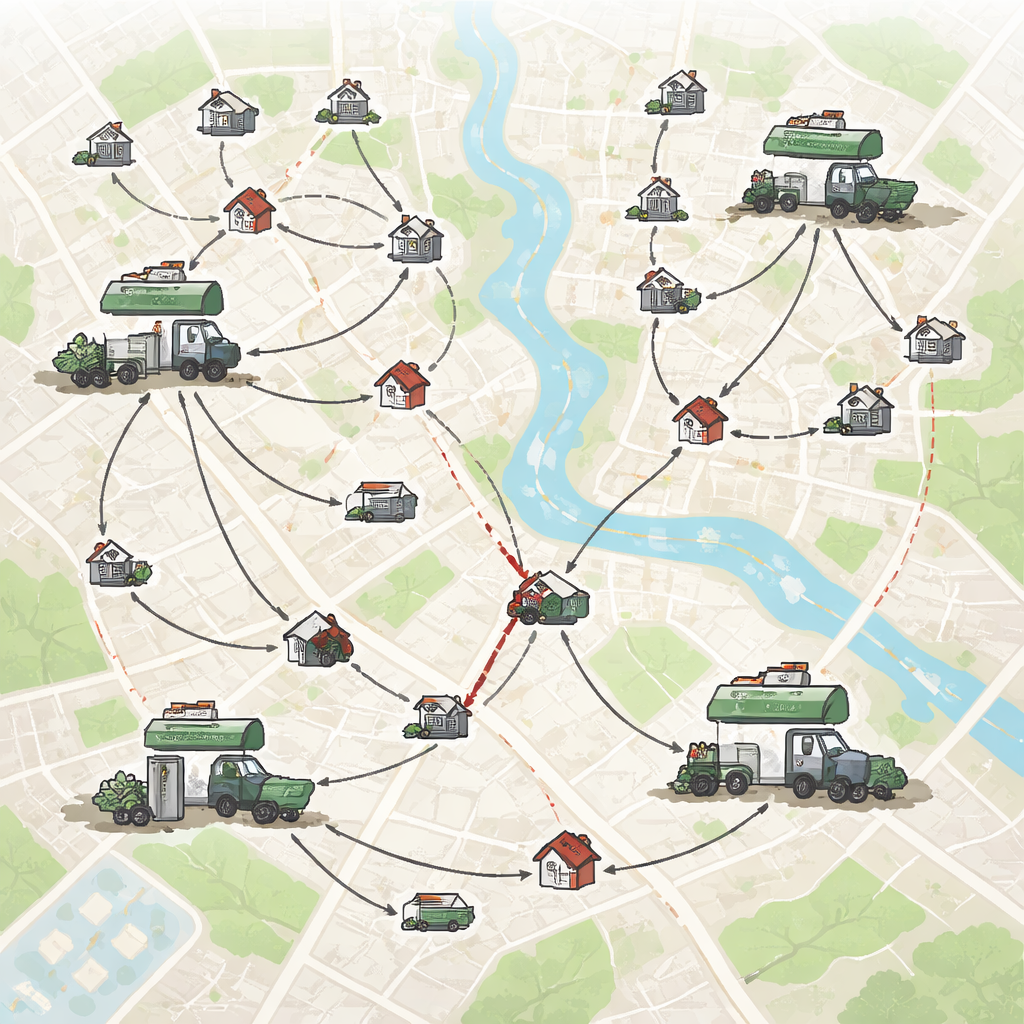
Every day, cities send out fleets of garbage trucks on tightly timed routes so that streets stay clean and neighborhoods remain livable. But the amount of trash that shows up at each bin or collection point can swing wildly with holidays, storms, big events, or sudden disruptions. When city planners assume that waste is perfectly predictable, trucks can end up overloaded, making extra trips, or leaving rubbish behind. This study explores how to design smarter collection routes that explicitly account for such uncertainty, helping cities save money while keeping service reliable.
Messy Realities Behind Everyday Garbage
Municipal solid waste comes from homes, shops, restaurants, offices, and public spaces. Globally, people now generate more than two billion tons of such waste each year, with projections of almost double that by 2050. Collecting and transporting this material is one of the most expensive parts of waste management, often accounting for 60 to 70 percent of total costs. In many cities, including those studied here, collection systems lag behind modern treatment plants, making it crucial to squeeze more efficiency out of trucks, depots, and routes. The catch is that the volume of waste at each pickup point is not fixed, but shaped by human behavior and outside events that are hard to forecast precisely.
From Fixed Numbers to Fuzzy Expectations
Most earlier research treated the amount of waste at each stop as a fixed number or tried to fit a precise probability curve using large amounts of historical data. Both approaches struggle in practice: detailed data are often scarce, and fixed assumptions ignore the swings seen during real-world operations. This study instead uses a "fuzzy" description of emissions, built around trapezoidal fuzzy numbers. In plain terms, each stop is assigned a reasonable range of likely waste amounts, with a central band that is especially plausible rather than a single best guess. The model then requires that any planned route has a high enough chance of staying within each truck’s capacity, according to a confidence level chosen by the city’s decision makers.
Designing Routes with Flexibility Built In
Given this fuzzier but more realistic picture, deciding which trucks should serve which neighborhoods becomes a complex puzzle with many possible answers. To tackle it, the authors build an optimization model for a city with several transfer stations and many collection points, all served within a narrow morning time window. They then craft a specialized search procedure called ALNS-TS, which mixes an adaptive large neighborhood search with a tabu search mechanism. In essence, the algorithm repeatedly tears apart and rebuilds candidate routes, learning which changes tend to cut cost while using a short-term memory to avoid getting stuck in repetitive or subpar patterns. This allows it to explore many routing options quickly, even when the underlying problem is very large.
What Happens When Uncertainty Is Respected
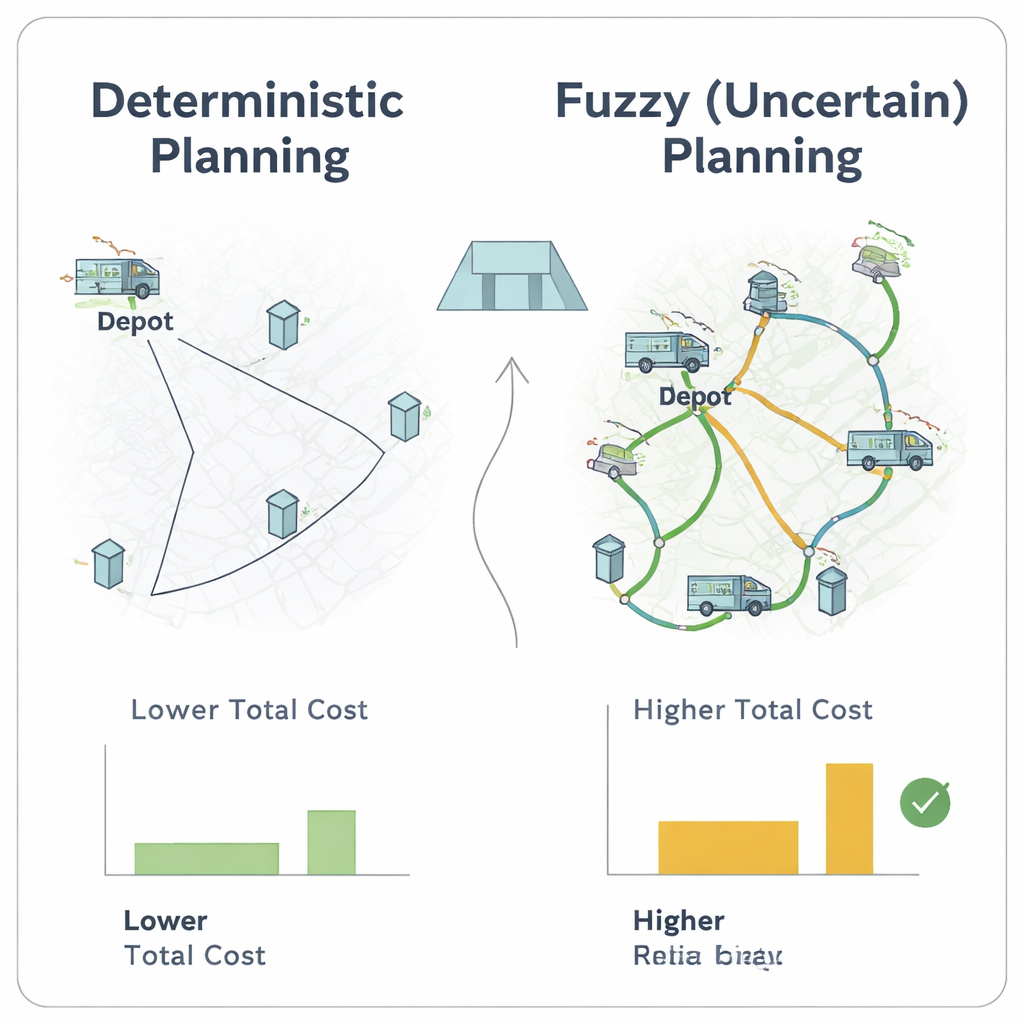
Using standard benchmark datasets, the researchers compare plans built under two assumptions: one where waste at each point is treated as exactly known, and one where it follows the fuzzy ranges. As expected, routes that ignore uncertainty look cheaper on paper: trucks travel fewer kilometers, and fewer vehicles are needed. However, once fluctuating emissions are taken seriously, extra mileage and additional trucks become necessary to avoid overloads and failed collections. The study also shows that higher desired confidence levels—meaning city managers are less willing to risk missed pickups—lead to steadily higher operating costs. Through sensitivity tests, the authors identify a middle-ground confidence setting that offers strong reliability without excessive expense.
Smarter Algorithms for Cleaner Cities
To check whether their solution method is worth the effort, the authors pit ALNS-TS against several popular optimization techniques, including a basic adaptive search, a genetic algorithm, and ant colony optimization. Across a variety of test cases, the hybrid method finds routes with lower total cost while using only modestly more computing time than simpler heuristics. From a practical perspective, this means a city agency could generate high-quality routing plans overnight or even within the span of a daily planning cycle, while explicitly accounting for uncertain trash volumes and chosen service standards.
What This Means for City Residents
For non-specialists, the main message is that garbage collection can be made both more reliable and more efficient by openly admitting that waste is unpredictable and planning around that fact. Instead of pretending that every bin fills at a fixed rate, this work models a realistic range for each stop and lets city managers decide how much risk of overflow or missed collection they are willing to tolerate. The result is a set of routes that may use a bit more fuel and a few more trucks but sharply reduce the chances of uncollected waste piling up on sidewalks. In short, by blending fuzzy descriptions of trash levels with advanced routing algorithms, cities can keep streets cleaner while using their resources more wisely.
Citation: Zhang, Y., Wei, Y., Zhang, B. et al. Fuzzy optimization of municipal solid waste collection routing under uncertain emissions. Sci Rep 16, 4857 (2026). https://doi.org/10.1038/s41598-026-35209-x
Keywords: waste collection routing, municipal solid waste, uncertainty modeling, fuzzy optimization, heuristic algorithms