Clear Sky Science · en
Association between serum alpha Klotho levels and the likelihood of abdominal aortic calcification
Why this matters for healthy aging
As people get older, their arteries can slowly harden with tiny calcium deposits, raising the risk of heart attacks, strokes, and other serious problems. This study looks at alpha-Klotho, a blood-borne protein often called an “anti-aging” factor, and asks a simple question with big implications: do people with more of this protein have less dangerous calcium buildup in a major blood vessel in the belly called the abdominal aorta?
Aging arteries and hidden calcium
Calcium in the walls of blood vessels, known as vascular calcification, is common in older adults and in people with conditions like kidney disease, diabetes, high blood pressure, and smoking. One frequent hotspot is the abdominal aorta, the main artery that carries blood from the heart to the lower body. Even when people feel fine, calcification in this artery is linked to weaker bones, serious falls, and a higher chance of dying from heart and blood-vessel disease. Doctors can estimate how much calcium is there using special spine scans that produce an “abdominal aortic calcification” (AAC) score: the higher the score, the more calcium.
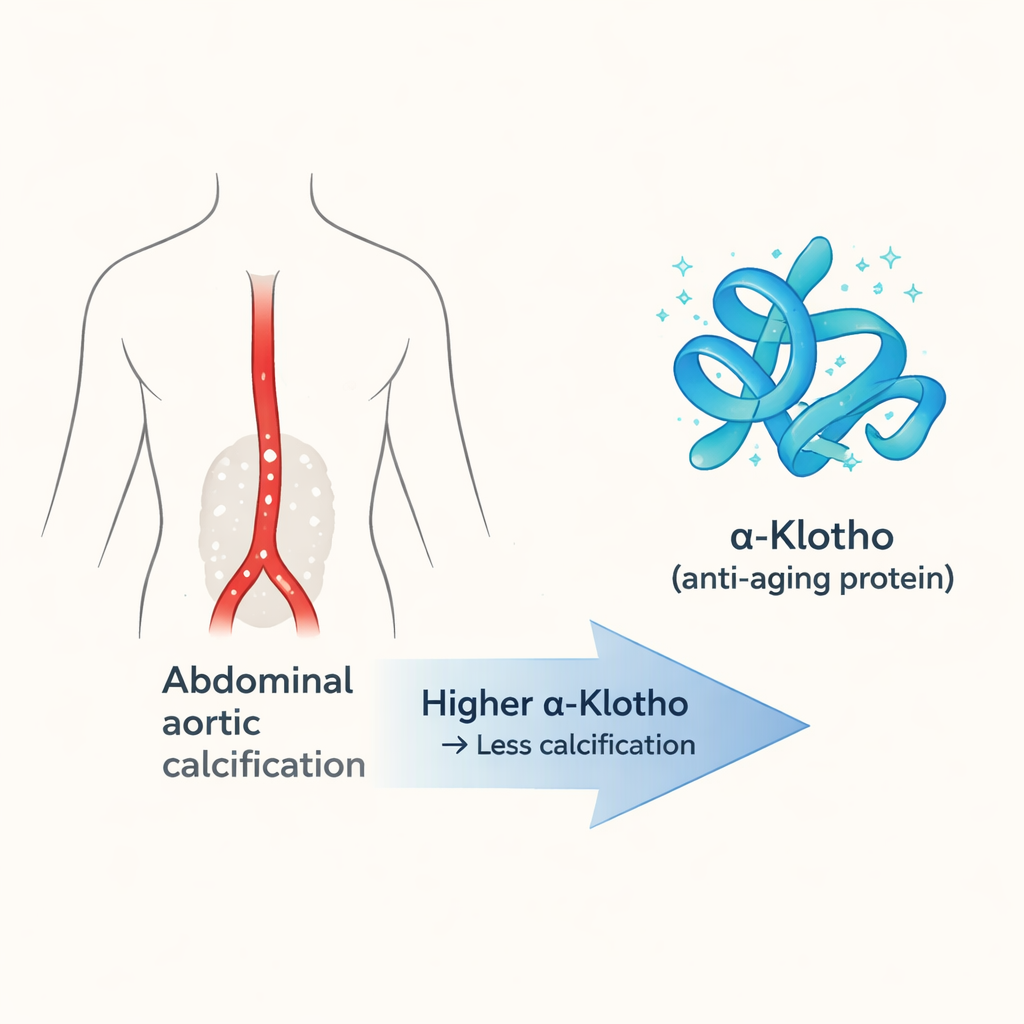
An anti-aging protein under the microscope
Alpha-Klotho is a protein made mainly in the kidneys and brain that helps regulate minerals, protect cells from stress, and support heart and kidney health in animal studies. Mice with extra Klotho live longer and show less age-related damage, while animals that lack it develop early aging signs, stiff arteries, and heart problems. In humans, lower blood Klotho levels have been tied to higher blood pressure, kidney injury, and a greater risk of death. These clues led researchers to wonder whether people with more Klotho in their blood might also be protected against calcium buildup in major arteries such as the abdominal aorta.
What the researchers did
The team analyzed data from 2,411 U.S. adults aged 40 and older who took part in the 2013–2014 National Health and Nutrition Examination Survey (NHANES). All participants had a blood test for alpha-Klotho and a spine scan to measure AAC. Researchers sorted people into four groups based on their Klotho levels, from lowest to highest, and then used advanced statistical methods to compare AAC scores. They carefully adjusted for many other influences on artery health, including age, sex, weight, blood pressure, cholesterol, blood sugar, kidney function, smoking, alcohol use, and more. They also checked whether the Klotho–AAC link differed across subgroups, such as men versus women, smokers versus non-smokers, and people with or without high blood pressure or diabetes.
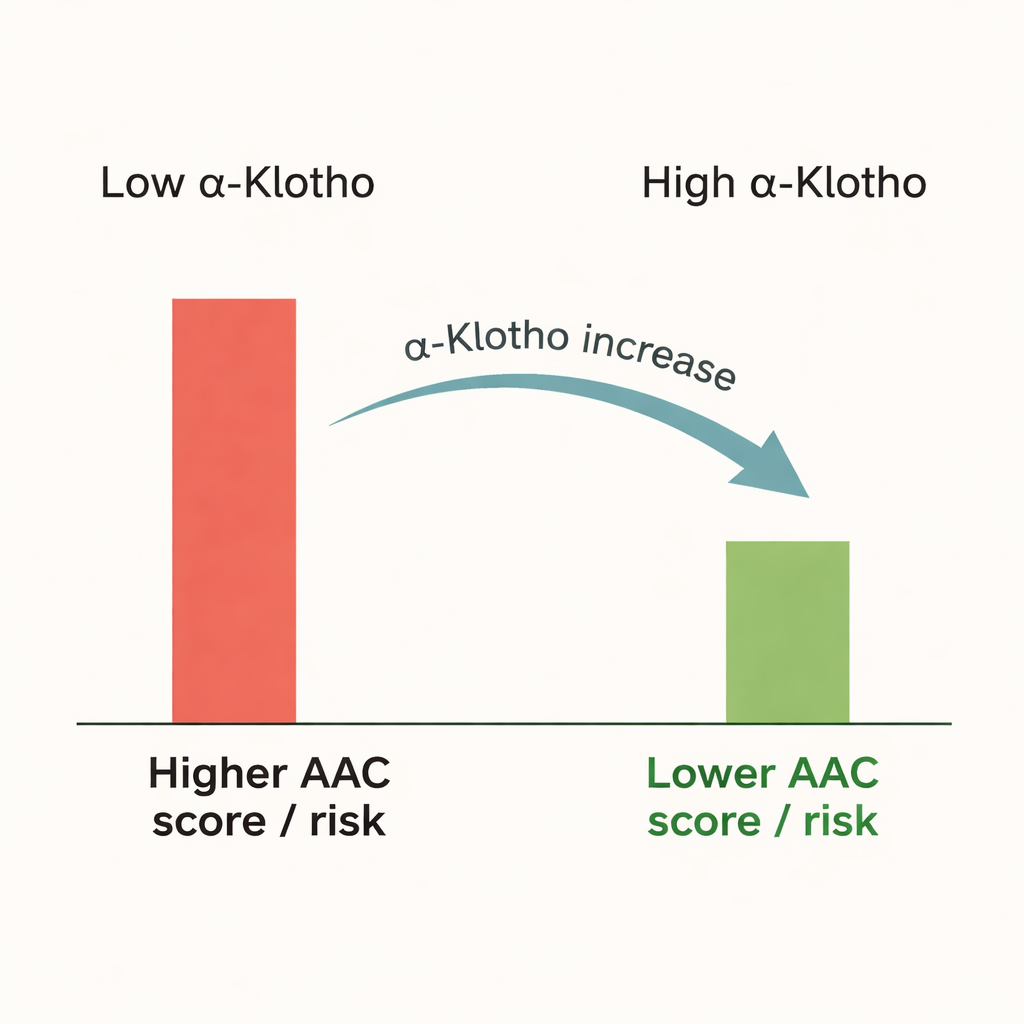
Higher Klotho, less artery calcium
People in the highest Klotho group had clearly less calcium in their abdominal aortas than those in the lowest group. Their average AAC scores were lower, and the share of participants with “severe” calcification (an AAC score above 6) fell from about 9% in the lowest Klotho group to about 4% in the highest. After accounting for dozens of other risk factors, those with the highest Klotho levels had AAC scores about 0.7 points lower on average and roughly half the odds of severe calcification compared with those with the lowest levels. The relationship was especially strong in men and in certain higher-risk groups such as people with high blood pressure and former smokers. When the researchers looked more closely at the data curve, they found that increasing Klotho seemed most protective up to a middle range; beyond that, the benefit plateaued.
How Klotho might shield the arteries
Although the study cannot prove cause and effect, it fits with growing evidence that Klotho helps keep blood vessels flexible and less prone to mineral buildup. Experimental studies suggest Klotho may limit how much phosphate (a mineral that can drive calcification) enters vessel wall cells, dampen harmful oxidative stress and inflammation, and encourage “self-cleaning” processes inside cells that block their transformation into bone-like cells. Lifestyle choices such as regular aerobic exercise and diets rich in antioxidant-rich fruits and vegetables, as well as vitamin D in some kidney patients, have been linked in other research to higher Klotho levels, hinting at possible ways to support this protective system.
What this means going forward
For a layperson, the takeaway is that people with more of the anti-aging protein alpha-Klotho in their blood tend to have less calcium hardening in a major artery that predicts serious heart and circulation problems. The findings do not yet mean doctors should routinely test Klotho or give Klotho-based treatments; current tests are not standardized, and the study looked at a single moment in time rather than following people over years. But the work strengthens the idea that Klotho is a promising marker of artery health and a potential future target for preventing or slowing age-related damage to blood vessels.
Citation: Liang, D., Liu, C. & Yang, M. Association between serum alpha Klotho levels and the likelihood of abdominal aortic calcification. Sci Rep 16, 4930 (2026). https://doi.org/10.1038/s41598-026-35205-1
Keywords: vascular calcification, alpha-Klotho, abdominal aorta, cardiovascular risk, healthy aging