Clear Sky Science · en
Orientation driven design and mechanical optimization of gyroid TPMS lattice structures
Lightweight structures that behave like shock absorbers
From bike helmets to airplane wings and medical implants, engineers are searching for materials that are light yet able to soak up heavy impacts. This study looks at a curious, sponge‑like shape called a gyroid and asks a simple but powerful question: if we rotate this shape in different ways before 3D printing it, can we control how it bends, buckles, and absorbs energy?
A maze of repeating curves
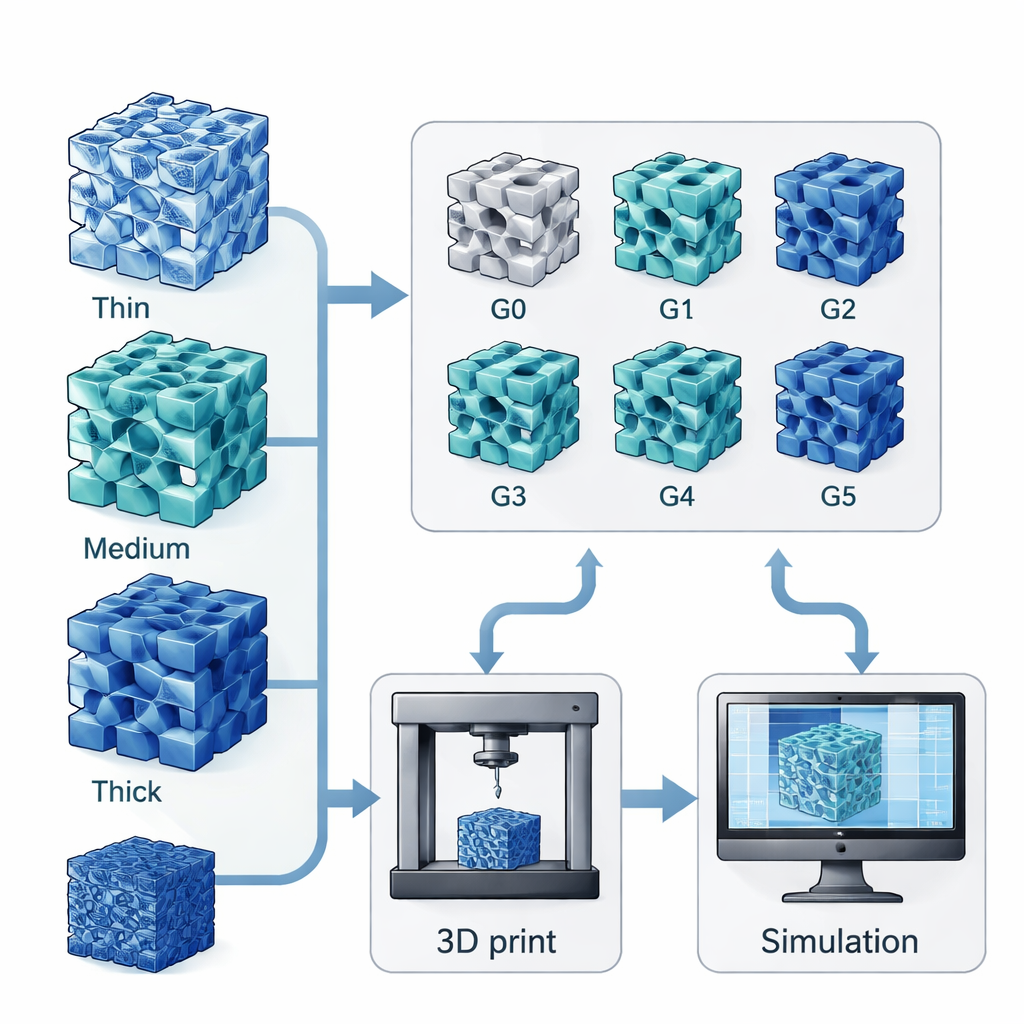
Gyroids belong to a family of shapes known as triply periodic minimal surfaces. In plain terms, they are smooth, endlessly repeating 3D mazes of solid and empty space. Because they are mostly air, they can be very light, yet their continuous curves spread loads smoothly, avoiding sharp corners where cracks like to start. The authors focused on one gyroid design and changed only its internal orientation in space. They created six versions, labeled G0 to G5, by rotating the tiny repeating cell at angles ranging from 0° to 180° relative to the loading direction. Each version was turned into a small test block using common plastic filament (PLA) on a desktop 3D printer, then squeezed in a compression machine to see how stiff, strong, and energy‑absorbing it would be.
Turning the same shape in different directions
The clever twist in this work is that nothing about the basic gyroid pattern, size of the repeating cell, or material was changed—only its orientation and the thickness of the thin walls that form the solid parts. By rotating the cell, the researchers changed how the internal channels line up with the direction of the applied load. Some versions had more of their internal “ribs” running along the loading direction, while others were angled or more randomly aligned. The team also increased wall thickness from 0.4 to 0.8 millimeters, which raised the amount of solid material but kept the outer size of the blocks the same. This allowed them to cleanly separate the effects of direction and density. Alongside the experiments, they built detailed computer models to simulate compression, track where stresses concentrate, and check how closely numerical predictions match reality.
From gentle bending to strong stretching
Both physical tests and simulations told a consistent story. The reference structure, G0, behaved like a classic cushioning foam: it was relatively soft, with thin ribs that bent and buckled in the middle of the block, creating a band of collapse. As the gyroid was re‑oriented in models G1, G3, and especially G5, more of the internal ribs lined up with the loading direction. These versions became noticeably stiffer and stronger, and they could absorb more energy before being crushed. As wall thickness increased, the way the structures carried load shifted from bending of slender ribs to more direct stretching and shearing along straighter load paths. The researchers quantified this behavior using established scaling laws that relate stiffness and strength to how much solid material is present, finding excellent agreement with the well‑known Gibson–Ashby model. This means the gyroid’s performance can be predicted and tuned using relatively simple formulas once its orientation and density are known.
Seeing inside the crush
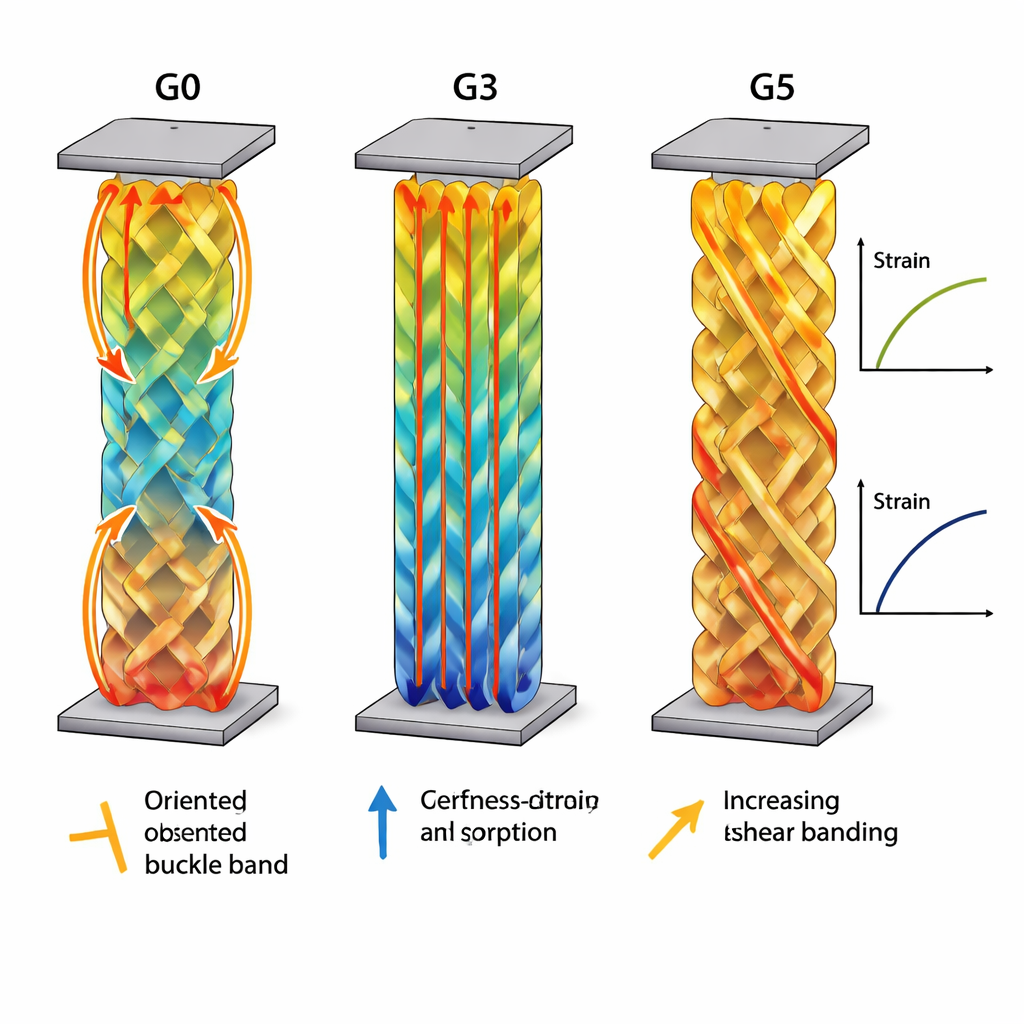
To understand how these tiny mazes fail, the team examined high‑magnification images and compared them with computer‑generated views of deformation. G0 showed symmetric buckling in the middle, consistent with a bending‑dominated “soft” collapse. G3 compressed more evenly along its height, with damage spreading gradually rather than forming a single failure band. G5 developed slanted shear bands, where entire diagonal layers yielded one after another, supporting high loads over a longer stretch of strain. When the team recalculated stresses using the true internal load‑bearing area—rather than treating each block as solid—they found that these oriented versions, especially G3 and G5, delivered the best combination of high stress, stable plateau behavior, and large energy absorption. In short, simply turning the same geometry gave rise to distinct mechanical personalities.
Designing smarter lightweight parts
For non‑specialists, the key message is that gyroid lattices are not just light; they can be steered. By rotating the repeating pattern and modestly adjusting wall thickness, engineers can decide whether a part should behave more like a soft cushion, a stiff pillar, or something in between. The study shows that certain orientations—those with ribs more aligned to the main load—are ideal for protecting against impacts in cars, aircraft, and helmets, or for supporting bones in implants while still allowing space for tissue growth. Because the experimental data line up well with computer models and simple scaling rules, designers can now use this orientation‑driven strategy to “dial in” the desired stiffness and crash behavior before printing, turning the gyroid from a mathematical curiosity into a practical building block for next‑generation lightweight structures.
Citation: El-Asfoury, M.S., El-Bedwehy, N.E., Shazly, M. et al. Orientation driven design and mechanical optimization of gyroid TPMS lattice structures. Sci Rep 16, 4373 (2026). https://doi.org/10.1038/s41598-026-35201-5
Keywords: gyroid lattices, 3D printed metamaterials, lightweight energy absorption, triply periodic minimal surfaces, architected materials design