Clear Sky Science · en
Optimization of proton exchange membrane fuel cell design parameters using Tianji’s horse racing optimization
Racing toward cleaner power
Hydrogen fuel cells promise quiet, clean electricity for cars, homes, and backup power systems—but only if we can model and control them accurately. This paper shows how an unusual algorithm inspired by an ancient Chinese horse-racing story can tune fuel cell models far more precisely than many modern competitors, potentially making hydrogen technologies more reliable and easier to integrate into real-world energy systems.
How these fuel cells make electricity
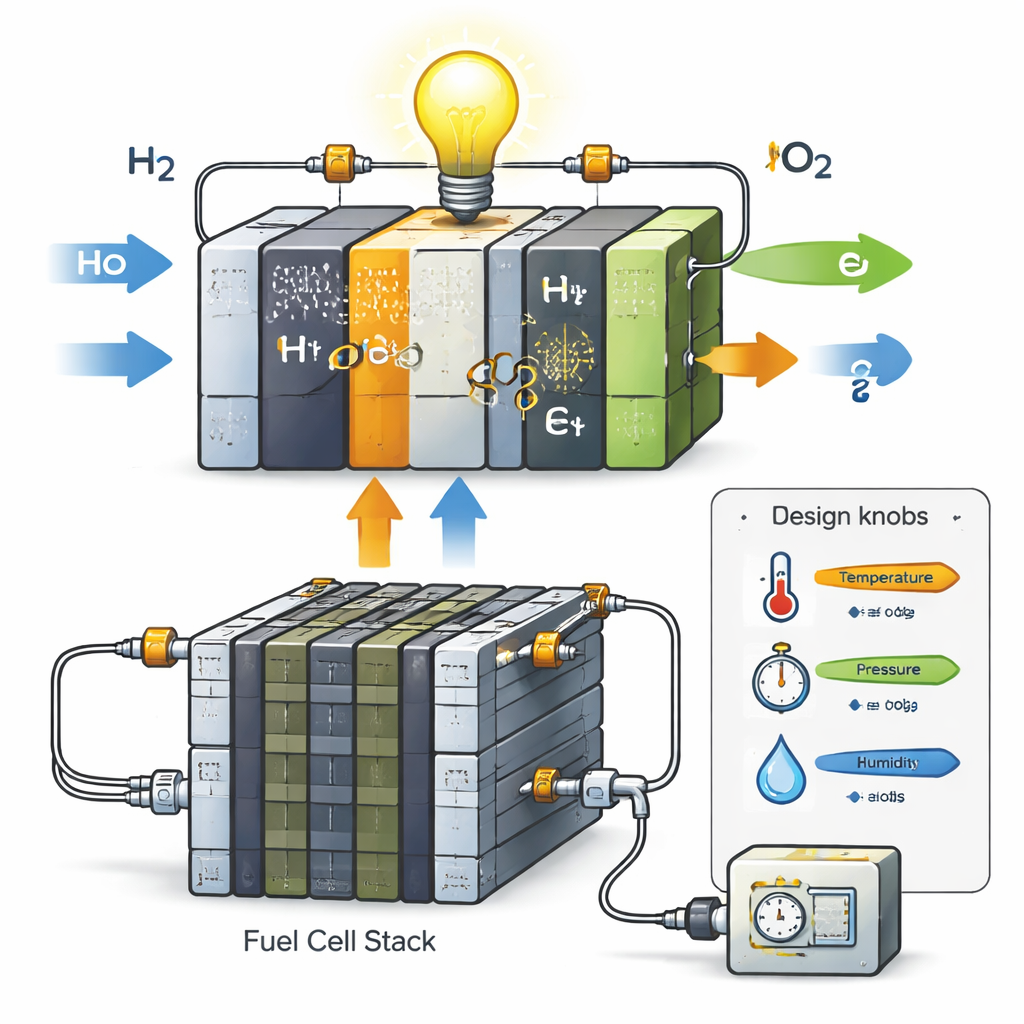
Proton exchange membrane fuel cells (PEMFCs) turn hydrogen and oxygen into electricity, heat, and water. Inside each cell, hydrogen gas arrives at one side (the anode), where it splits into positively charged protons and electrons. The protons slip through a thin plastic-like membrane, while the electrons must travel around an external circuit, doing useful work along the way. On the other side (the cathode), the protons, electrons, and oxygen reunite to form water. Many individual cells are stacked together to reach practical voltages, forming fuel cell stacks used in vehicles and stationary power units. To design, control, and diagnose these systems, engineers rely on mathematical models that predict the voltage of a stack for given operating conditions such as temperature, pressure, and gas humidity.
Why accurate models are hard to get
Even for a widely used representation like the Amphlett model, several key parameters cannot be measured directly. They describe, for example, how quickly reactions proceed at the electrodes, how easily protons move through the membrane, and how much voltage is lost when gases are depleted near the reaction sites. These hidden numbers must be inferred by matching the model’s voltage–current curve to experimental data from real fuel cell stacks. The matching process is tricky: the underlying physics is strongly nonlinear, and many different combinations of parameters can appear reasonable. Over the past decade, researchers have turned to so‑called metaheuristic algorithms—search methods inspired by animals, physics, or human behavior—to hunt for parameter sets that minimize the difference between model predictions and measurements.
From ancient horse races to modern optimization
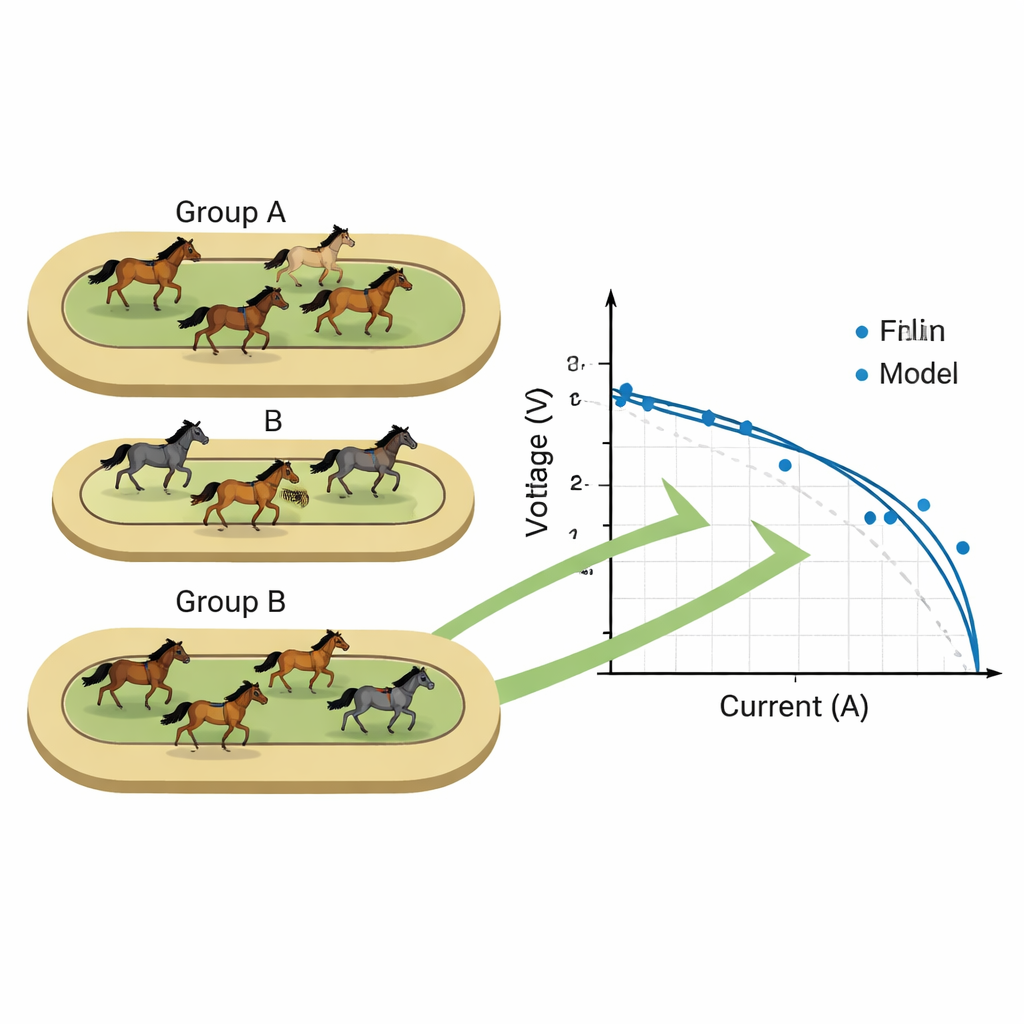
The method explored in this study, called Tianji’s Horse Racing Optimization (THRO), is based on a famous story in which a general, Tianji, beats a king in a three‑race contest by pairing his horses strategically rather than simply matching strongest to strongest. In the algorithmic version, candidate solutions to a problem are treated like horses belonging to two stables. At each iteration, these horses are ranked and paired in different ways—sometimes pitting weak against strong, sometimes strong against strong—to encourage both broad exploration and fine‑tuning. After each “race,” the algorithm updates the horses’ attributes, nudging them toward better performance while also injecting a controlled amount of randomness. This dynamic matching and training scheme is designed to avoid getting stuck in poor solutions while steadily homing in on the best parameter set.
Putting the new method to the test
The authors applied THRO to six well‑known commercial PEMFC stacks, ranging from small 250‑watt units to larger systems such as the NedStack PS6 and Ballard Mark V. For each stack, the goal was to adjust seven model parameters so that the model’s voltage closely tracked experimental voltage–current data under various conditions. THRO’s performance was compared against five recent metaheuristic methods with colourful names such as the Flood Algorithm, Educational Competition Optimizer, Kepler Optimization Algorithm, Fata Morgana Algorithm, and Spider Wasp Optimizer. All algorithms were given the same number of candidate solutions and iterations, and each test was repeated 30 times to gauge reliability. Across all stacks, THRO consistently delivered the lowest sum of squared errors—meaning the closest fit to real data—and, remarkably, its results varied by only tiny amounts from run to run, indicating very stable convergence.
What the numbers mean for real systems
Beyond raw error scores, the study examined how quickly and smoothly the algorithms converged, how sensitive they were to random starting points, and how well the resulting parameters worked under new operating conditions. THRO not only matched or beat competing methods in accuracy, it also produced nearly identical parameter sets in every run and passed stricter statistical tests of significance. When the tuned model was used to predict fuel cell behavior at different gas pressures and temperatures, its curves continued to line up with experimental measurements, showing good generalization. The main trade‑off is that THRO can take slightly longer to compute than the very fastest competitors, though its cost remains reasonable for offline design and analysis.
Why this matters for the energy transition
For non‑specialists, the message is simple: better tuning of fuel cell models leads to better design, control, and health monitoring of hydrogen systems. By reliably finding parameter sets that make models closely mirror reality across different commercial stacks and operating conditions, the Tianji’s horse racing approach offers a powerful new tool for engineers. While still primarily suited to offline use, refinements or hybrids with faster methods could bring it closer to real‑time applications, helping fuel cell technology deliver on its promise of clean and flexible power in the broader move away from fossil fuels.
Citation: Bouali, Y., Imarazene, K., Alamri, B. et al. Optimization of proton exchange membrane fuel cell design parameters using Tianji’s horse racing optimization. Sci Rep 16, 4980 (2026). https://doi.org/10.1038/s41598-026-35200-6
Keywords: proton exchange membrane fuel cell, hydrogen energy, optimization algorithm, model calibration, renewable power