Clear Sky Science · en
A longitudinal study on emotional burnout among a prospective cohort study of novice early childhood education teachers: change from entry to 24 months
Why the First Years of Teaching Matter
For many parents, a child’s preschool teacher is the first adult outside the family who shapes how that child thinks, feels, and makes friends. Yet those same teachers often face long days, modest pay, and high expectations from families and society. This study follows more than two thousand new early childhood teachers across China during their first two years on the job to see how their emotional energy changes over time—and what puts some teachers at higher risk of burning out than others.
Following New Teachers Over Time
Instead of taking a single snapshot, the researchers repeatedly surveyed 2,455 preschool teachers who had just entered the profession. Using a widely accepted questionnaire on job burnout, they measured three aspects: feeling emotionally drained, growing distant or cynical toward children, and feeling less successful at work. These teachers completed the survey six times over 24 months, allowing the team to track how feelings shifted rather than assuming they stayed the same. Advanced statistical techniques were then used to group teachers with similar patterns of change into different “paths” or trajectories.
Three Paths of Emotional Tiredness
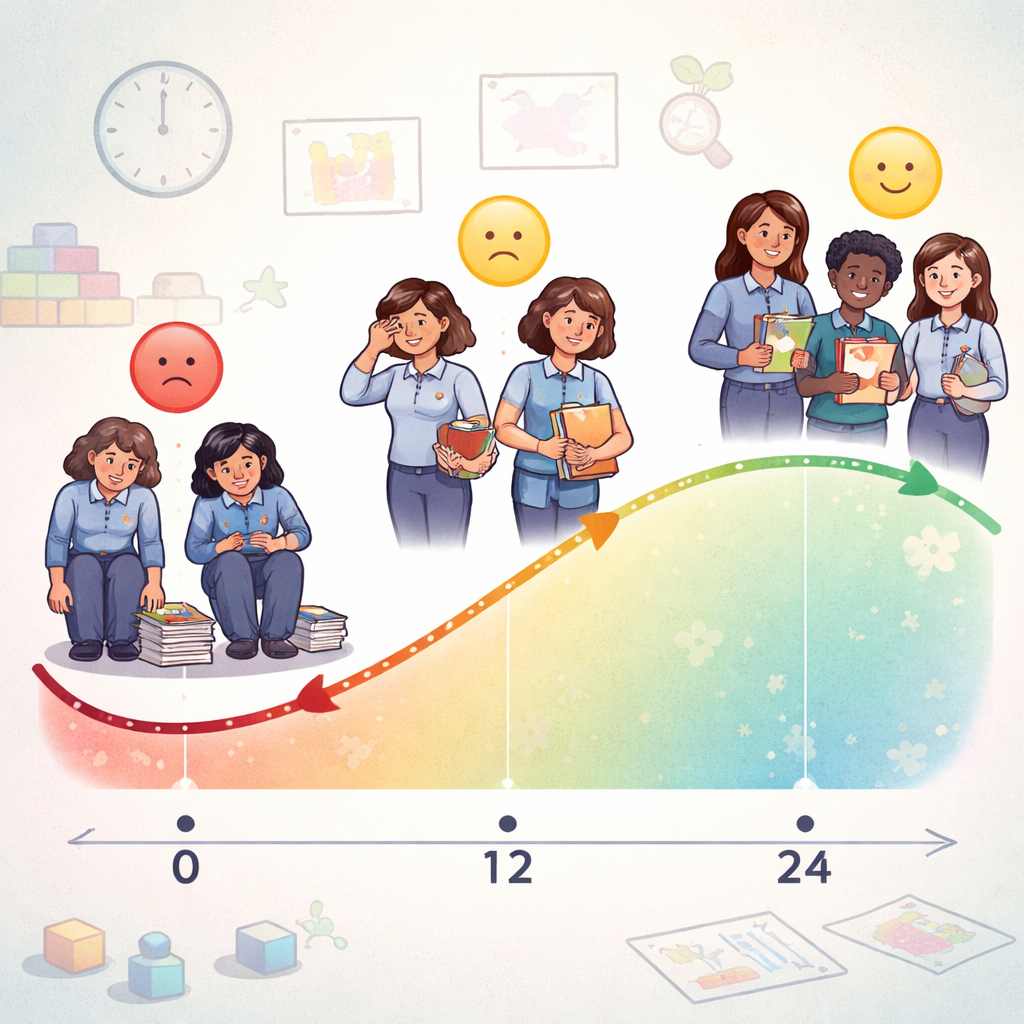
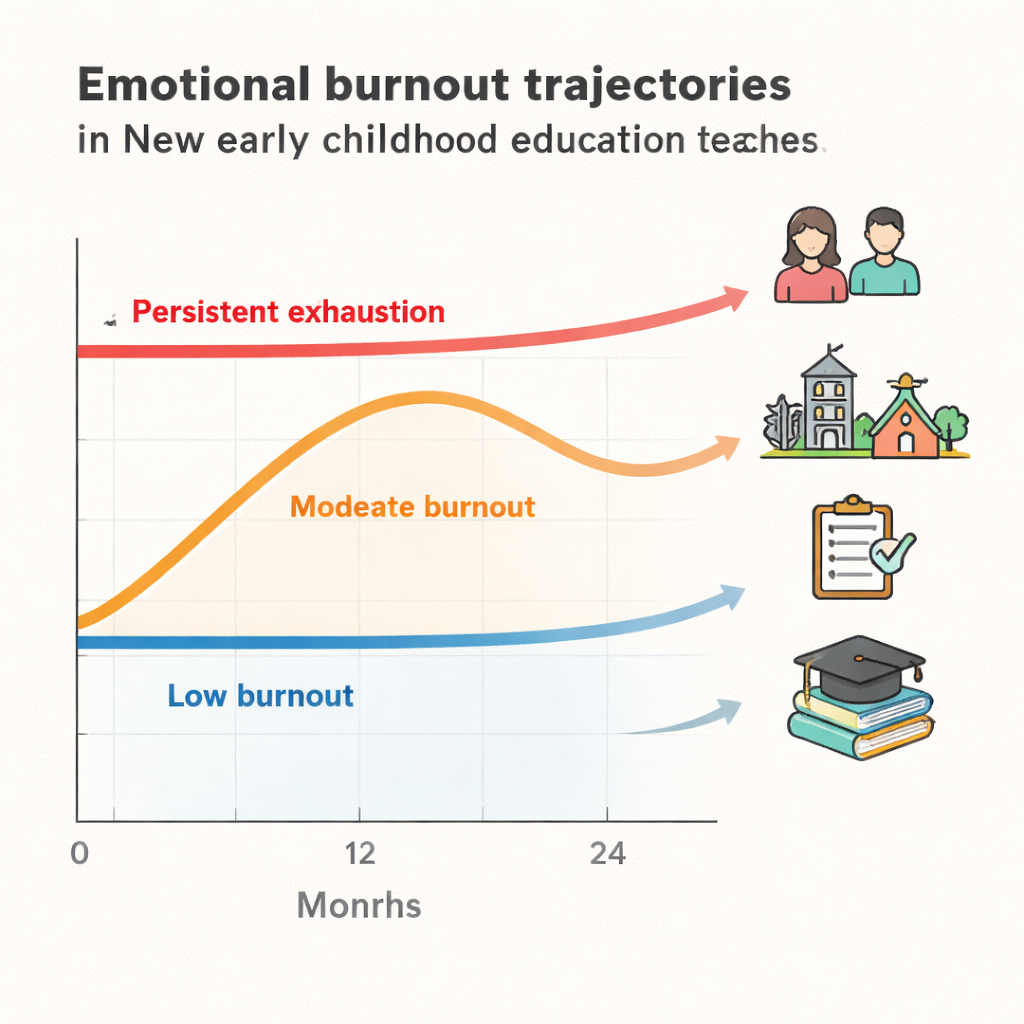
The first key finding concerns emotional exhaustion—the feeling of being used up at the end of the day. Most new teachers did not follow a single, uniform pattern. Instead, they fell into three groups. A small group started at a high level of exhaustion; their stress eased somewhat during the first year as they adjusted, but then crept back up in the second year. A second, larger group began at a moderate level, climbed to a peak of tiredness around the one‑year mark, and then declined again as they gained confidence and routine. The biggest group started out with relatively low emotional strain and stayed low, suggesting stronger coping skills or more supportive conditions from the start.
Growing Distance and Sense of Success
The study also tracked how teachers’ attitudes toward their work and their own sense of success evolved. For emotional distance—feeling detached or negative toward children—teachers again split into two groups: one with higher, changing levels and one that stayed low. Some teachers initially grew more distant but then improved as they became more comfortable in the classroom; others, especially under heavier pressure, became more withdrawn again over time. A similar divide appeared in feelings of personal accomplishment. One group consistently felt capable and effective, while the other reported a low and relatively flat sense of success, which can feed burnout even when a teacher cares deeply about children.
Who Is Most at Risk
To understand why teachers landed in different groups, the researchers looked at background factors. Female teachers were more likely to follow the high‑exhaustion path, perhaps because they juggle more roles at work and at home. Male teachers were more likely to show higher emotional distance but also a stronger sense of achievement. Teachers with university degrees in education tended to feel more successful and less detached, likely because they had more tools for understanding children and managing classrooms. Working in city preschools was linked to greater emotional strain—families and communities often expect more—but also to a stronger sense of accomplishment, perhaps due to better training and resources. Prior hands‑on experience in early childhood settings appeared to protect against exhaustion, helping newcomers adjust more smoothly.
What This Means for Children and Schools
Burnout in early childhood teachers is not simply an individual weakness or a single number on a survey; it is a changing pattern shaped by training, support, and working conditions. This study shows that during the first two years, some teachers’ emotional health improves while others steadily slide into deeper stress, distance, and doubt. For families and policymakers, the message is clear: investing in better preparation, mentoring, and emotional support for novice preschool teachers is an investment in children’s daily experience. By identifying those who follow high‑risk paths early on, schools and health authorities can step in with targeted help, keeping teachers healthier, more engaged, and better able to offer the warm, stable relationships that young children need to thrive.
Citation: Pan, F., Lei, Y. & Guo, Q. A longitudinal study on emotional burnout among a prospective cohort study of novice early childhood education teachers: change from entry to 24 months. Sci Rep 16, 4920 (2026). https://doi.org/10.1038/s41598-026-35199-w
Keywords: teacher burnout, early childhood education, novice teachers, mental health, preschool workforce