Clear Sky Science · en
Soil organic carbon modeling in cropland under several climatic scenarios using machine learning in western India
Why the carbon in our soils matters to everyone
Healthy soils do more than grow crops—they quietly lock away huge amounts of carbon that would otherwise warm the planet. This paper explores what might happen to that hidden carbon in farmland soils in western India as the climate changes this century, and how smarter farming practices could help protect both food production and the climate. Using satellite data and modern computer learning techniques, the authors show that choices we make about energy, land use, and agriculture today will strongly shape how much carbon our croplands can hold tomorrow.
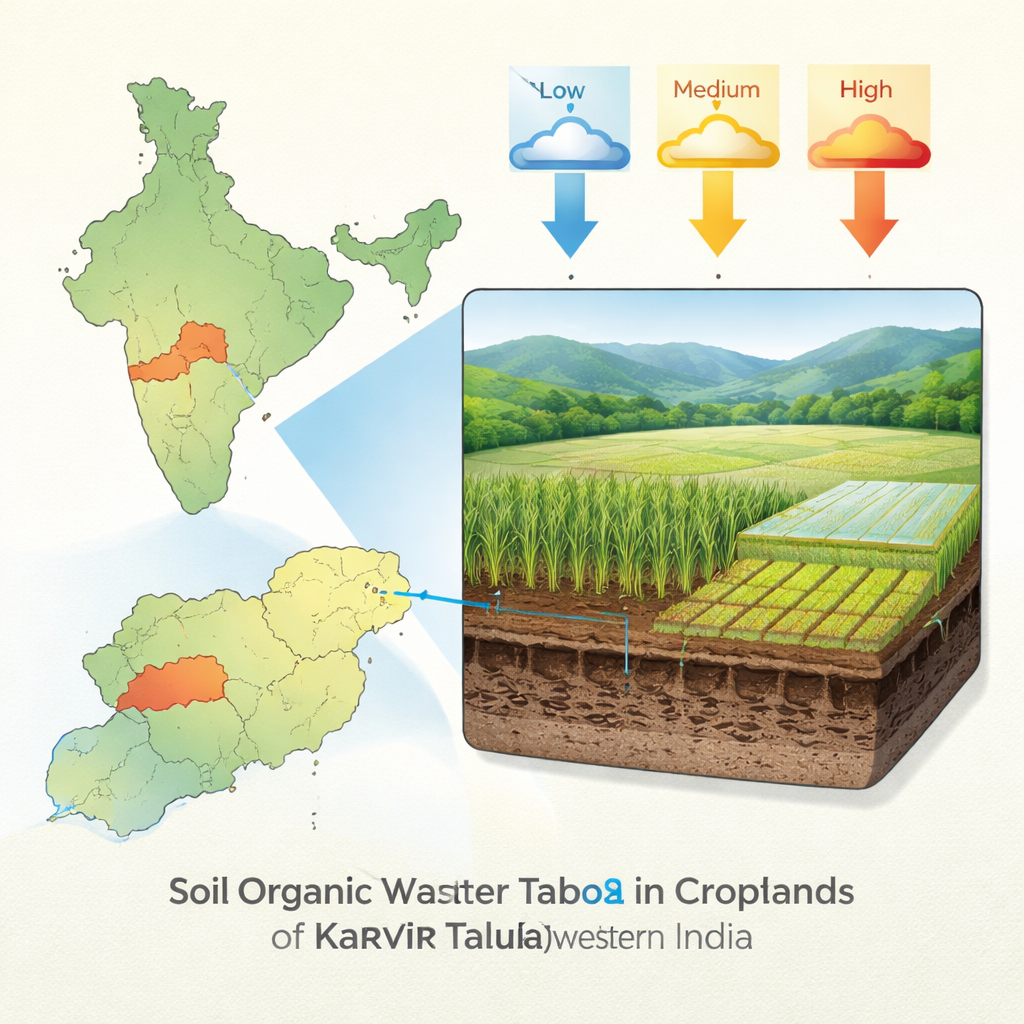
A closer look at fields in western India
The study focuses on Karvir Taluka, an agricultural region in Maharashtra where farmers grow crops such as sugarcane, rice, sorghum, and pulses on rolling tropical terrain. Over the past four decades, satellite images reveal that cropland area has gradually shrunk, from about 520 to 440 square kilometers, as land use has shifted. At the same time, the climate record shows relatively stable temperatures up to about 2019, followed by projected warming through 2100, and rainfall that stays roughly within its historical range but with more extremes. These local changes in land use and climate set the stage for understanding how soil organic carbon—the mix of decomposed plant and animal matter that gives soil much of its life—will evolve.
How future worlds shape the soil beneath our feet
To explore different possible futures, the authors use the IPCC’s shared socioeconomic pathways, or SSPs. These storylines range from a sustainability-focused world with low greenhouse gas emissions to a fossil-fueled, high-emission future. For Karvir’s croplands, the team translated these global scenarios into local projections of temperature, rainfall, heatwaves, droughts, and cold spells from 2020 to 2100. Under the mildest pathway, average temperatures rise only slightly and extreme heat remains limited. Under the most intense pathway (known as SSP5-8.5), however, average temperatures could reach about 34 °C by 2100 and warm spells may stretch across most of the year, drastically changing conditions for crops and soil life.
Teaching computers to read the soil
Instead of relying solely on slow, costly field sampling, the researchers combined laboratory measurements from a local soil-testing lab with global soil maps, satellite imagery, and climate data processed in Google Earth Engine and geographic information systems. They fed this information into three machine learning models—Random Forest, Extreme Gradient Boosting (XGB), and Support Vector Regression—to learn how soil carbon relates to factors such as temperature, rainfall, elevation, slope, soil texture, vegetation greenness, and farming practices. After training on historical data (1982–2024), the models were tested against independent lab analyses. XGB stood out, closely matching measured values and capturing subtle, non-linear relationships between environment, management, and soil carbon.
What the models say about tomorrow’s soils
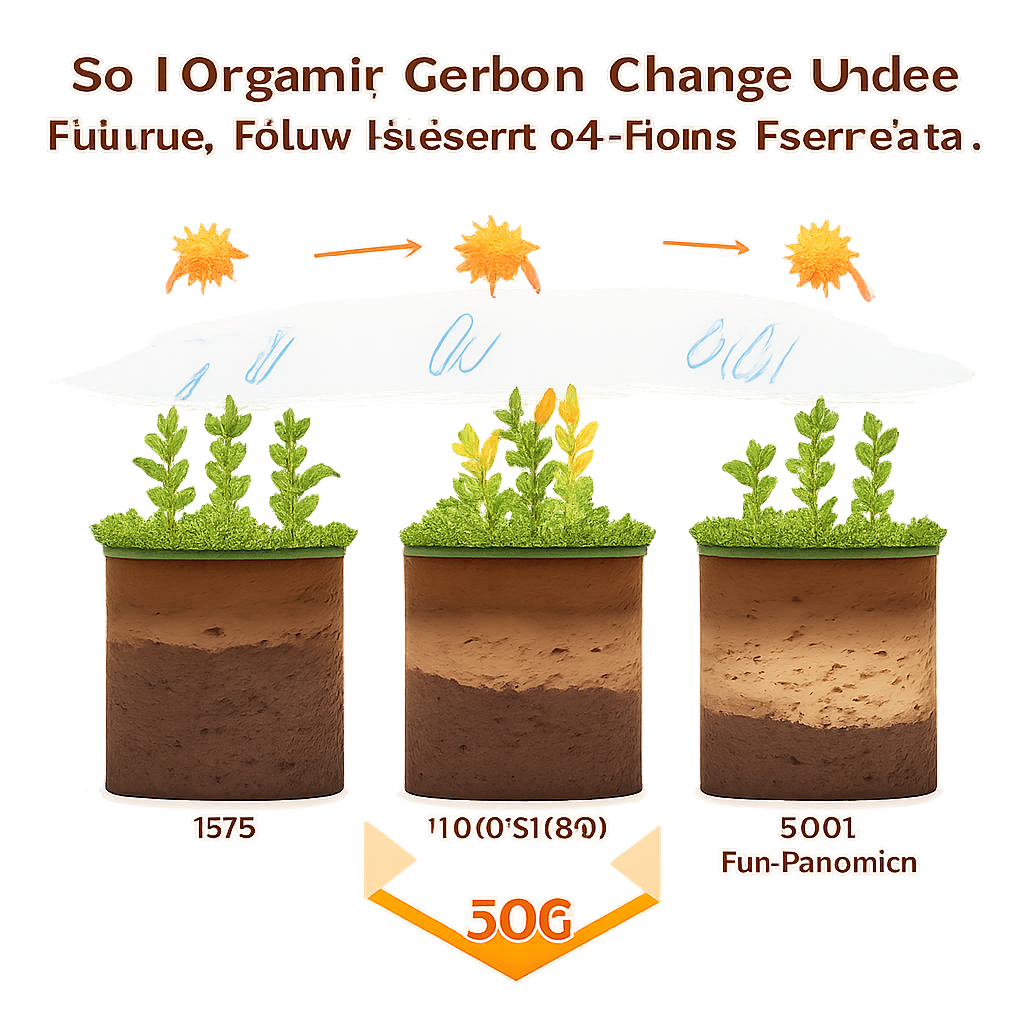
Armed with the best-performing model, the team projected soil organic carbon in croplands for the years 2040, 2060, 2080, and 2100 under five SSP futures. In low-emission scenarios, average soil carbon remains relatively high—around the mid-40 grams per kilogram level in mid-century—though it still declines somewhat by 2100. In contrast, under the high-emission SSP5-8.5 pathway, average soil carbon in croplands is projected to fall by roughly half between 2040 and 2100, with many areas dropping below 30 grams per kilogram. Spatial maps show that today’s carbon-rich zones steadily give way to poorer soils as rising temperatures, longer heatwaves, and more erratic rainfall speed up the breakdown of organic matter and erode the soil. Yet the study also notes a recent uptick in soil carbon since 2018 in places where farmers adopted conservation practices such as no-till, mulching, composting, and better residue management.
Managing uncertainty and acting on what we know
The authors carefully examine sources of uncertainty—from imperfect climate and soil data to the limits of machine learning models—but their overall message is clear. Even with these uncertainties, the direction of change is consistent: warmer, more extreme climates tend to strip carbon from cropland soils, especially under high-emission futures. However, the results also demonstrate that local management can significantly slow or even reverse losses, as seen in the recent gains linked to conservation agriculture.
What this means for food, climate, and farmers
For non-specialists, the takeaway is straightforward but urgent: the way we power our economies and manage our fields will decide whether soils remain a strong ally in fighting climate change. If emissions remain very high, cropland soils in regions like Karvir are likely to lose much of their stored carbon, becoming less fertile and less able to buffer floods, droughts, and heat. Under cleaner energy pathways, and with widespread adoption of practices such as reduced tillage, cover crops, and organic amendments, these same soils can continue to store carbon and sustain harvests. This study shows how combining satellites, local measurements, and machine learning can guide climate-smart farming and policy, helping protect both farmers’ livelihoods and the planet’s largest land-based carbon bank.
Citation: Adeel, A., Hasani, M. & Jadhav, A.S. Soil organic carbon modeling in cropland under several climatic scenarios using machine learning in western India. Sci Rep 16, 5485 (2026). https://doi.org/10.1038/s41598-026-35191-4
Keywords: soil organic carbon, climate change scenarios, conservation agriculture, remote sensing, machine learning