Clear Sky Science · en
Porphyrin-nitrogen carbon dot composites for high-performance organic light-emitting diodes
Brighter, Greener Screens from Tiny Carbon Dots
From smartphone displays to next‑generation lighting, organic light‑emitting diodes (OLEDs) are at the heart of many devices we use every day. Yet making them both highly efficient and environmentally friendly remains a challenge, especially when manufacturers want to use low‑cost, solution‑based processes instead of expensive vacuum fabrication. This study explores a new, metal‑free material made from a common light‑absorbing molecule and ultra‑small carbon particles that can boost OLED performance while keeping production simple and sustainable.
A New Supporting Layer for Light‑Making Devices
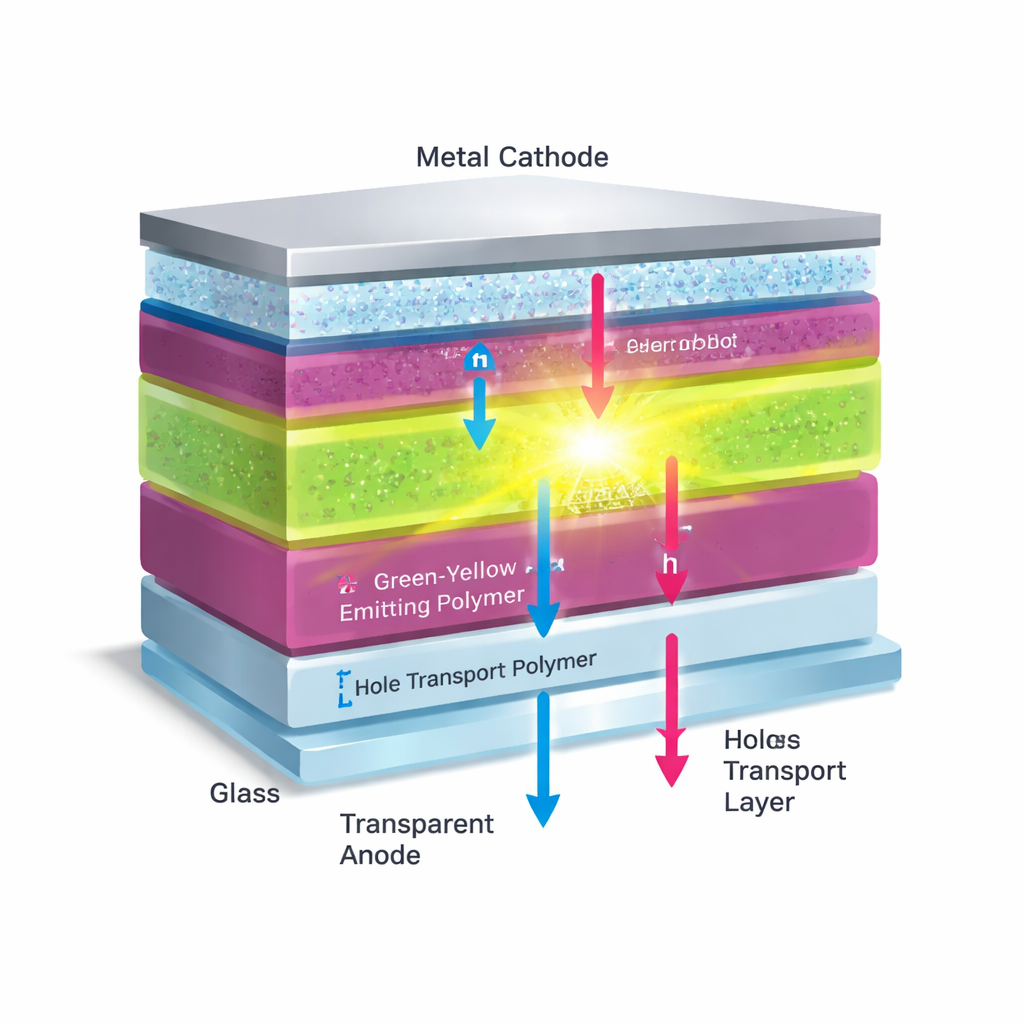
In an OLED, light is produced in a thin organic layer, but the overall performance depends heavily on how easily electrical charges can move in and out of that layer. A key component is the electron transport layer, a thin film that helps electrons reach the light‑emitting region while blocking unwanted charge leakage. Traditional electron transport materials often rely on vacuum deposition or contain heavy metals. The authors instead propose a solution‑processable, metal‑free alternative: a hybrid material that combines a porphyrin (a ring‑shaped molecule related to those found in chlorophyll and hemoglobin) with nitrogen‑doped carbon dots. When this hybrid is used as the electron transport layer in a green‑yellow OLED based on the polymer F8BT, the device becomes both brighter and more efficient.
How Porphyrins and Carbon Dots Team Up
The researchers chemically link tetra‑carboxyphenyl porphyrin molecules to nitrogen‑doped carbon dots to form a single nanocomposite. This connection creates an extended network of electrons across both components, making it easier for charges to move. Optical measurements show that the hybrid preserves the main light‑emitting properties of the F8BT layer while subtly changing how light is absorbed, a sign that electrons can be shared across the interface. Infrared spectroscopy reveals hydrogen bonding and stacking interactions between the polymer and the hybrid layer, indicating a well‑matched contact that supports charge transfer rather than trapping it. Atomic‑force microscopy confirms that the films remain very smooth at the optimal hybrid concentration, which is important for avoiding electrical shorts and maintaining stable operation.
Designing a Smoother Path for Electrons
Electrochemical tests show that the energy levels of the porphyrin–carbon dot composite fall neatly between those of the F8BT emitter and the aluminum cathode. This alignment means electrons can step down in energy more easily from the metal into the organic layers, while holes (the positive counterparts of electrons) are discouraged from flowing backward. In practical terms, the hybrid layer acts like a well‑designed ramp that allows electrons to enter the light‑emitting region efficiently but prevents them and their opposite charges from recombining in the wrong place. This balanced flow reduces energy losses that would otherwise turn into heat instead of light.
Measurable Gains in Brightness and Efficiency
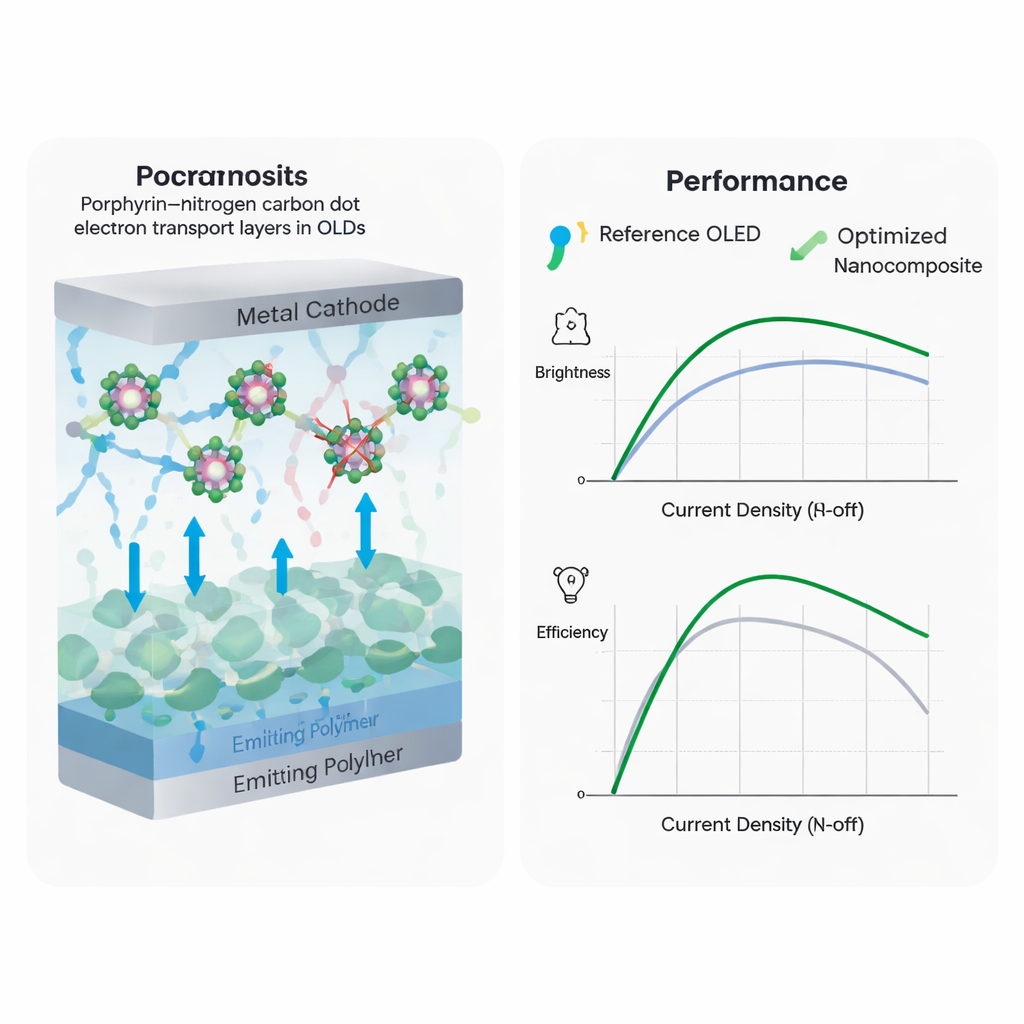
When the hybrid material is used as the electron transport layer, the performance of F8BT‑based OLEDs improves dramatically. At an optimal solution concentration of 1 milligram per milliliter, the devices show nearly three times higher brightness than those without this layer and clearly outperform a common inorganic additive, cesium carbonate. The luminous efficiency and power efficiency increase by about 160% and 190%, respectively, and the external quantum efficiency—the fraction of electrical charges converted into photons—rises by about 22%. Importantly, these gains come with reduced efficiency roll‑off, meaning the device continues to emit light efficiently even at high brightness, a common weak point for fluorescent OLEDs.
Stability Under Everyday Conditions
Beyond raw performance, the team also tests how well the devices hold up when simply left in air for several days. While control devices rapidly lose most of their brightness and efficiency, those containing the porphyrin–carbon dot layer retain much stronger output. The best‑performing devices keep a substantial portion of their original efficiency and remain the brightest among all tested designs after four days. This suggests that the hybrid layer does not just improve charge transport, but also helps protect the delicate interfaces inside the OLED.
What This Means for Future Displays and Lighting
To a non‑specialist, the key message is that a cleverly engineered, metal‑free mix of a porphyrin dye and tiny carbon dots can make solution‑processed OLEDs brighter, more efficient and more stable, without complicating manufacturing. By fine‑tuning how electrons move through a single, ultra‑thin layer, the researchers show a practical route toward greener, high‑performance displays and lighting panels that are easier and cheaper to produce at large scale.
Citation: Georgiopoulou, Z., Rizou, M.E., Verykios, A. et al. Porphyrin-nitrogen carbon dot composites for high-performance organic light-emitting diodes. Sci Rep 16, 5507 (2026). https://doi.org/10.1038/s41598-026-35190-5
Keywords: OLED displays, carbon dots, porphyrin materials, electron transport layer, green electronics