Clear Sky Science · en
Resilience enhancement strategies for distribution networks considering the coordination of 5G base stations and multiple flexible resources
Keeping the Lights On When Storms Hit
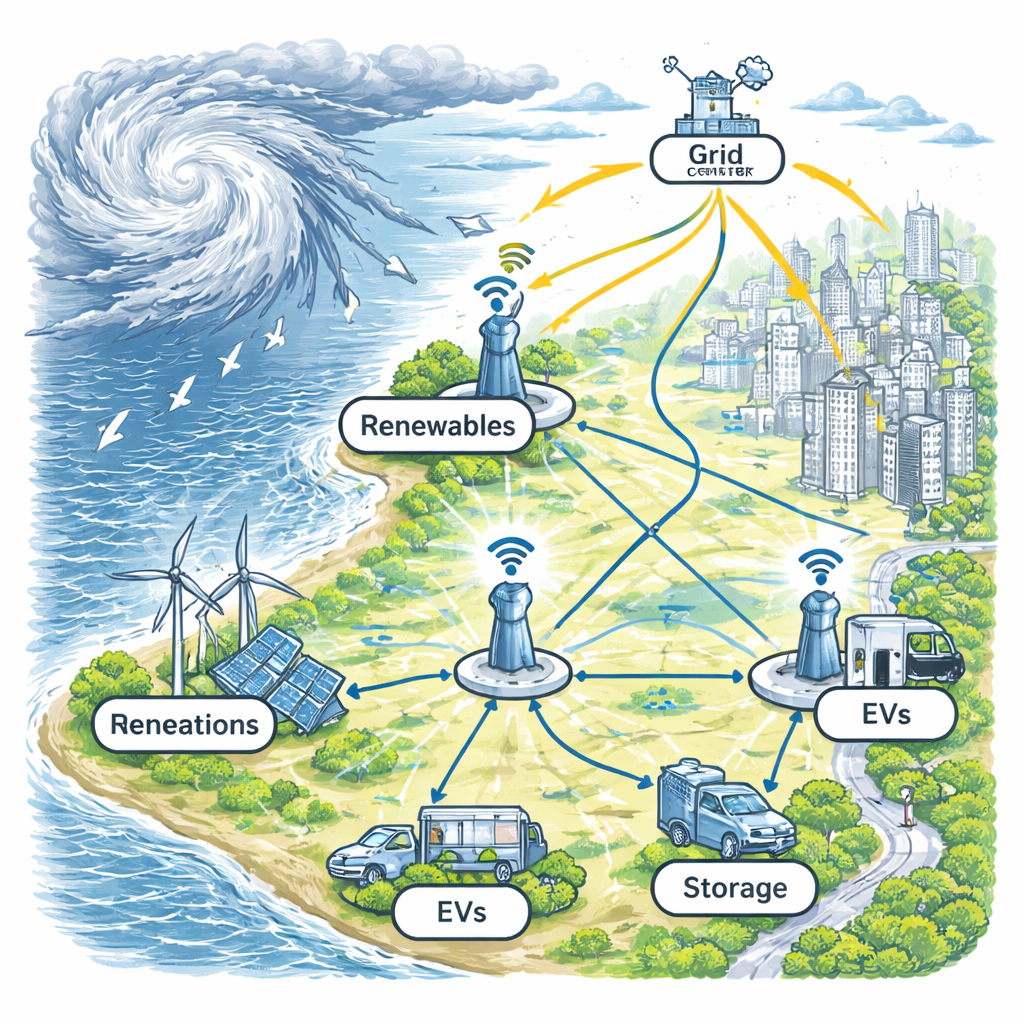
When powerful storms knock down power lines, the consequences go far beyond a few hours without electricity. Homes go dark, hospitals and emergency centers struggle, and even our mobile phones can lose connection. This study explores how modern tools—especially 5G mobile phone towers and flexible energy technologies like rooftop solar, batteries, electric vehicles, and mobile storage trucks—can work together to keep electricity flowing and communications running during extreme typhoons.
Why Power Grids Struggle in Extreme Weather
Traditional power grids were built mainly for day-to-day reliability, not for rare but devastating events such as super-typhoons or historic blizzards. In such conditions, strong winds can snap distribution lines, while clouds and heavy rain sharply cut the output of solar panels and even force wind turbines to shut down for safety. The result is a double blow: less electricity available just when more people need power for heating, cooling, and information. The authors argue that resilience—how well a grid can withstand, adapt to, and recover from disasters—must now be treated as a core design goal, not an afterthought.
Turning 5G Towers into Emergency Power Helpers
5G base stations are usually thought of as communication assets, but each tower also has a sizable backup battery designed to keep phone and data services alive during outages. This study treats those batteries as a new kind of emergency energy resource. The researchers split each battery’s capacity into two parts: one strictly reserved to keep the 5G tower running, and another portion that can safely be shared with the local power grid. By carefully managing how these batteries charge before a storm and discharge afterward, 5G sites become miniature local power plants that can temporarily support nearby customers without sacrificing communication reliability.
Coordinating Many Small Energy Sources
Beyond 5G towers, the modern grid already hosts many scattered energy devices: wind turbines, solar plants, electric-vehicle charging stations, and mobile battery trucks that can be driven to where they are most needed. On their own, each resource has limits. The innovation in this work lies in coordinating all of them together, along with the ability to reconfigure network switches to route power along different paths. The authors build a detailed mathematical model that weighs two goals at once: reducing the loss of vital loads such as hospitals, key businesses, and important community services, and cutting the economic losses from spoiled goods, lost production, and emergency measures.
Planning for the Worst with Smart Scenarios
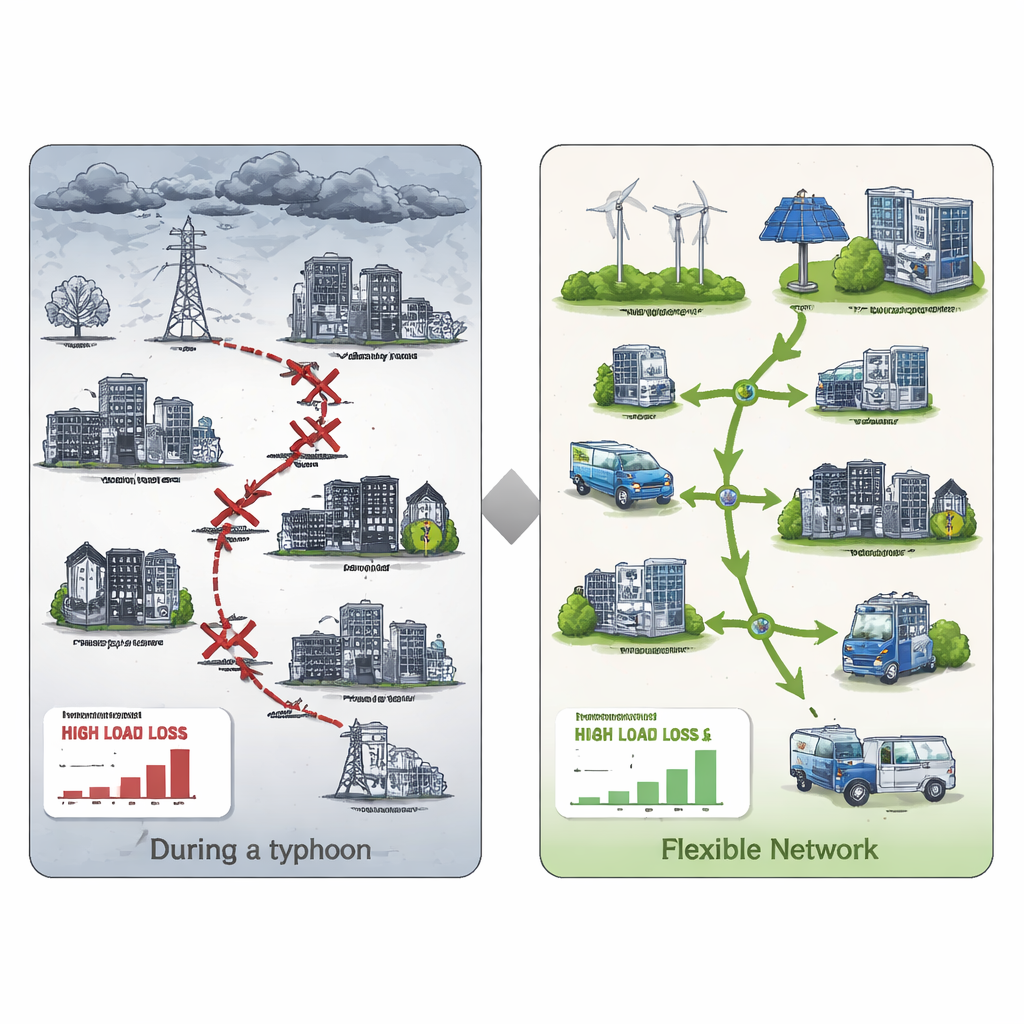
Because no two storms are alike, the team generates many possible typhoon situations, varying wind speeds, which lines fail, and how much solar and wind output is lost. They use advanced sampling and clustering techniques to condense these many possibilities into a few representative scenarios, such as grids that can be reconnected to the main system and isolated "islands" that must run on local resources alone. They then test different operating strategies on a standard model of a 33-bus distribution network, comparing a "do nothing" approach with increasingly sophisticated coordination of flexible resources and 5G batteries.
How Much Better Can a Smarter Grid Do?
The results are striking. Under a severe typhoon without any special coordination, the model shows very large losses of critical loads and significant economic damage. When conventional flexible resources like wind, solar, and electric vehicles are coordinated, both types of loss fall by about half. Adding 5G base station batteries improves things even more, reducing critical load loss by about 85% and cutting economic losses by roughly 77%. Finally, when 5G towers and mobile storage trucks are deliberately placed to support isolated pockets of customers that have been cut off from the main grid, the overall resilience improvements reach nearly 90%. In plain terms, far more important customers keep their power, and the community’s financial hit is much smaller.
What This Means for Future Storm-Ready Cities
For non-specialists, the key message is that we do not need to rebuild the entire power system from scratch to better weather extreme storms. Instead, by treating communication towers, electric vehicles, and mobile batteries as shared community resources—and by planning how to use them together before disaster strikes—cities can dramatically improve their ability to keep essential services running. The study shows that 5G infrastructure can pull double duty as both a communication lifeline and an emergency power asset, pointing toward future neighborhoods where electricity and connectivity remain available even when the winds howl and the main grid is under siege.
Citation: Wang, H., Ge, J., Zhao, Y. et al. Resilience enhancement strategies for distribution networks considering the coordination of 5G base stations and multiple flexible resources. Sci Rep 16, 5481 (2026). https://doi.org/10.1038/s41598-026-35188-z
Keywords: power grid resilience, 5G base stations, extreme weather, renewable energy, energy storage