Clear Sky Science · en
AI-driven framework for accurate detection of Alzheimer’s disease in EEG
Why brainwaves matter for memory loss
Alzheimer’s disease slowly erodes memory and independence, yet by the time symptoms are obvious, much of the damage is already done. Doctors urgently need ways to spot the disease earlier, using tools that are safe, affordable, and practical for routine checkups. This study explores whether simple recordings of brainwaves—electroencephalograms, or EEGs—combined with modern artificial intelligence can reveal hidden signs of Alzheimer’s long before they are visible on brain scans or in daily life.
Listening to the brain without surgery
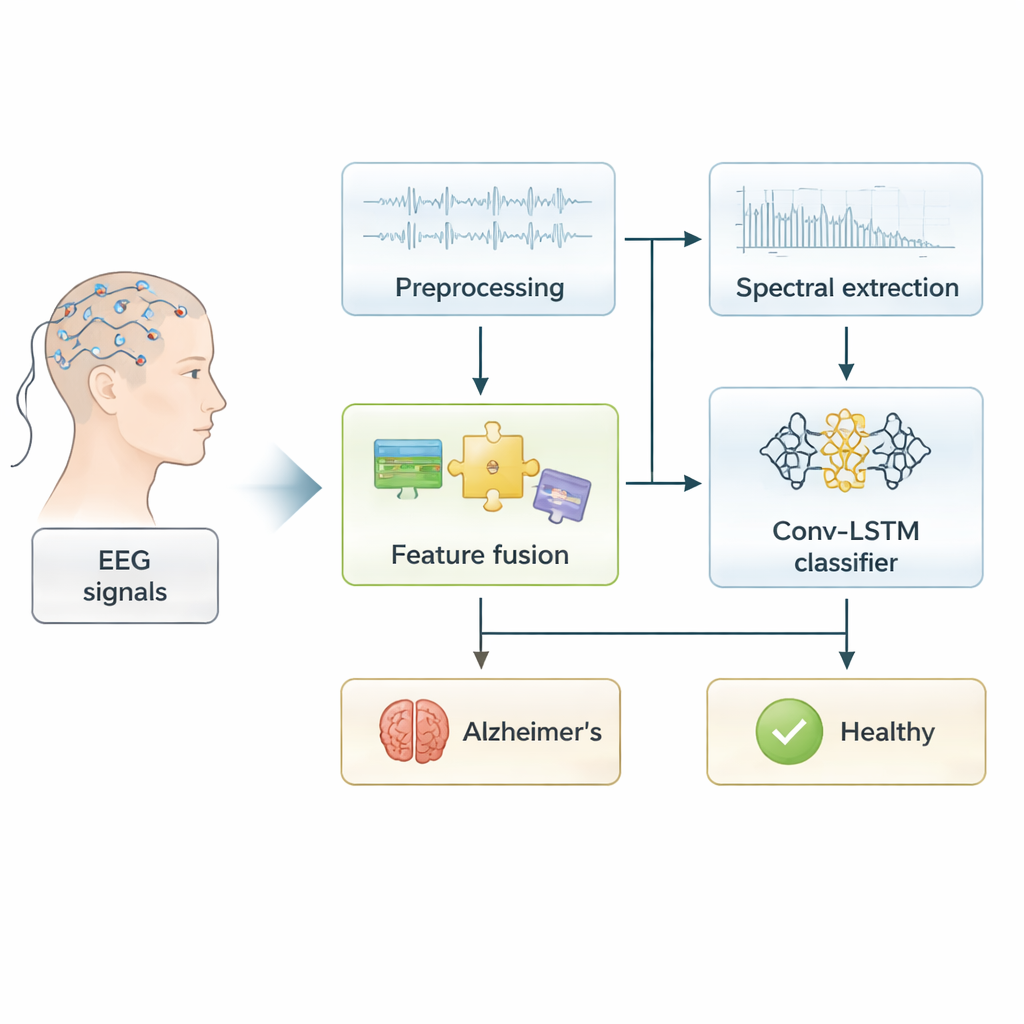
EEG is a painless test where small electrodes placed on the scalp pick up the brain’s electrical activity. It is far cheaper and more portable than MRI or PET scans and can be repeated often. However, raw EEG signals are messy. They are full of noise from blinking, muscle movements, and the environment, and the patterns linked to Alzheimer’s can be subtle and spread across many brain regions and frequencies. Traditionally, researchers either focused on hand-crafted mathematical summaries of these signals or used deep-learning programs that learn patterns directly from the raw data. Each approach has strengths but also serious blind spots.
Blending two ways of seeing brain activity
The authors propose a hybrid strategy that combines the best of both worlds. First, they clean the EEG recordings by filtering out unwanted noise and correcting slow drifts in the signal. Then they extract “spectral” features that describe how the brain’s electrical power is distributed across different frequency bands—slow waves linked to drowsiness, for example, versus faster rhythms linked to attention. These measures have long been known to change in dementia. At the same time, a specially designed convolutional neural network (CNN) looks at the EEG data in a more holistic way, automatically learning complex spatial patterns that may not be obvious to human experts.
Teaching AI to read changes over time
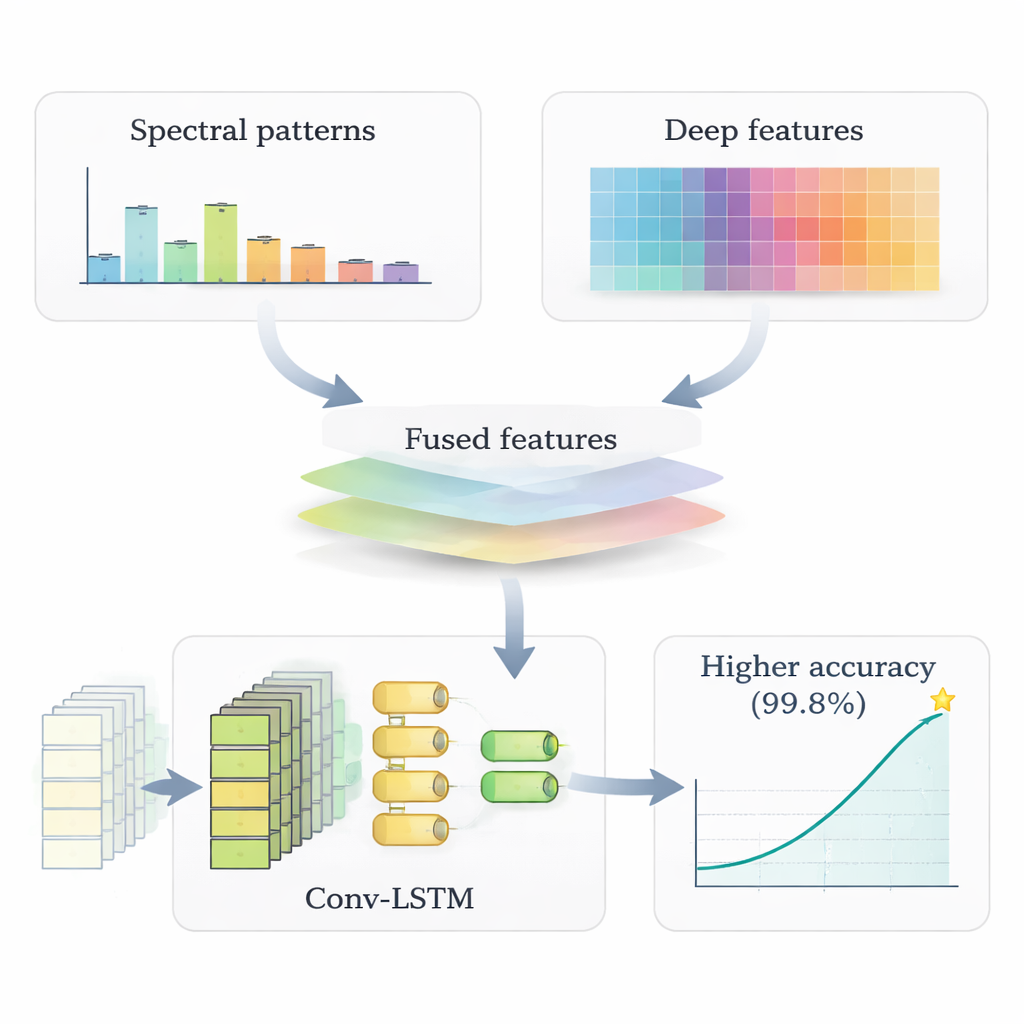
Rather than treat these two feature sets separately, the system fuses them into a single rich description of each person’s brain activity. This combined representation is then fed into a more advanced network called a Convolutional Long Short-Term Memory (Conv-LSTM) model. The “convolutional” part captures how activity is organized across the scalp, while the “LSTM” part is designed to follow how patterns evolve over time, much like tracking phrases in spoken language. In effect, the model learns both where and when Alzheimer’s-related changes appear in the EEG, using around 0.9 million trainable parameters—compact enough to run on standard hardware.
How well does the system work?
The researchers tested their framework on resting-state EEG data from older adults with and without Alzheimer’s disease. They split the recordings into separate sets for training, validation, and final testing, and evaluated performance using standard measures of accuracy and reliability. The fusion-based Conv-LSTM model correctly distinguished Alzheimer’s from non-Alzheimer’s cases in 99.8% of instances—substantially better than several comparison systems, including CNNs alone, LSTM networks alone, and conventional machine-learning approaches. Models that lacked either the spectral features or the deep-learned features were consistently less accurate, underscoring the value of combining complementary views of the same brain signals.
What this could mean for patients and clinics
For a non-specialist, the takeaway is straightforward: by letting artificial intelligence listen more carefully to brainwaves, this method turns a familiar, low-risk test into a powerful early-warning system for Alzheimer’s disease. The work suggests that a relatively lightweight, automated EEG-based tool could help clinicians screen patients in everyday settings, flagging those who need closer follow-up or advanced imaging. While larger and more diverse studies are still needed before such systems can guide treatment decisions, this research points toward a future in which routine brainwave recordings, interpreted by smart algorithms, help detect dementia earlier and more accurately, potentially giving patients and families more time to plan and benefit from emerging therapies.
Citation: Hemalatha, B., Venkatachalam, K., Siuly, S. et al. AI-driven framework for accurate detection of Alzheimer’s disease in EEG. Sci Rep 16, 5509 (2026). https://doi.org/10.1038/s41598-026-35184-3
Keywords: Alzheimer’s disease, EEG brainwaves, deep learning, early diagnosis, medical AI