Clear Sky Science · en
Analysis of the influence of new tunnel excavation on the stability of adjacent existing tunnels
Why crowded cities need safer tunnels
As big cities add more subway lines, new tunnels increasingly have to weave around ones that are already in service. Digging a fresh tunnel too close to an existing one can nudge, twist, or crack the older structure, with obvious safety and service implications. This study looks at how much an operating metro tunnel can deform when a new tunnel is excavated nearby, and offers simple formulas engineers can use to keep future construction from endangering today’s riders. 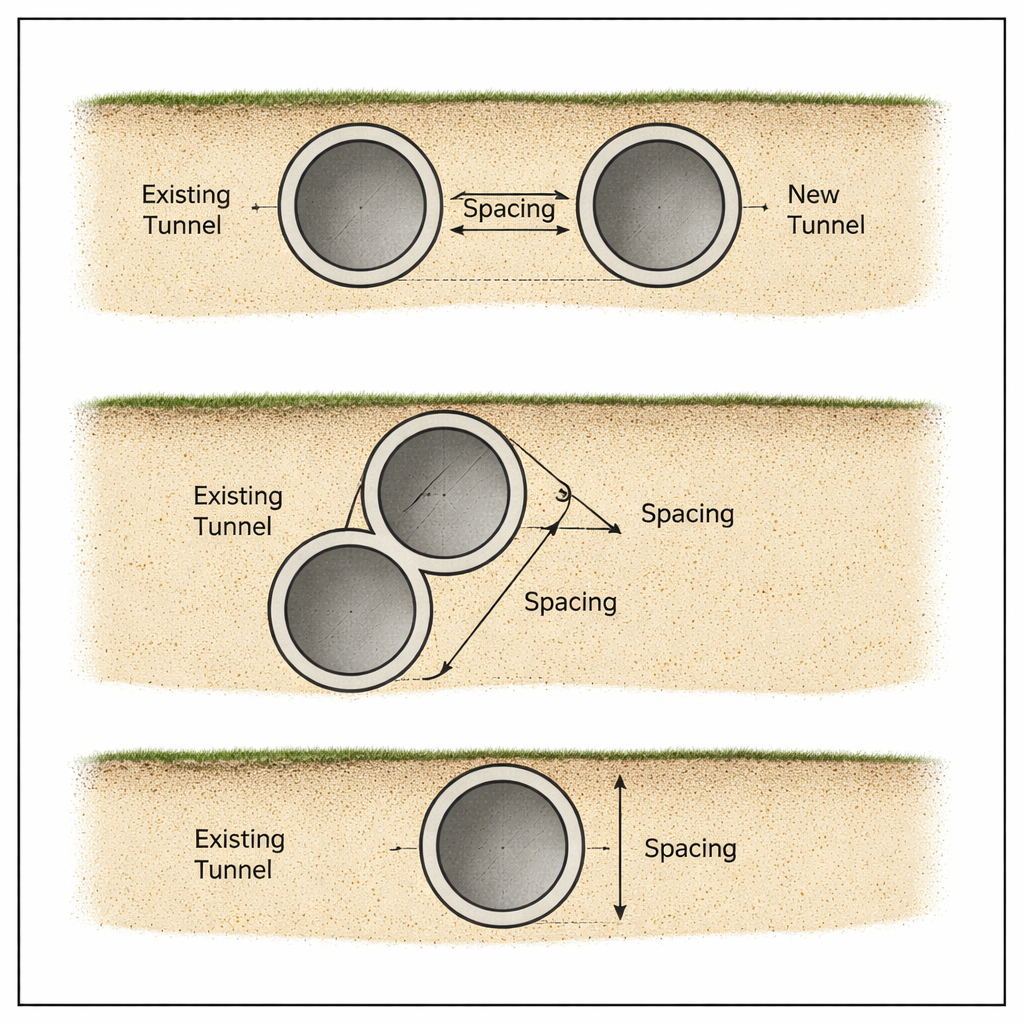
How new tunnels disturb the ground
Tunnel boring machines carve out soil and rock and replace it with a concrete-lined tube. That process slightly loosens and shifts the surrounding ground. In turn, the ground pushes differently on anything already buried there, such as an older tunnel. The authors first revisit how the weight of the soil above a tunnel is usually estimated. Classic methods assume a smooth “arch” of earth that carries loads around the opening, but they neglect how much ground is actually lost or displaced during excavation. The team refines this idea to handle loess and similar soils common in Xi’an, China, where many new metro lines are planned.
Updating how we estimate soil pressure
Traditional calculations, going back to Karl Terzaghi’s work in the 1930s, treat the soil arch over a tunnel as fully formed and use a fixed factor to convert vertical weight into sideways pressure on the lining. Later research showed this misses an important detail: when the tunnel face advances, some ground settles or moves, weakening the arch. The authors adopt a newer “incomplete soil arch” approach that explicitly includes the ground loss ratio—how much the surface or crown settles as the tunnel is dug. They show that for realistic loss levels in clayey loess, the refined method usually predicts lower, and more realistic, pressures on the tunnel than the older formulas, especially when ground loss is not tiny.
Virtual experiments with twin tunnels
To see how a new tunnel affects one that already exists nearby, the researchers built detailed three-dimensional computer models using typical Xi’an soil and metro tunnel dimensions. They varied three things: the diameters of the tunnels, the distance between them, and their relative positions—side by side, diagonally offset, or one directly above the other. In each case, they simulated the tunneling process ring by ring and tracked how eight key points around the existing tunnel’s cross-section moved. The models show that the closer the tunnels are, and the larger the existing tunnel, the more it deforms. They also reveal that existing tunnels do not simply shift; they tend to twist, with one side moving more than the other. 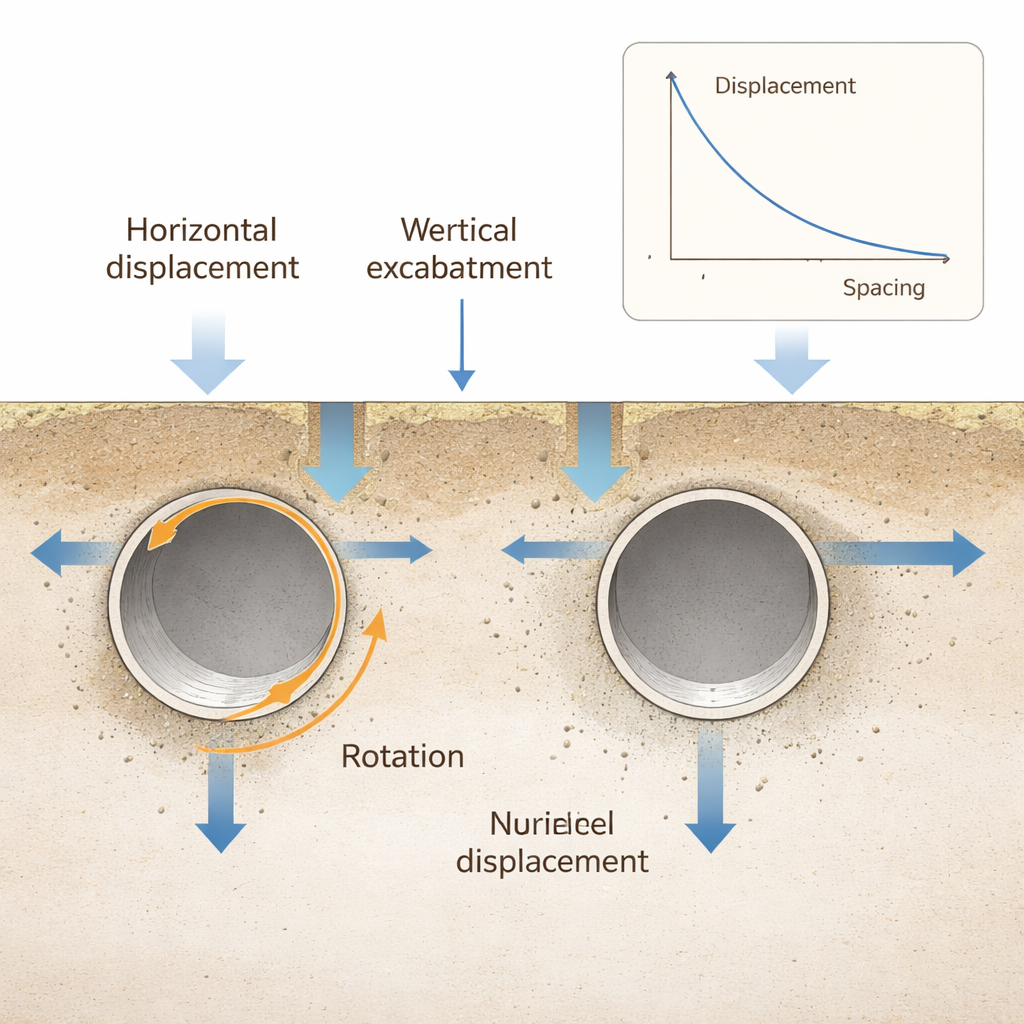
How tunnels move, twist, and settle
When the new tunnel runs roughly parallel and at a similar depth, the older tunnel is pushed mainly sideways toward the excavation, with only small vertical settlement. In this case, horizontal displacement dominates, and the twisting (rotation) of the old tunnel is most pronounced when the clear distance is only about five meters. As the spacing grows to 20 meters, the maximum sideways movement can drop by more than two-thirds, and the twist becomes negligible. When the new tunnel lies diagonally or directly underneath, the story changes: the existing tunnel both shifts and settles. Vertical movements can reach nearly two centimeters when tunnels are close and large, decreasing steadily as spacing increases. In all layouts, the rotation angle grows with tunnel diameter but shrinks as tunnels are placed farther apart, following smooth mathematical curves.
Simple formulas engineers can actually use
From these simulations, the authors distilled prediction formulas that link the maximum sideways and downward movements of an existing tunnel to two easy-to-measure quantities: its radius and its distance from the new tunnel. The relationships mostly follow logarithmic trends in spacing, meaning that bringing tunnels very close sharply increases deformations, whereas adding extra distance beyond about 15–20 meters yields diminishing returns. The study also clarifies that, for side-by-side tunnels, keeping horizontal movements within code limits automatically keeps vertical movements safe as well.
What this means for future subway building
For non-specialists, the key message is straightforward: when you add a new subway tunnel near an existing one, the older tunnel will move—but by a predictable amount if the spacing, sizes, and soil conditions are understood. By refining how soil pressures are estimated in loess and by providing compact formulas for tunnel twist and displacement, this work gives designers practical tools to decide how close is too close, when extra strengthening is needed, and how to plan alignments that protect the tunnels that cities already rely on.
Citation: Yang, M., Liu, N., Li, H. et al. Analysis of the influence of new tunnel excavation on the stability of adjacent existing tunnels. Sci Rep 16, 5510 (2026). https://doi.org/10.1038/s41598-026-35181-6
Keywords: subway tunnels, tunnel excavation, ground deformation, tunnel interaction, urban underground space