Clear Sky Science · en
Enhancing corrosion resistance of Epoxy-Based composite coatings on mild steel using functionalized aluminium oxide (Al₂O₃) nanoparticles
Why Rust Protection Matters
From bridges and ships to cars and pipelines, much of the modern world is built from mild steel. Yet this workhorse metal has a weakness: it rusts easily, especially in salty or humid environments. Rust does more than stain surfaces; it can weaken structures, cause leaks, and lead to costly repairs or even dangerous failures. This study explores a new type of protective paint that uses specially treated ceramic nanoparticles to give steel a tougher, longer‑lasting shield against corrosion.
Turning Ordinary Paint into a Strong Shield
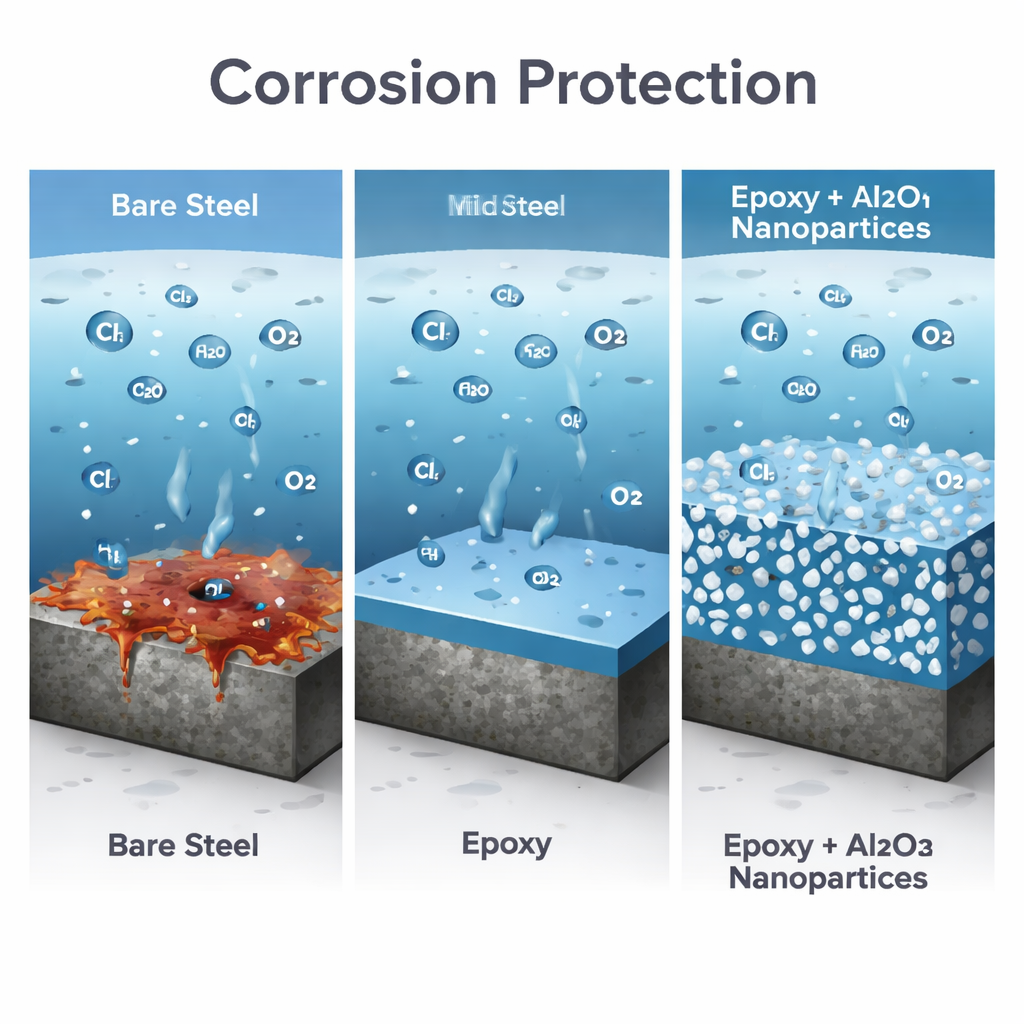
Engineers often rely on epoxy coatings—tough, adhesive paints—to keep steel from rusting. Epoxies already resist water and chemicals, but over time tiny pores and defects can let in salt and moisture, starting corrosion underneath the coating. The researchers set out to improve epoxy by adding aluminum oxide (alumina) nanoparticles. These ceramic particles are so small that they can plug microscopic gaps in the coating. To push performance even further, the team chemically "functionalized" the alumina surface with organic groups, helping the particles mix more evenly into the epoxy instead of clumping together.
Building Better Nanoparticles
The team first made pure alumina nanoparticles from a liquid aluminum compound, turning it into a gel and then heating it to form a fine white powder. They confirmed its structure and particle size using tools such as electron microscopes and thermal analysis. Next, they modified the alumina by attaching molecules known as acetoximes to its surface, creating functionalized alumina (Al₂O₃F). This treatment changed the particles’ surface chemistry, adding nitrogen‑ and oxygen‑containing groups that help them bond more strongly with the epoxy resin. Tests showed that these modified particles were better dispersed, less clumped, and formed more uniform nanostructures.
Coating Steel and Putting It to the Test
The researchers sprayed mild steel panels with three kinds of coatings: plain epoxy, epoxy with regular alumina, and epoxy with functionalized alumina, each at different nanoparticle loadings (1, 3, and 5 percent by weight). They then subjected the coated and uncoated steel to harsh, salt‑rich conditions similar to seawater, using 3.5% sodium chloride solution. Over hundreds of hours, they measured weight loss from corrosion, watched how the surface changed in a salt spray chamber, and probed the coatings with electrochemical methods that reveal how easily corrosive ions move through them.
How the New Coating Fights Rust
Several simple tests showed how the nanoparticle‑filled coatings outperformed plain epoxy. Contact angle measurements—how water beads up on the surface—revealed that coatings with nanoparticles, especially functionalized ones, were more water‑repellent and less porous. Pull‑off adhesion tests showed that adding alumina improved how tightly the coating clung to the steel, with the functionalized alumina at 5% giving the strongest bond and cohesive rather than adhesive failures. Most telling were the corrosion measurements: the functionalized alumina coating at 5% dramatically lowered the corrosion current and rate, and electrochemical impedance tests indicated that it formed a dense, highly resistant barrier that blocked chloride ions from reaching the metal. Visual salt spray tests backed this up—the advanced coating showed little rust, blistering, or peeling even after long exposure.
A Simple Picture of the Protection Mechanism
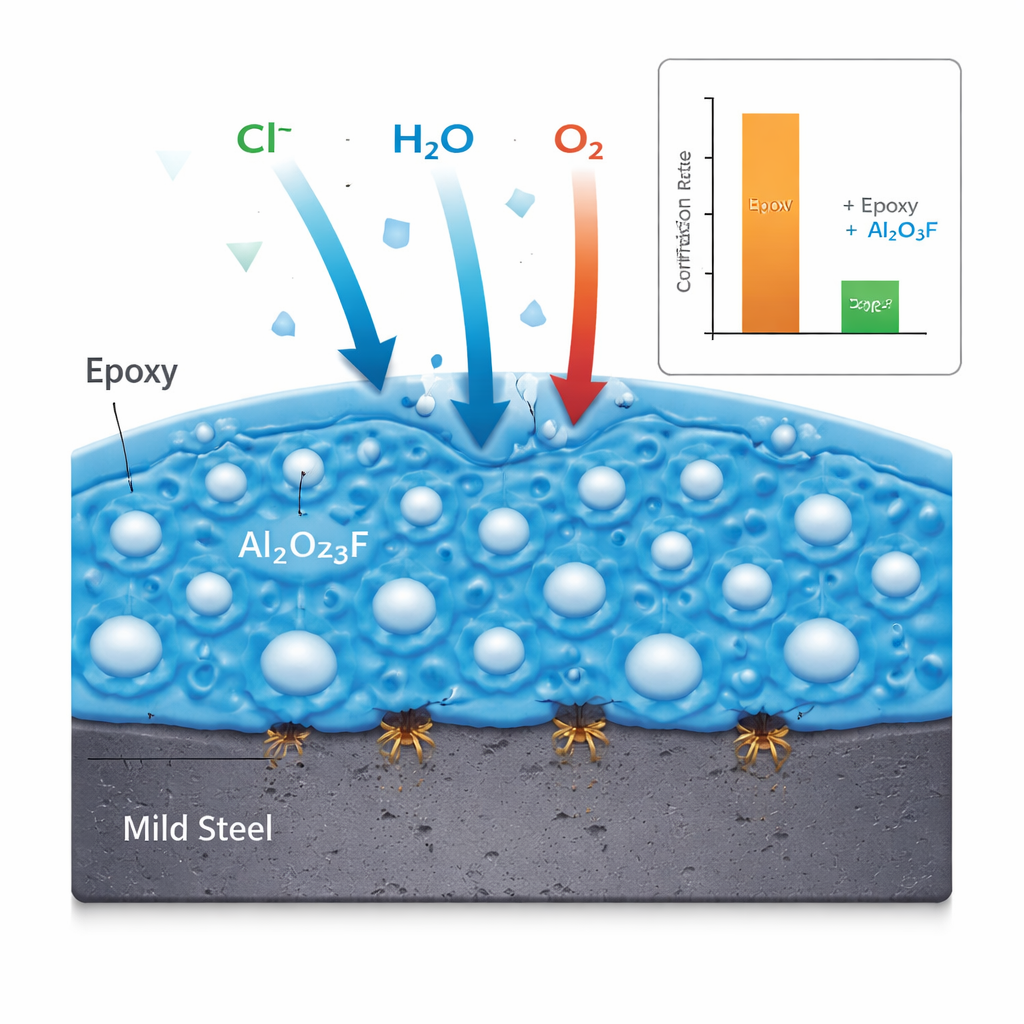
At a microscopic level, the improved coating works in two main ways. Physically, the tiny alumina particles pack into the epoxy, creating a maze‑like path that is hard for water and salt ions to navigate, slowing their journey to the steel surface. Because the particles are functionalized, they bond better with the epoxy, spreading evenly and forming an interlocking network that strengthens the coating and reduces defects. Chemically, by keeping chloride ions, oxygen, and moisture away from the metal surface, the coating greatly slows the usual rust reactions that turn iron into flaky oxides and hydroxides.
What This Means for Real‑World Structures
For non‑specialists, the key takeaway is that a modest change to familiar epoxy paints—adding well‑designed, surface‑treated alumina nanoparticles—can significantly extend the life of steel in salty, aggressive environments. The functionalized alumina system provided up to about 99–100% corrosion protection in laboratory tests, far outperforming plain epoxy. In practical terms, such coatings could help ships, offshore platforms, pipelines, and infrastructure resist rust for longer periods, cutting maintenance costs and improving safety. This work points toward a new generation of smart, nanoparticle‑enhanced paints that keep steel stronger and rust‑free for years.
Citation: Ola, S.K., Chopra, I., Ola, T. et al. Enhancing corrosion resistance of Epoxy-Based composite coatings on mild steel using functionalized aluminium oxide (Al₂O₃) nanoparticles. Sci Rep 16, 5514 (2026). https://doi.org/10.1038/s41598-026-35180-7
Keywords: corrosion protection, epoxy coating, nanoparticles, mild steel, aluminum oxide