Clear Sky Science · en
Early-life supplementation of poultry-derived lactobacilli drives microbial succession and gut immune modulation in broiler chickens
Helping Chicks Get a Healthier Start
Modern chickens grow fast, but their gut bacteria and immune systems need time to catch up. In today’s hatcheries, chicks don’t meet adult birds, so they miss out on the helpful microbes that would normally coat their guts from day one. This study asked a simple question with big implications for animal health and food production: if we give chicks friendly bacteria while they are still in the egg, can we steer their gut microbes and immune defenses onto a healthier path from the very beginning?
Why Early Gut Life Matters
The community of microbes living in a chicken’s intestines helps it digest food, build a strong gut lining, and fend off germs. In the first days after hatching, this community is fragile and easily invaded by opportunistic bacteria such as Klebsiella and Enterococcus, which are common in barns and feed and can carry antibiotic resistance. Over the next few weeks, the gut normally becomes more diverse and stable, with helpful groups like Lactobacillus and certain Clostridiales taking over. Because this early “microbial succession” shapes long-term gut health, scientists are exploring whether adding probiotics during this window can tilt the balance toward beneficial species and calmer immune responses.
Giving Probiotics Before and After Hatching
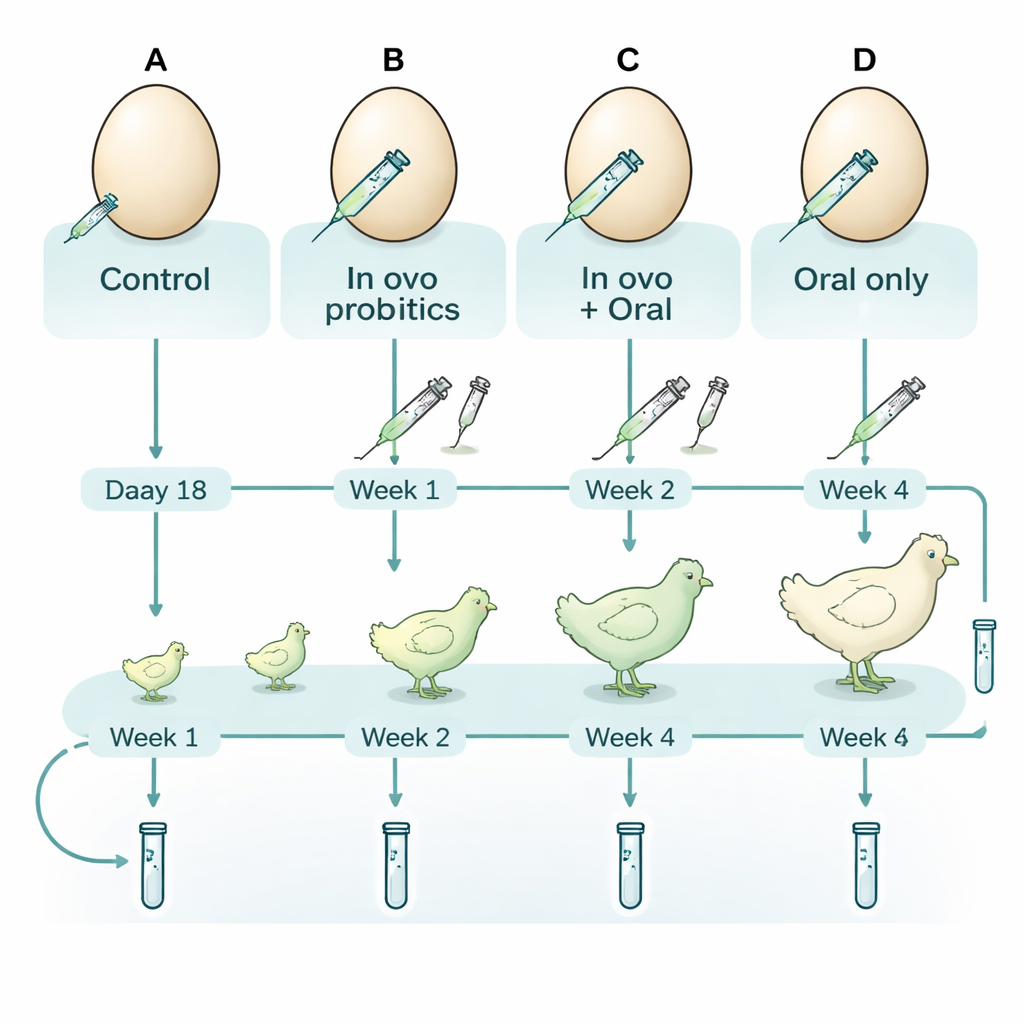
To test this idea, the researchers used a mix of four Lactobacillus strains originally isolated from healthy chickens. They compared four groups: eggs that received a harmless salt solution and no probiotics (control), eggs injected with the probiotic mix three days before hatching (in ovo), chicks that got both in-egg and weekly oral doses, and chicks that received only weekly oral doses after hatching. After hatching, all birds were raised under similar, clean conditions and fed a standard diet. Each week for five weeks, the team collected gut contents from the cecum (a major fermentation chamber in birds) and measured which bacteria were present, how diverse the community was, and how strongly gut immune tissues were expressing inflammatory signals.
Shaping Who Moves into the Gut
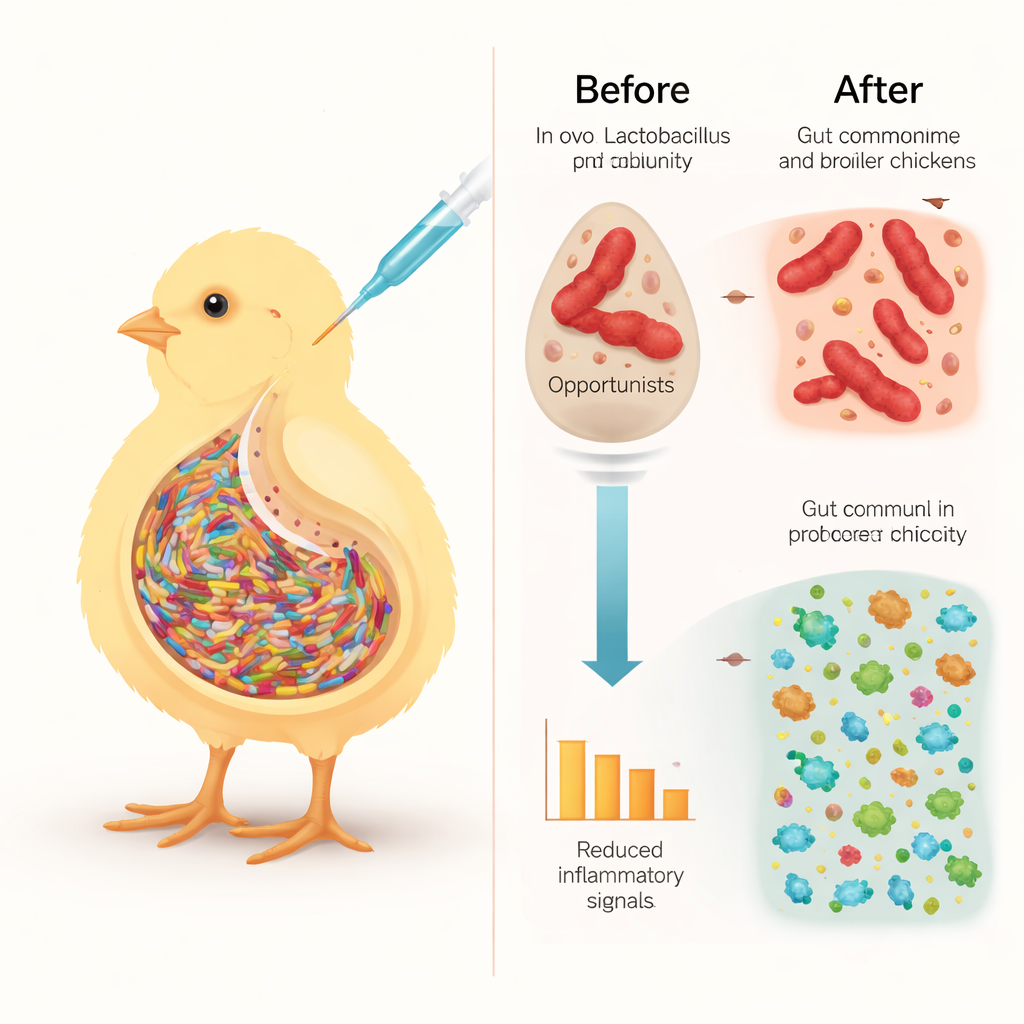
Across all groups, gut bacterial diversity rose steadily during the first two weeks and then leveled off by week three, reflecting the normal pattern of microbial succession. But the kinds of bacteria that dominated early on differed depending on probiotic treatment. Chicks that received Lactobacillus, especially in the egg, had more Lactobacillus and other helpful groups like certain Clostridiales earlier in life. At the same time, they carried much lower levels of Klebsiella and Enterococcus, two opportunistic genera that were common in untreated birds at the start but faded later. These shifts were most obvious in the first and second weeks and became less distinct by weeks three to five, suggesting that the probiotic mainly re-shaped the crucial early “settling in” phase rather than permanently changing the final community.
Calmer Early Immune Reactions
The team also looked at the gut’s immune sensors by tracking genes that encode key inflammatory messengers. During the first week of life, chicks that received probiotics—whether in the egg, by mouth after hatch, or both—showed lower activity of several pro-inflammatory signals in the cecal tonsils compared with untreated birds. Signals related to alarm and inflammation were dialed down, suggesting that early Lactobacillus exposure helps the young gut respond more calmly rather than mounting a strong, energy-costly inflammatory reaction. After the first week, these immune differences faded, mirroring the temporary but important nature of the microbiome changes.
One Early Dose Can Go a Long Way
From a practical standpoint, one of the most striking findings was that a single in-egg dose of poultry-derived Lactobacillus produced effects similar to repeated weekly oral dosing. In-egg treatment slightly improved early hatch rates, reduced early opportunistic bacteria, boosted beneficial Lactobacillus, and muted early inflammatory signals. For poultry producers, this suggests that adding a well-chosen probiotic to existing in-egg vaccination procedures could help chicks start life with a healthier gut community and a better-tuned immune system, potentially lowering reliance on antibiotics and improving overall robustness without continuous dosing after hatch.
Citation: Sharma, S., Seekatz, A., Alizadeh, M. et al. Early-life supplementation of poultry-derived lactobacilli drives microbial succession and gut immune modulation in broiler chickens. Sci Rep 16, 5030 (2026). https://doi.org/10.1038/s41598-026-35177-2
Keywords: chicken gut microbiome, probiotics, Lactobacillus, in ovo supplementation, poultry immunity