Clear Sky Science · en
Bioinspired STHVO based MPPT control for grid connected photovoltaic water pumping systems
Smart Solar Pumps for Hard-to-Reach Places
Getting clean water to remote villages and farms is one of the toughest challenges in the shift to sustainable energy. Solar-powered water pumps are an attractive answer, but their performance often drops whenever the sun ducks behind a cloud or the light changes quickly. This article presents a new control method, inspired by the hunting tactics of a desert viper, that helps solar pumps squeeze more power from sunlight and keep water flowing steadily, even under fickle skies.
Why Solar-Powered Water Pumps Matter
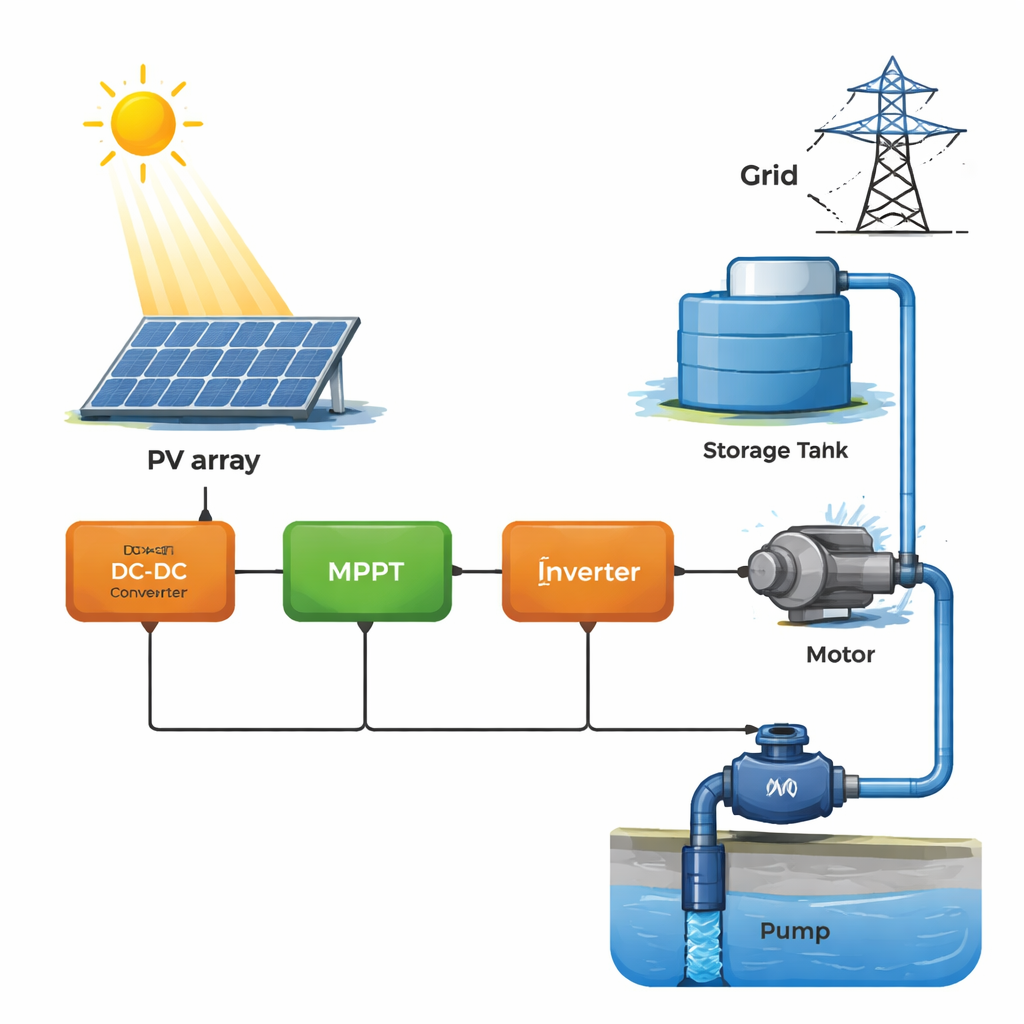
In many rural and off-grid regions, farmers and households still rely on diesel pumps to lift water for crops, animals, and daily use. Diesel is expensive, polluting, and hard to transport. Solar pumps, by contrast, use sunlight captured by photovoltaic (PV) panels to run electric motors that drive water pumps. They cut fuel costs, reduce emissions, and require less maintenance. But there is a catch: solar panels only deliver their best performance at a particular operating point, which shifts constantly with temperature, time of day, and passing clouds. If a system cannot track this point in real time, valuable energy is lost and the water flow becomes unreliable.
Finding the Sweet Spot in Changing Sunlight
Most modern solar systems rely on a controller called Maximum Power Point Tracking (MPPT) to continuously adjust the electrical conditions so panels operate at their sweet spot. Traditional MPPT methods are simple and cheap, but they struggle when sunlight changes quickly or panels are shaded unevenly. They may react too slowly or hunt around the target, causing power to wobble. To overcome this, researchers have been turning to smarter, nature-inspired approaches that imitate how animals search, adapt, and make decisions in complex environments.
A Snake-Inspired Search for Maximum Power
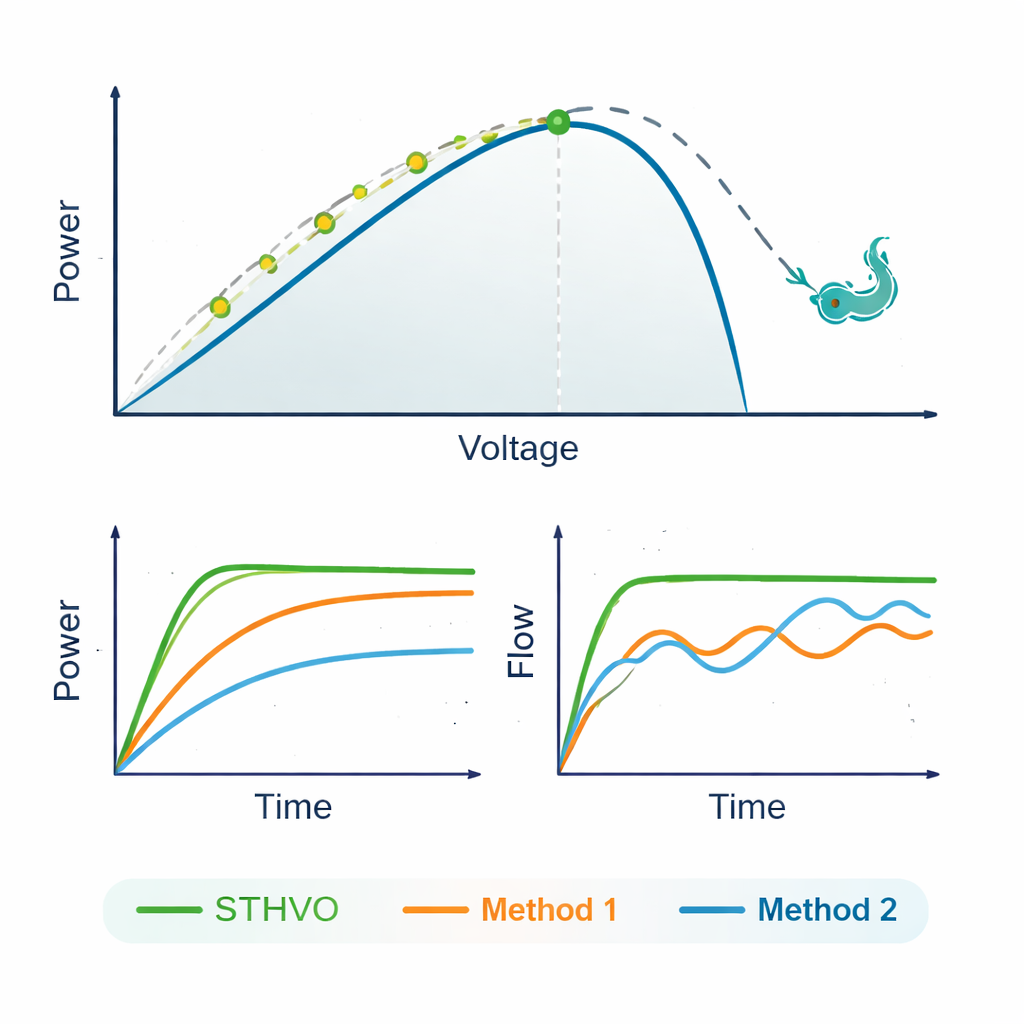
The authors introduce a new MPPT controller called Spider-Tailed Horned Viper Optimization (STHVO), named after a real Middle Eastern viper that lures birds by wriggling its tail like a spider. Instead of rushing its prey, the snake waits, explores different tail motions, and then strikes precisely when a bird comes close. In the same spirit, the STHVO controller first "explores" by testing different operating voltages for the solar array, then "exploits" the most promising region, refining the setting until it reaches the highest power point. This two-step process helps the controller avoid getting stuck in poor solutions and lets it adapt quickly when sunlight changes.
Building and Testing the Complete Solar Pump System
To judge how well STHVO works, the researchers modeled a full grid-connected solar pumping system in MATLAB/Simulink. The virtual setup includes a 3 kW PV array, a step-up (boost) converter, a three-phase inverter, an induction motor, and a centrifugal pump used to lift water. The STHVO controller sits in the loop, reading the panel voltage and current, estimating the power, and updating the converter’s duty cycle to steer the panels to their best operating point. The team compared STHVO against two established MPPT methods—Incremental Conductance and a modified Artificial Bee Colony algorithm—under both ideal sunlight and real-world conditions taken from a mountainous village in northern Morocco, where clouds and terrain cause strong irradiance swings.
More Power, Smoother Motors, and Steadier Water Flow
Under clear, steady sunlight, the STHVO controller reached the maximum power point in about 0.19 seconds and achieved nearly 99% conversion efficiency, slightly outperforming the advanced bee-based method and clearly beating the classical approach. The payoff is not just in watts: the induction motor ran at a stable speed of about 195 radians per second, and the pump delivered a steady water flow of roughly 0.65 liters per second with a peak hydraulic power of 72 watts. When driven by the older technique, the system showed more oscillations in power, motor torque, and water flow. Under realistic, fluctuating sunlight from the Bni Hadifa site, STHVO again tracked the changing conditions faster and more smoothly, keeping the system close to its maximum available power while the competing methods lagged or wobbled.
What This Means for Real-World Water Access
For a non-specialist reader, the core message is simple: a smarter, bioinspired controller can help solar pumps make better use of every ray of sunlight. By rapidly homing in on the best operating point and staying there, the STHVO approach boosts energy efficiency, stabilizes the electric motor, and keeps water delivery steady even when clouds roll through. Although the results come from detailed simulations rather than hardware tests, they suggest that such nature-inspired algorithms could make solar-powered water supply more reliable and attractive for farms, villages, and remote communities that depend on both the sun and a dependable source of water.
Citation: Ballouti, A., Chouiekh, M., Ameziane, H. et al. Bioinspired STHVO based MPPT control for grid connected photovoltaic water pumping systems. Sci Rep 16, 4866 (2026). https://doi.org/10.1038/s41598-026-35176-3
Keywords: solar water pumping, photovoltaic systems, maximum power point tracking, bio-inspired optimization, rural water supply