Clear Sky Science · en
Socioeconomic and nutritional determinants outweigh gut microbiota influence on neurodevelopment in young children from Antananarivo, Madagascar
Why children’s growth and brains matter
Across the globe, millions of young children do not grow as tall as expected for their age, a condition known as stunting. Parents and doctors worry not only about height, but also about how this might affect learning, behavior and future opportunities. At the same time, the trillions of microbes living in our intestines have been hailed as key players in health, including brain development. This study, carried out among young children in Madagascar, asked a simple but important question: when it comes to early brain development, what matters more – poverty and nutrition, or the gut microbiome?
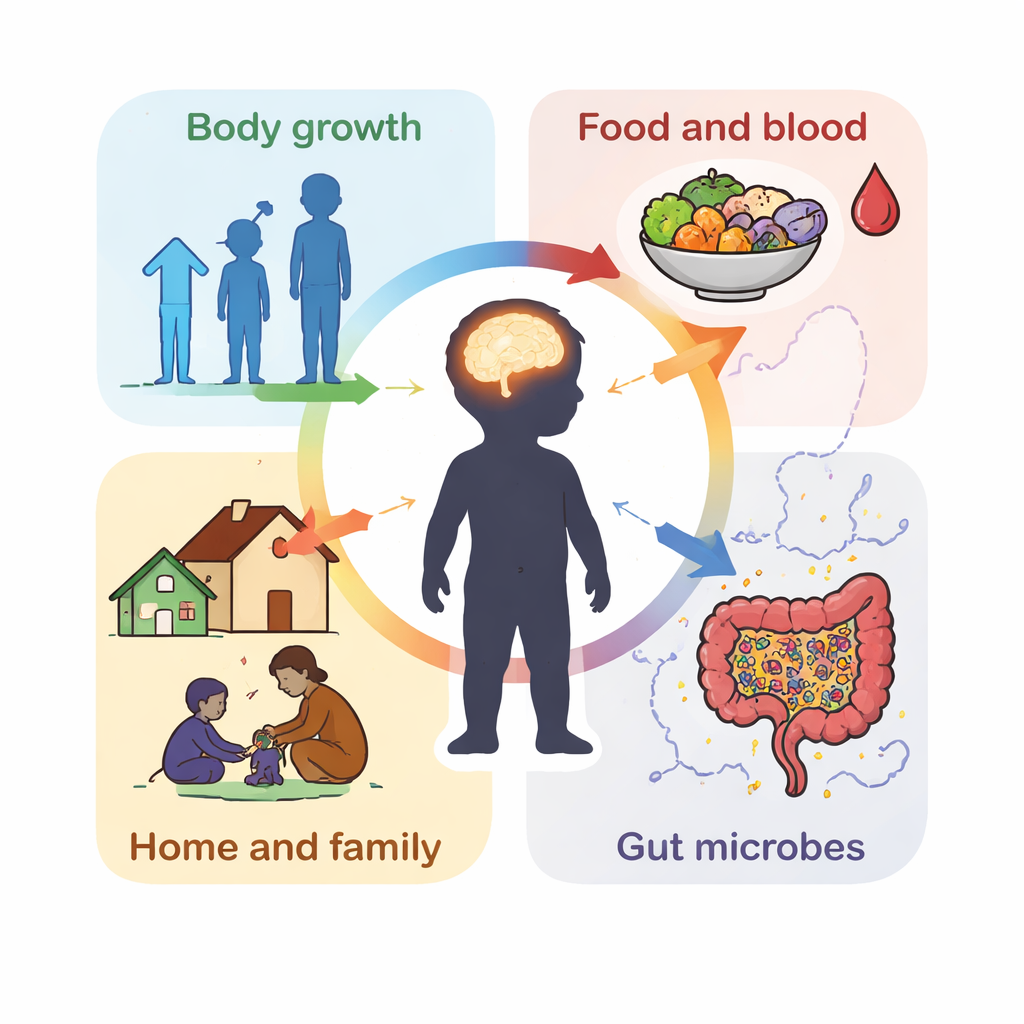
Looking closely at children in Madagascar
The researchers worked with 349 children aged 2 to 5 years living in low-income neighborhoods of Antananarivo, Madagascar, as part of the Afribiota study. About half of these children were shorter than expected for their age, and some were severely stunted. Trained psychologists assessed each child’s development using a standard tool that looks at five areas: communication, problem-solving, personal and social skills, and fine and gross motor skills (such as using hands or running). At the same time, the team collected stool samples to analyze the gut microbes, blood samples to measure nutrients such as hemoglobin and branched-chain amino acids, and detailed information on the children’s families, homes, and diets.
Growth and poverty weigh heavily on development
When the team compared children, a clear pattern appeared. Those who were moderately stunted scored, on average, about 10 points lower on overall development tests than well-grown children, and those who were severely stunted scored nearly 19 points lower. The biggest gaps were in problem-solving and motor skills. Beyond height, aspects of the home and family situation also mattered. Children from households with more rooms and better overall socioeconomic status – reflecting housing quality, parental education, and access to safe water – tended to achieve higher developmental scores. In contrast, factors such as age or reported size at birth were not strongly linked to how children were performing at the time of testing.
Gut microbes show only a modest signal
The gut microbiome analysis covered more than 1,600 types of bacterial genetic variants. The researchers examined two kinds of diversity: how many different microbes lived within each child, and how much microbiomes varied between children. Overall, the composition of gut bacteria showed only weak and inconsistent links with development. One measure of within-child diversity, called the Shannon index, was associated with slightly better fine motor scores, and in the most detailed statistical model showed a modest direct link with overall neurodevelopment. However, broader patterns of microbiome differences between children, and specific bacterial groups that had previously been tied to poor growth, were not reliably related to how children scored on developmental tests.
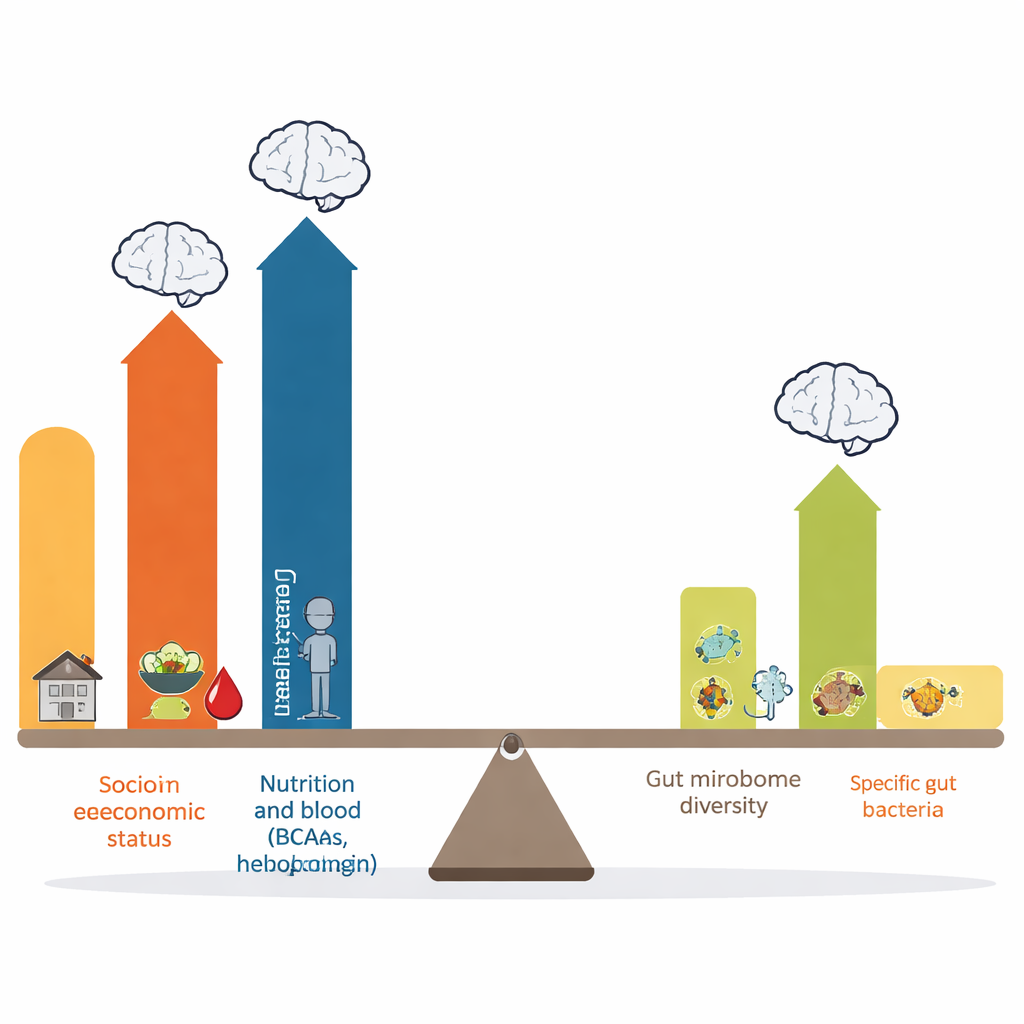
Untangling direct and indirect pathways
Because many of these factors influence each other – for example, poverty can shape diet, infection risk, and growth – the team used a method called structural equation modeling to trace direct and indirect links. Across several models, stunting consistently showed a direct association with poorer development, suggesting that the chronic undernutrition and biological stress it reflects harms children’s ability to reach their potential. Socioeconomic status also had a strong direct effect on development, independent of height, likely capturing stimulation in the home, parental resources, and living conditions. Blood measures of nutrition, such as branched-chain amino acids and hemoglobin, were mainly connected to development indirectly: they supported better linear growth, which in turn related to higher developmental scores. By contrast, the microbiome’s influence remained small and did not explain the pathway from poor growth to poorer development.
What this means for children’s futures
For families and policymakers, these results send a clear message. In this group of Malagasy children, the main drivers of early brain development were not which specific microbes lived in the gut, but whether children had enough nutritious food, healthy blood and body growth, and a less crowded, more resourceful home environment. While a richer mix of gut bacteria may offer some benefit, microbiome-focused interventions alone are unlikely to fix developmental gaps if children remain poor, undernourished, or chronically stunted. The authors argue that efforts to improve early learning and lifelong opportunities should prioritize tackling poverty, improving diets, preventing anemia, and supporting healthy growth, while future long-term studies continue to explore how gut microbes fit into this broader picture.
Citation: Tamarelle, J., Doria, M.V., Rambolamanana, V. et al. Socioeconomic and nutritional determinants outweigh gut microbiota influence on neurodevelopment in young children from Antananarivo, Madagascar. Sci Rep 16, 5484 (2026). https://doi.org/10.1038/s41598-026-35174-5
Keywords: stunting, child development, nutrition, socioeconomic status, gut microbiome